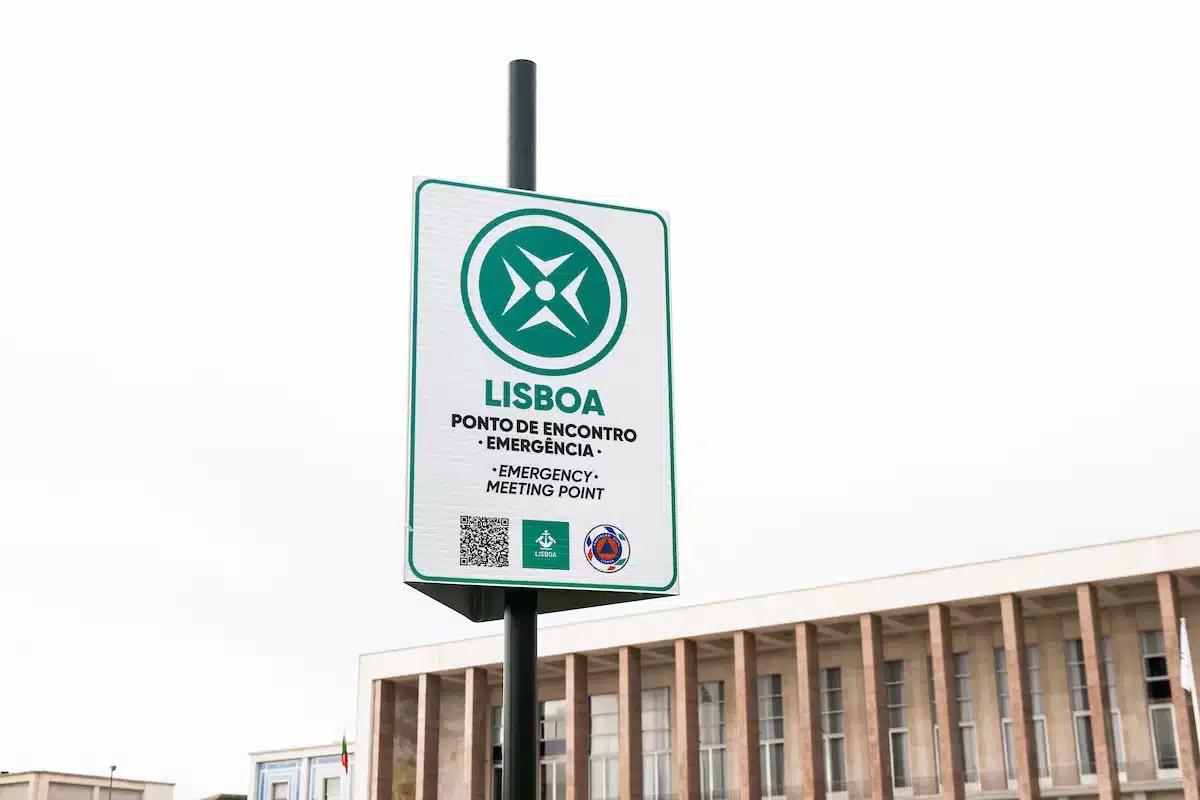
Lisbon’s Municipal Civil Protection Service has begun installing signs for Emergency Meeting Points – safe places where people should go in the event of a serious accident or disaster.
The signs started going up today: coincidentally the day after Polish, Dutch and Italian fighter jets were scrambled to intercept a wave of Russian drones that fell in Poland.
The first sign went up in Alameda das Universidades (PE09), as part of a project that will continue over the next few weeks – ensuring that the 86 Emergency Meeting Points in total are spread throughout the city.
According to a note from the municipality, these locations “ensure the necessary assistance in emergencies and facilitate the coordination of rescue operations, allowing emergency teams to act quickly and effectively”.
They were defined as part of the review of Lisbon’s Municipal Civil Protection Emergency Plan (PMEPC), taking into account risks identified in the document, namely earthquakes, tsunamis, plane crashes, railway accidents, fires and/ or floods, with a “serious impact on the city and causing loss of housing and the need for basic goods and care for a large part of the population”.
In the event of a serious accident or catastrophe jeopardising the safety of the population, it may be recommended to evacuate affected areas to these meeting points, where citizens should remain and wait for ‘civil protection agents’ (police, firefighters, INEM, etc.).
According to the town hall, the location of the points was defined through “a risk analysis methodology and technical field visits”, i.e. it was technically assessed taking into account criteria such as “exposure to natural and technological risks, capacity to accommodate a large number of people, accessibility, state of conservation of the adjacent buildings, as well as other characteristics of the surrounding area”.
The 86 official points have the capacity to accommodate more than 600,000 people and were established taking into account all the parishes, says Lusa.
It is unclear if they would be used in the event of a serious accident/ catastrophe ‘outside’ the parameters of ‘earthquakes, tsunamis, plane crashes, railway accidents, fires and/ or floods’. Other catastrophes might not lend themselves to encouraging large numbers of people to congregate in well-publicised areas.
Source material: LUSA