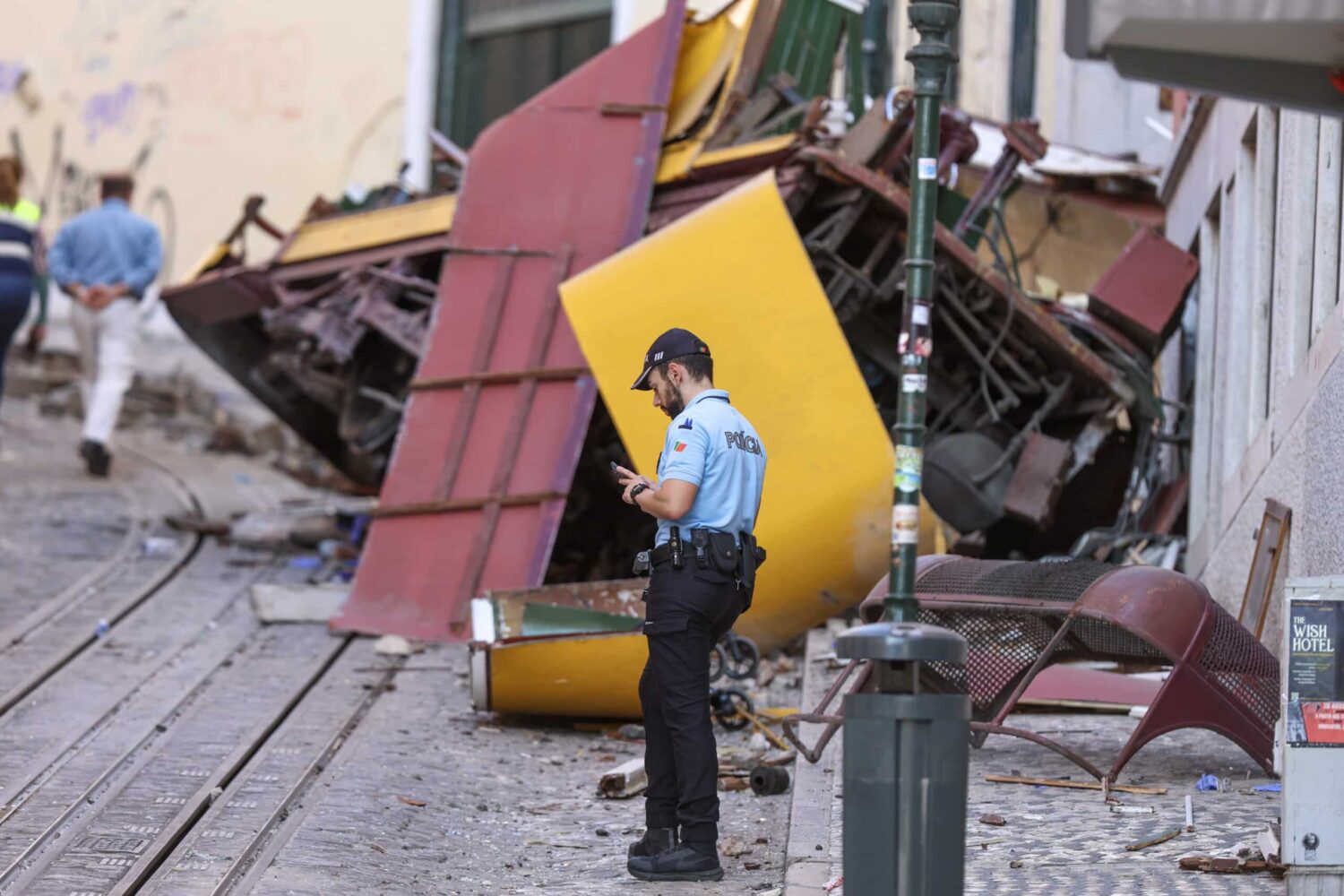
An interim report, which stresses that this is not the moment to apportion blame, has revealed that the cable connecting the two cabins of the Glória funicular/ elevator which gave way at its attachment point to the carriage that derailed on September 3, killing 16 people and injuring countless others, did not meet the specifications of transport operator Carris – nor was it certified for use in the transporting of passengers.
According to the document compiled by GPIAAF (Portugal’s Aircraft and Railway Accident Prevention and Investigation Office), “the installed cable did not comply with Carris’ specifications” for use in the Glória elevator, nor was it “certified for use in passenger transport facilities.”
GPIAAF adds that the cable “was not suitable for installation with swivels at its ends, as is the system in the Glória elevator (and in the Lavra elevator)”.
The investigation found flaws in Carris’ cable acquisition process and in the internal control mechanisms of the company.
“The use of cables that were multiple times non-compliant with the specifications and usage restrictions was due to several accumulated failures in their acquisition, acceptance and application process by CCFL (Companhia Carris de Ferro de Lisboa), whose internal organisational control mechanisms were not sufficient or adequate to prevent and detect such failures”, considers GPIAAF.
Investigators accept, however, that, previously, identical cables were in use for 601 days on the Glória elevator (and 606 days on the Lavra elevator), without incident.
“Therefore, it is naturally concluded that, at this time, it cannot be stated whether the use of this type of non-compliant cable was involved, or what intervention it had, in the rupture that occurred after 337 days of use, although it is certain for the investigation that there were other factors that necessarily had to intervene”, says the report.
The investigation highlights that the area where the cable broke was not subject to visual inspection without dismantling the cable attachment area.
“A macroscopic analysis of the ends of the broken cords reveals progressive ruptures, occurring gradually over time, and of various types. The metallographic examinations that will be performed during the investigation will clarify the rupture mechanisms involved,” says this preliminary report.
GPIAAF also reveals that “immediately before preparations for the start of the journey” of the accident, in cabin 1, which was at the top of Calçada da Glória, there were 27 people, including a child and the brakeman, while inside cabin 2, next to Praça dos Restauradores, there were 33 people, including three children and the brakeman.
“Therefore, both were well below their maximum capacity of 42 occupants”. On the day of the accident the elevators “had made 53 trips in total.”
“The average occupancy was 22 passengers in cabin 1 and 17 passengers in cabin 2, with the maximum capacity of 42 passengers being reached on two trips in cabin 1 and on one trip in cabin 2,” the investigation found.
In the preliminary report, the GPIAAF also states that both elevators “were equipped with four video surveillance cameras each, and a device equipped with low-precision accelerometers (equipment to measure acceleration)”, noting that on Calçada da Glória “there are also several surveillance cameras”.
“This allowed the investigation to establish with sufficient rigour the sequence of events that preceded the accident,” says the document.
The first collision occurred at an estimated speed of between 41 and 49 kilometers per hour, with 33 seconds having elapsed since the preparation for the trip and 20 seconds since the movement began.
Since these findings were made public, a number of statements have come from Carris/ the mayor of Lisbon, appearing to be aimed at deflecting any possibility of blame. Carris, for example, has gone as far as to blame the previous administration for acquisition failings.
In today’s papers, Correio da Manhã highlights the fact that no-one seems able to remember any point where the emergency brake (which failed catastrophically) was ever tested.
The paper also repeats a sentence from GPIAAF’s report in which investigators refer to the “situation in Portugal flagrantly contrasting with the reality” in other European countries where there are “national and regional authorities” responsible for the “periodic supervision” of funiculars and similar modes of passenger transport.
The ‘final report’ on this tragedy which will be the subject of countless insurance claims is scheduled to be released in the summer of 2026.
Sources: Lusa/ Correio da Manhã