Reservoirs near capacity ending drought fears
March may have brought some devastating storms to the Algarve, wreaking havoc especially in Faro, but there was a silver lining to the extreme weather phenomenon – the heavy rainfall that ensued has filled the region’s three main dams in Odelouca, Odeleite and Beliche. In fact, rainfall was so intense that it helped pull 80% of Portugal out of a serious state of drought.
According to experts at the national sea and atmosphere institute (IPMA), this March has been the “third rainiest since the start of the century”, and it isn’t even over yet.
They say it has rained “eight times more than normal” which helped significantly reduce the seriousness of the country’s state of drought.
It was with great relief that Isabel Soares from regional water company Águas do Algarve spoke to us this week to tell us how the situation has “improved a lot” in the Algarve since the last few days of February when the rainfall became more intense.
“We are much more comfortable now; the levels of rainfall have been very good,” she told the Resident.
She explained that Odelouca dam’s water levels were at 17% of the reservoir’s capacity before the rainfall, having now increased to 51%.
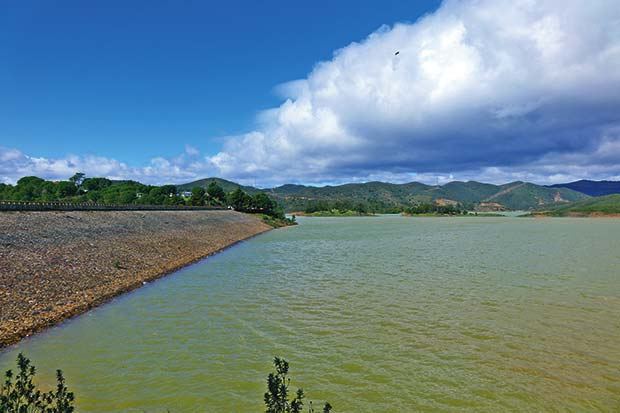
Elsewhere in the region, the Odeleite and Beliche dams have seen their water levels increase to a much more comfortable 90% and 78%, respectively. The Arade dam, visited by our reporters last week, is also nearly full.
Harder to tally is the effect that the rainfall had on the Algarve’s groundwater levels, although Soares says that soils are soaked with water which is a good sign.
While there was never any real fear that the Algarve’s water supply was in jeopardy, the Águas do Algarve boss says that “we must realise how scarce a resource this is”.
“We must all take measures to ensure that we save as much water as we can. In fact, one of our main goals at Águas do Algarve is to promote the recycling of water,” she told us.
Soares said that some golf courses in the Algarve already use water that is treated at the region’s ETAR water treatment plants, while talks have been underway with many others.
“The feedback has been very good. I can tell you that Quinta do Lago and Infraquinta are thinking about reusing these waters, while demand has been very high from other golf courses.”
Meantime, the question that is being asked in Portugal following these weeks of rainfall is how the country can adapt to these “shorter but much more intense” periods of rain that are becoming the norm in the country.
The answer, according to Portugal’s confederation of farmers (CAP), is “more dams”.
“The heavy rain showers of the past few weeks have only proved one thing: Portugal has to seriously invest in increasing its water storage capacity, so that it can have more of it when it becomes scarce,” CAP president Eduardo Oliveira de Sousa told Expresso newspaper this week.
In other words, “we have to build more dams all over Portugal”.
He does not believe his viewpoint will be contested by environmentalists as “the situation is serious and requires radical measures”.
€4.5 billion project in pipeline for Tejo River
As we went to press on Wednesday, a meeting was due to take place between President Marcelo Rebelo de Sousa and the developers of ‘Projeto Tejo’, a €4.5 billion project to build a series of dams and water reservoirs along the Tejo River.
Likened to the Alqueva dam in the Alentejo, the project aims to provide water to 300,000 hectares of land in the areas of Ribatejo, the Setúbal peninsula and the western region known as Oeste.
It plans to not only gather water for agricultural means, but also make the river navigable between Lisbon and Abrantes in a bid to promote the river’s tourist value.
Expresso newspaper reports that the idea has already been pitched to two banks which have shown an interest in financing it, although the project will only be feasible with access to community funding, according to developers.
Businessmen Manuel and Miguel Campilho and agricultural planning specialist Jorge Froes were due to meet with President Marcelo on Wednesday afternoon to present the plans to him directly.
The newspaper adds that government officials, namely Agriculture Minister Capoulas Santos and Secretary of State for Agriculture Luís Vieira, are already aware of the plans.
However, the project has already sparked controversy among councils, environmentalists and other entities along the Tejo River, which have criticised President Marcelo for accepting to meet with the people behind a project that appeared in such a “non-transparent” way and which foresees the construction of a series of infrastructures that will have a “negative environmental impact” on the river.
By MICHAEL BRUXO michael.bruxo@algarveresident.com
Photo: The Arade dam, visited by our reporters last week, is also nearly full
Photo by: OPEN MEDIA GROUP