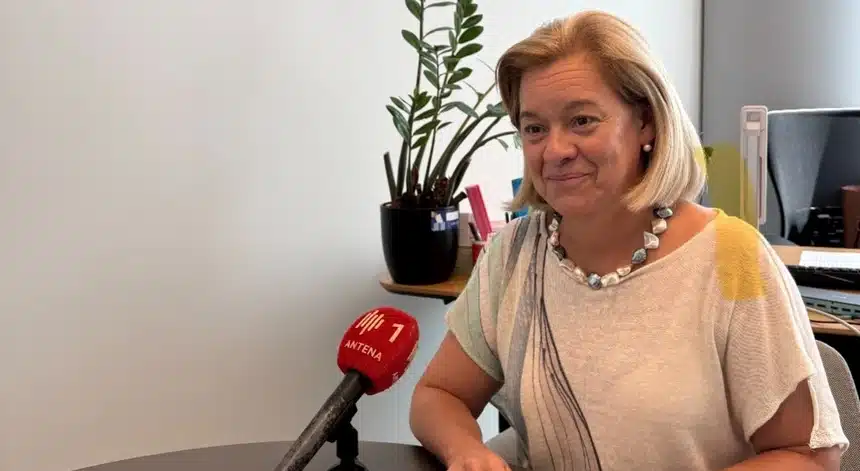
Euro MP Carla Tavares outlines hurdles ahead
The European Commission has presented its proposal for a long-term EU budget of two billion euros for seven years from 2028. The European Parliament does not yet have all the data it needs to analyse the proposal, but Euro MP Carla Tavares – elected to represent Portugal’s Euro MPs in the dialogue with the Commission and the Council on this issue – says it is unlikely to be enough.
“We don’t think so”, she has told Antena 1 (radio). “But now we have to crunch the numbers. But from the outset, given that we have new challenges, such as competitiveness and defence, and that we don’t think we can cut Cohesion policies, the European Social Fund, the Common Agricultural Policy… well, it’s not enough for everything.”
Not least because Portugal needs to respond to new priorities, and start paying the interest on joint debt incurred during the pandemic in 2028.
“Within these two billion is the payment of interest on Next Generation EU – which was a path that parliament never defended”, Tavares explains, adding that parliament never defended not starting to pay interest (…) Qhat we understand is that other mechanisms must be found and not within the next Multiannual Financial Framework. It shouldn’t be that way, because this is like at home: we have a family budget, if it doesn’t grow, if we have more challenges, you can’t do more with the same or even more with less (…) therefore parliament would like this process to be autonomised from the point of view of the next Multiannual Financial Framework – so that we can respond to the new challenges and continue with traditional policies.
In addition, each member state must present a national plan for seven years. It can decide where it wants to invest the most, within certain conditions defined by the European Commission.
“Basically, it’s almost like having 27 multi-annual financial frameworks, one for each member state, and now each member state will negotiate with the Commission,” says Tavares adding that this too is weighted in the Commission’s favour. “To use a Portuguese expression, (the Commission has) the knife and the cheese in its hand (…) not only does Parliament not exercise or lose the capacity to exercise what are its competences – and it must not give up on that at any time – but the capacity to manage the whole process, to monitor the whole process, remains solely between member states and the Commission.”
With this proposed methodology, will there be a need to fulfil targets and milestones in order for more money to come in, Tavares queries.
“And that brings us to the issues of conditionality and macro-conditionality. It always reminds me of the troika (the triumvirate of lenders overseeing Portugal’s bailout years), when we were obliged to carry out a series of reforms as the member state (…) and parliament won’t accept that. It’s not possible.”
Ursula von der Leyen proposes merging the Union’s two biggest policies into a single envelope, a pillar called National and Regional Partnership Plans, which will also include funds for social policy, fisheries and maritime policy, migration, border management and internal security, totalling €865 billion.
Carla Tavares believes that it is inappropriate to combine Agriculture and Cohesion in the same financial envelope.
“It’s a different way of looking at these policies and we don’t think it’s a good way. We can’t have Cohesion competing with Agriculture, and farmers competing with the regions. It doesn’t make sense.”
“We have always defended the flexibility of the next framework. I’ll say it again, we realise that it’s not about maintaining the status quo, that life has changed. But flexibility doesn’t mean putting everything together. In parliament – from the very first moment of every meeting – we have always been very clear that the Cohesion package and the Agriculture package have to be packages that should remain separate due to their strategic importance: social cohesion and territorial cohesion.
“Having done the maths – as I’m telling you, it’s very premature and it’s almost a risk what I’m about to tell you – but looking at the size of the Multiannual Financial Framework and with this amalgamation of programmes, with everything in the third box, where the economy, cohesion, agriculture, tourism, fisheries, etc. are – I don’t know how there isn’t less available for the next Financial Framework.!
The next budget will keep €300 billion earmarked for direct CAP (Common Agricultural Policy) support but, overall, experts admit the bloc’s agricultural spending is expected to be cut by 25% in real terms.
“It’s a very different way of approaching the Common Agricultural Policy. The Common Agricultural Policy has a role and importance in the European context that is not insignificant. That’s why it was set aside, because it is in fact a very, very important pillar in the European context,” insists Tavares.
Until now it was one third for Cohesion, for Agriculture and even for the other programmes. Has that changed, asks Antena 1.
“It has changed completely and so Agriculture is really very important and because of its importance – there are things that we have to treat differently, because they are naturally different and that’s why they’ve always been left out – because the rules are there to make exceptions whenever justified. We can’t, in a context of 27 countries, with such a diverse territorial reality, want to treat areas that are so relevant and naturally different in the same way”.
“Given the shape, or rather the size, of the next Financial Framework, I think it’s very difficult – if I’m being unfair here, I’ll apologise later – for Cohesion and the Common Agricultural Policy to be able to maintain the same levels.”
Funds for Defence and Security are going up fivefold, included in an envelope that also includes support for Competitiveness. The Commission is proposing €131 billion for the defence and space sectors, Antena 1 points out.
Tavares counters with ‘the rest’: “We’re not free from a European blackout. And security is not about buying armaments. Security is much more than that. It’s investing in technology, it’s investing in protection, it’s investing in artificial intelligence to safeguard our basic and essential resources for living in a community. And I think it’s absolutely essential that this happens.”
All in all, negotiations over this new long-term budget look set to be hugely complicated, particularly as member states will expected to increase their percentage contribution from the current almost 1.1% of GDP to 1.26%.
Source material: Antena 1, RTP