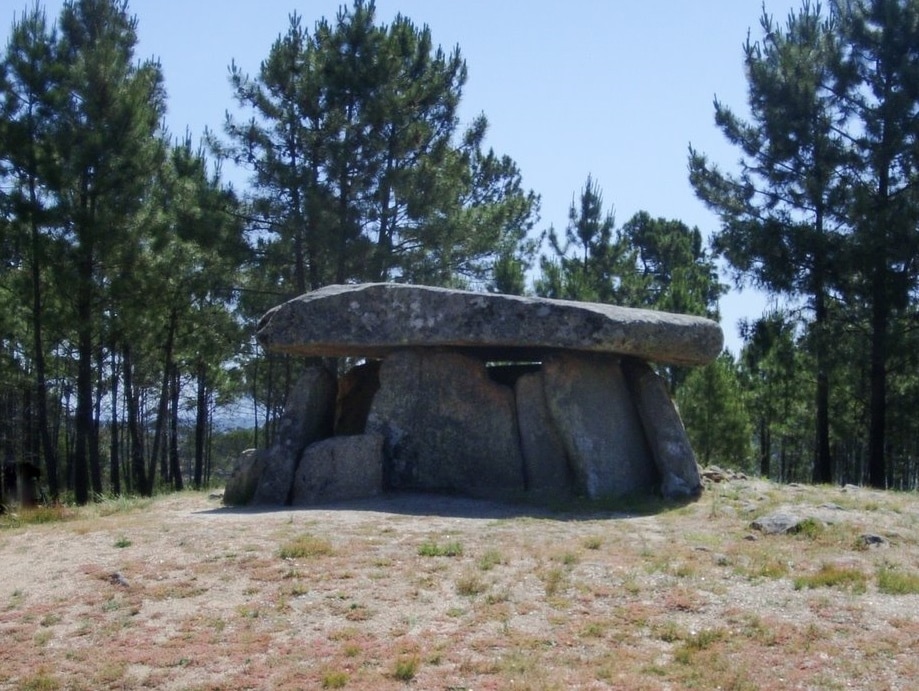
Along the seaboard of western Iberia can be seen some of the finest European examples of ancient stone monuments such as dolmens, menhirs, hillforts and bridges or stepping-stones. Their existence and conjecture as to their original purpose was examined in “A Misty History of Palaeolithic Portugal”, which was serialised in The Resident from January 29 to February 27, 2024.
During the present century, improved methods of archaeological research have produced new theories concerning the nature of the tribes which built and utilized these constructions. Unfortunately, promotion by Turismo of accessible sites as being romantic locations has led to their being ransacked by vandals with metal detectors in search of mythical treasure or artefacts which can be sold to devotees of New Age fiction.
In particular, there has been speculation concerning the supernatural and funerary association with alien species or eschatological myths.
Therefore, it is refreshing to read the conclusions reached in Dr. Henna Lindström’s masterly thesis dated 2014 and titled Casas das Mouras Encantadas – A Study of Dolmens in Portuguese Archaeology and Folklore. This can be found on the website of academia.edu or through research at Helsinki University.
It posits that the menhirs which date from around 5000 BCE and the dolmens which came about 1,000 years later were built by women who had been enchanted for that purpose and were then beholden to act as the guardian gatekeepers to the netherworld until the spell could be broken by recitation and performance of tasks.
The homonym word “Moura” is thought by etymologists to have roots in the Indo-European “mrtuos” and the Latin “mortuus”, which combined to form “morto” in the Portuguese/Galician languages. There is also a link to the Celtic language whose peoples invaded western Iberia circa 700 BCE and adapted megalithic monuments to their own uses.
However, that does not clarify the nature of the original tribal constructors who may have been the Oestriminis – mentioned by Greek historians as being a part of an indigenous substratum which preceded the evolvement of the Lusitanians and Celts.
Characteristics attributed to the Mouras Encantadas vary from region to region, but all legends agree that they are anthropomorphic, female spirits which are able to change size and shape.
In human form, they are portrayed as voluptuous maidens who spend their time combing their golden tresses, spinning threads (of life), baking bread, cultivating plants and animals all of which can be transformed into precious metals. Unfortunately for the recipients of such gifts, they turn to dust and ash when removed from the sacred vicinity of the dolmen!
Other concepts of treasure are that it consists of knowledge and documents which can be imparted to whoever dares to enter the dolmen at the bewitching hours of sunset, sunrise and solstices in an endeavour to break the spell.
However, such attempts are rarely successful, and the adventurer risks being trapped in limbo or transformed into a beast such as a bull or bear which is then set to fiercely ward off intruders. The Mouras themselves are popularly described as transformable into serpents, frogs and other smaller animals.
The stone structures of the dolmens are liminal. They represent not only a resting place for corpses on the threshold of the underworld but are also the exit for souls being released from a spiritual womb.
This aspect was succinctly examined by the late Professor Ana Rosa Gomes Pinto da Cruz in her erudite essay “The archaeology of death in the Abrantes Region during the Final Bronze Age (13th to 8th centuries BCE): the necropolis of tumuli of Bioucas-Souto”.
Her work is included in “Multicutural Mankind” which she compiled with Marco Valente in 2024 and makes valuable conclusions from an examination of scientific evidence and folklore.
The supernatural nature of spirits similar to the Mouras Encantadas and in the presence of shamanistic rituals is attributed also to some of the incised rock art of the Escoural cave in Montemor-o-Novo and the famed Foz Côa valley in northern Portugal. Among the representations of extinct aurochs, ibex, deer and horses are abstract figures of what could be deceased hunters.
In June 2020, a near-perfect panel was discovered in sediment which has enabled a dating to 21,000 BCE. The question then arises as to the identity of these gifted people who were able to express themselves so eloquently over a period of 12,000 Mesolithic years.
Popular theory is that they were descended from the Cro-Magnon tribes who occupied most of Europe from around 50,000 BCE. Relics of shamanism such as red deer face masks have been found in former cave dwellings as well as paintings on rock surfaces.
Some confusion has risen by modern storytellers interpreting the Muslim word Moor for Moura.
In the Alentejo, some folklore describes the Mouras as having brown (not golden) hair and of darker complexion, while in Galicia the colour is sometimes red/ginger. This may have some historical truth in that tribes from both the British Isles and from North Africa are thought to have come by sea to colonise the western coast of Iberia.
A list of Antas (the Portuguese word for ‘dolmen’) which can be visited under supervision is available from Turismo, but be warned that, once within the stone structure, time may change and one may be enchanted forever.