According to the World Meteorological Organisation (WMO), heatwaves are one of the most dangerous natural weather hazards. Intense heatwaves can pose serious health, social, environmental, and economic risks.
Portugal is in a climate transition region, very vulnerable and exposed to climate change, to frequent droughts, with future projections of more extreme events, less rain, more heat, and higher fire risk.
At the time of writing this feature, Portugal is experiencing a heatwave and the country just recorded on June 29 its highest June temperature of 46.6ºC at Mora, Évora District. This is very close to Portugal’s highest temperature of 47.4ºC which was recorded on August 1, 2003 in Amareleja, Beja District.
Heatwave Duration Index
Increasing awareness of health-related impacts and complex relations with drought, desertification and forest fires, as well as increasing public concern with climate change and environmental issues, have strengthened the need to manage the risks and mitigate the impacts of heatwaves. In 2001, the WMO began using a Heat Wave Duration Index (HWDI), which defined a heatwave as occurring when maximum daily temperature exceeds by 5ºC or more the average daily maximum of the reference period during a period of at least six consecutive days.
Heatwave trends
Although heatwaves can occur in all seasons, they are most common and their impacts most felt in the summer, when centers of high pressure form and remain stationary for extended periods, from days to weeks, causing hot, dry weather.
Over the last 30 years, there have been more extreme heatwave events during the summer in mainland Portugal. This situation has been noticeable throughout the country, although the regions of the interior of the North and Centre (districts of Bragança, Vila Real, Viseu and Guarda) and Alentejo (districts of Setúbal, Évora and Beja) are the most affected.
The most severe episodes of heatwaves (highest number of waves, highest number of days in heat waves) occurred after 1990 in the inland North and Central regions and after 2000 in the South region. The summers with the highest percentage of weather stations experiencing a summer heat wave since 2000 were: 2013 (89%); 2006 (85%); 2003 (76%) and 2018 and 2022 (74%)
The highest total number of heatwave days, 918 days, occurred in the summer of 2022, with a significant contribution from the Northeast region; in this region, in some stations there were four heatwaves, corresponding to a total of more than 40 days in a heatwave. Bragança, Mirandela and Carrazeda should be noted with 44, 42 and 41 days, respectively. The years 2003 and 2006 also stand out as having the most days of heatwaves, with 687 and 667 days, respectively.
The 2003 heatwave was the longest recorded since 1941, reaching 17 days in some inland parts of the country, 14 days in the districts of Beja, Évora, Portalegre, Castelo Branco, Vila Real and Bragança, and more than 10 days in over two thirds of the country. 2003 was so exceptional that forest fires, usually concentrated more in the northern and central regions, also occurred in the south with great intensity. Of the seven districts with over 10,000ha of total burnt area, all except Faro were fully exposed to heatwave conditions. In the remaining 11 districts, which had less than 10,000ha of total burnt area, only three had 100 per cent of their territory under heatwave conditions.
According to the UNDRR, by the end of the 21st century, Portugal could experience as many as 8-10 heatwaves each year. Under extreme climate scenarios, temperatures could rise by as much as 5°C by 2100, with the greatest increases expected in the north eastern interior regions.
Relationship between heatwaves and fires
Heatwaves and droughts have a strong influence on fire incidence, as shown by several studies in the past few years in Mediterranean Europe. The impact of droughts on vegetation creates favourable conditions for the ignition and spread of wildfires, especially during summer, but also in winter. In addition, fire incidence increased dramatically with the combined effect of prolonged drought and heatwaves on vegetation.
A study published in December 2021 by Calheiros, T., Benali, A., Pereira, M., Silva, J., and Nunes, J found that variability in burned area is mainly influenced by the precipitation anomaly in spring and the occurrence of abnormal atmospheric patterns that generate very hot and dry days in the western Iberian Peninsula during summer. Most (97 %) of the total number of extreme wildfires (with a burned area over 5000 ha) occurred during heatwaves.
2022 heatwaves and wildfires
Following several heatwaves in parts of southern, western and central Europe in June and the first half of July 2022, a powerful heatwave built up over Western Europe during mid-July, under the influence of a wide and persistent synoptic ridge, centred roughly over north-west Africa, the western Mediterranean and towards France and Germany.
The high pressure ridge was responsible for mostly cloud-free conditions, enabling the sun to additionally heat up already warm air masses. No low pressure systems managed to break the ridge and exchange air masses on a synoptic scale. Also a relatively strong and persistent cut-off low system resided for many days off the coast of Portugal, pulling even hotter air from north-west Africa towards the north. In Portugal and Spain, temperatures in the low to high 40s were recorded from July 7, with the maximum temperature of 47°C recorded in Pinhão and Santa Bárbara, Portugal on July 14.
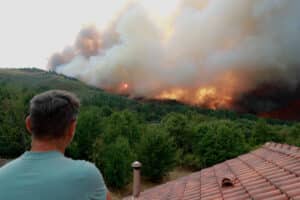
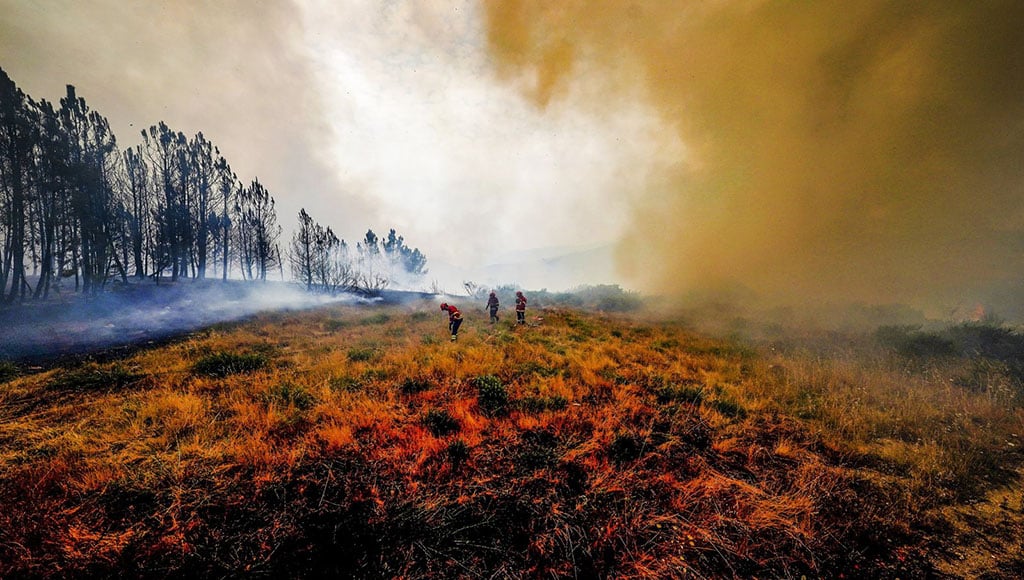
Multiple forest fires occurred in Portugal: the Serra da Estrela fire started in early July 2022 and was contained in early September, having burned about 27,340 hectares. The Murça (7,156 hectares) and Revel fires (1,638 hectares) burned for short periods in mid to late July 2022 and ultimately combined into a single burned area.
While the majority of wildfires are started by human actions, the conditions during heatwaves and droughts can significantly exacerbate the situation, making fires easier to ignite, spread more rapidly, and burn with greater intensity.
The future
Heatwaves represent a challenge for the population in Portugal, requiring special care to preserve health and safety and minimise the impacts. It is crucial that the authorities, health services, and the general population are prepared to deal with these extreme conditions. Additionally, raising awareness about the causes of heat waves and the importance of climate change mitigation measures are crucial to addressing this long-term challenge.