Dare we foreigners speak up on a matter of national importance in these politically-charged times? Is this a good time to put our heads above the cultural parapet and venture to add an estrangeiro opinion about which the Portuguese could themselves easily come to blows?
Please hold my Sagres because this week I am going in. I feel the need to have my say on a meaty matter, even if I get a ‘mouthful’, which, actually, I hope I do.
You see, just last week, a chap by the name of Bruno Aleixo asked on social media: “Que sandes deve representar o nosso País, Portugal?” (Which sandwich should represent our country, Portugal?). As immigrants, incomers and essentially humans presumably keen to connect culturally, I think it’s our civic duty to help him, and in the process get a little more societal education, in case this important subject is included in the proposed, new citizenship tests, which, of course, it should be.
“What should we bring to the Sandwich World Cup, whenever it happens?” asked Bruno on X and Facebook, urging his fellow country men and women to vote in advance, on the day that “marks the anniversary of the invention of the sandwich”, in his estimation – August 6, way back in 1762.
Re-emphasising that great affinity between the Brits and Portuguese, although raising some questions about the correct date for honouring the world’s best thing since sliced bread, Senhor Aleixo took the opportunity to honour the 4th Earl of Sandwich, John Montagu, but mainly to adulate Portugal’s own variations on the theme. So, let’s honour hisingenuity and enthusiasm by casting an eye over the runners and riders in the padaria paddock, and bite into this big debate.
Quite brilliantly, as the British Sandwich Association story goes (and why, we wonder, had no one thought of this before?), Montagu requested, whilst playing cards, that his food be served between two slices of bread, so he might eat without getting his hands messy.
Since then, the idea went more viral than a Covid-filled papo-seco, and the Portuguese – you may have noticed – have picked it up and run with it like a higher quality fast food, often adding a non-absorbent napkin for added hygiene that the originating Lord would have no doubt loved.
OK, let’s get into this, and work our way around Bruno’s nominees, noticing immediately a couple of (to me) glaring omissions (more on them later), and starting with what we can say is ‘the mother of all sarnies’ – Pão com manteiga – essentially the butter sandwich, AKA bread and butter.
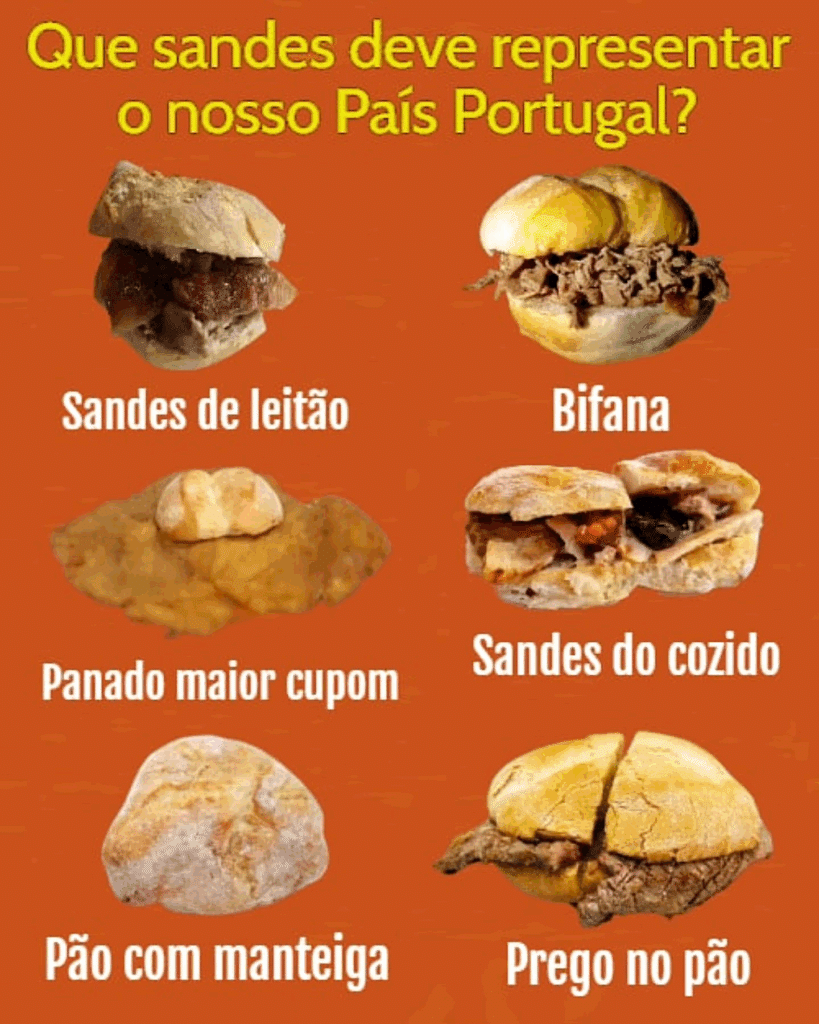
Without her, none of the others are technically possible, although some might prefer to lose the ‘manteiga’ when bringing in other elements, such as a chicken escalope, as we introduce the Panado maior cupom.
For me, this is a trip down memory lane, back to the ‘continental’ cafés of London, where I grew up in the 80s; a delightful sight to see on arrival in Portugal, with its familiar simplicity of a thinly-sliced and breaded chicken fillet (the panado), usually resplendent on a lettuce leaf, with the meat hanging out of the bread, begging to be eaten.
But if you’re wondering why maior cupom, it’s time to introduce you to my virtual Portuguese neighbour, António Ferreira, from the virtual village that is the Portugal Club. Online vizinho português António revealed, as he does in his unending and incredibly generous efforts to educate us foreigners, that “panado maior cupom” is the way those with a “Northern Portuguese accent” say “Panado maior que o pão”, which is hilarious, yet something we’d have never in a milhões de anos have figured out on our own.
Moving onward and upward, at least as Bruno’s infographic is concerned, we next get our laughing gear around the Sandes de leitão or suckling pig butty, which some might have come close to with a native roast pork sandwich, but which here is next-level succulence. Bathed in its de rigeur peppery sauce and including some chewy and/or crunchy skin, the Bairrada region speciality is a very strong contender, given a close association with fizzy red wine, that is as unusual as it is delicious. Do try this combo when travelling from Coimbra to Aveiro and thank me later.
Top right … spoiler alert … is my personal pick to represent the nation when the world goes head-to-head, slice-to-slice at the bread-based convenience food Olympics. And it’s The Bifana – the only one of the contenders herewith, served up by both McDonalds and Mercadona (see my reviews here and here, respectively).
The fact that these corporations have dared to create their own branded versions tells you a lot about the Portuguese people’s love of this marinated pork bap that can be found at most events where large numbers gather and need to be fed. Something that can’t be said of our next consideration, the Sandes de cozido.
I recall when first arriving in Portugal, Mrs M and I blithely asked one lunchtime to have what the staff were having at a neighbourhood café in Costa da Caparica. Surprised and giggly, the locals brought out what I was later to discover was the classic Cozido, or Portuguese stew, consisting often of indistinguishable chunks of meat, one of which, on my initiation, seemed to be an ear including a tattoo upon it.
Now I am not averse to this seriously traditional and much-loved dish, but I will not be commending it for global competition purposes, basically a stew sandwich – originating, I understand, from Torres Vedras. It is, in the best sense, working class but not world-class, in my opinion.
This leaves the Prego, which probably has the best back-story, which I am surprised has not been turned into the basis of a corporate chain like Portugália or Padaria Portuguesa. Legend has it that the concept takes its name not from the sometimes tough old ‘nail’ of meat that the sandwich should contain (usually a steak or ‘bitoque’ of beef, but sometimes pork), but from its originator – Manuel Dias Prego. One of the founders of Praia das Maçãs (Apple Beach), where I have had memorable seafood, he had a rudimentary tavern where seasoned and sauced meat met fresh, local bread, with an obligatory glass of locally-produced wine – divine!
Honestly, I would eat any and all of these throughout the week and for the rest of my life, and as mentioned, I think there are a couple missing in action from a working man’s day, namely the Sandes mista and the national classic, the Francesinha, in essence if not appearance, also a sandwich.
The former is a howling error, given its ubiquitousness and staple nature, not ever containing the best quality ham or cheese, but a comfort food of the highest order and greatest national affection.
Of the Francesinha, and there’s nothing little about this little French girl (as a literal translation suggests), aforementioned António says: “Some people say it is a kind of sandwich but has to be eaten with knife and fork”, thereby disqualifying it as a true sandwich in the spirit of its 18th century inventor.
In conclusion, it must be added that none of the above would be possible without Portuguese bread, the torment of the gluten-intolerant and carb-averse, in all its glorious variations, but invariably and preferably fresh each day and from a local baker, whose bond with the community is a typically Portuguese understated thing of beauty.
Bakers of Portugal, we therefore salute and thank you in anticipation of this great occasion, ahead of the Sandwich World Cup, that we are sure to win, but in what form we can only guess and cheer-lead for until that blessed day comes.
And did I miss anything?