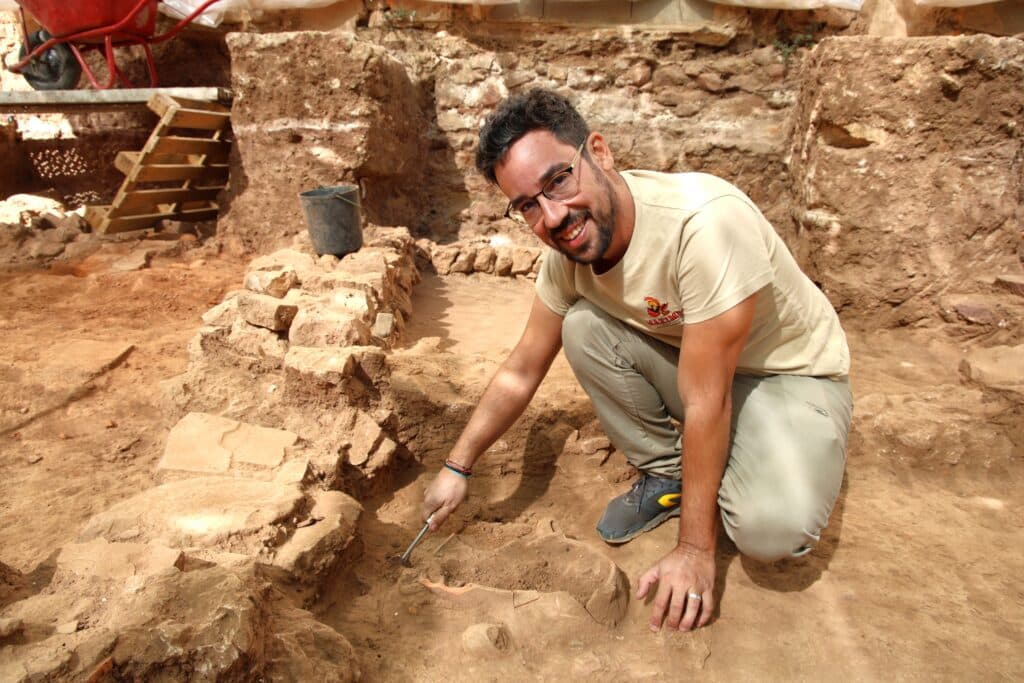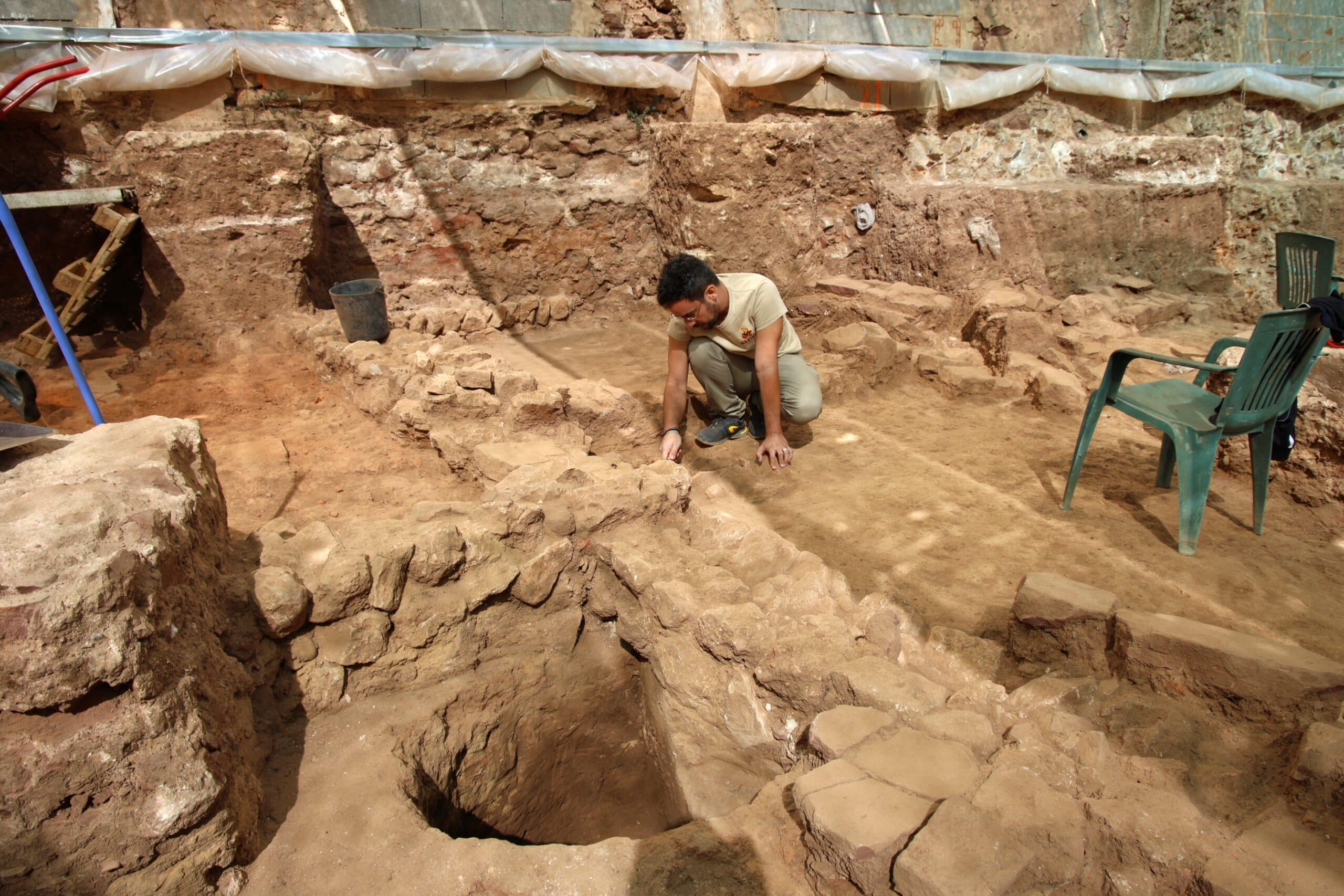
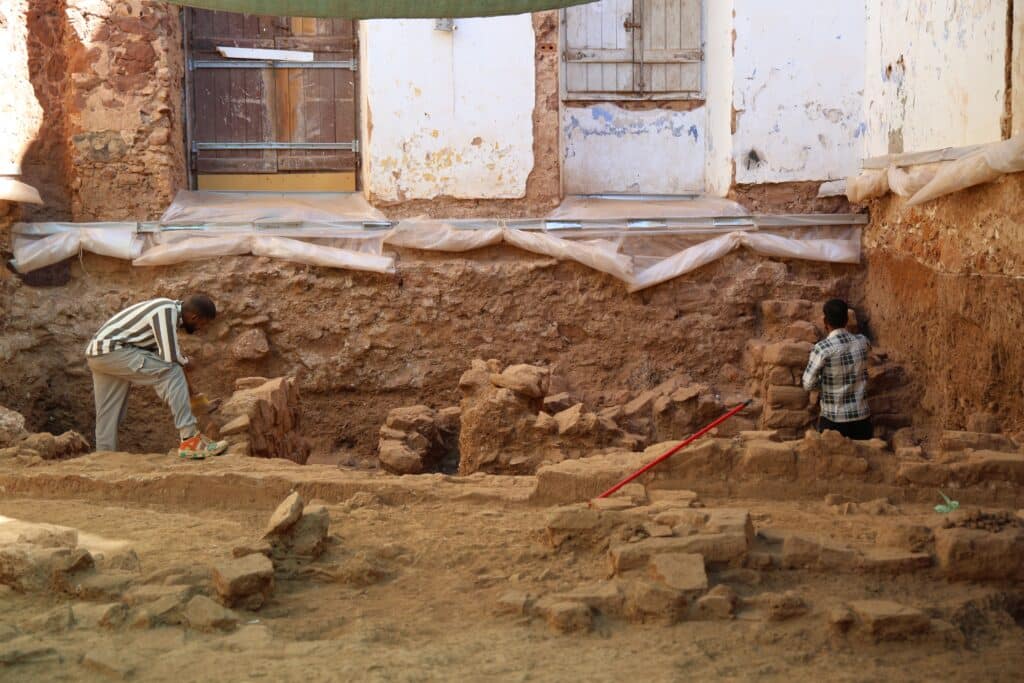
At the corner of Rua João de Deus and Rua Alexandre Herculano, archaeologists Francisco and Eliana Correia – founders of Maximus Arqueologia Lda. – are leading a dig that has revealed remains of an Islamic street covering about 300 square metres. The team dates the site to the 12th and 13th centuries, spanning the period just before and after Silves was taken by Christians.
The building under excavation since the start of this summer was constructed shortly after the 1755 earthquake. Over time, it served many purposes and was recently purchased by a Swedish investor who plans to convert it into apartments while preserving the historic façade.
A mysterious pot
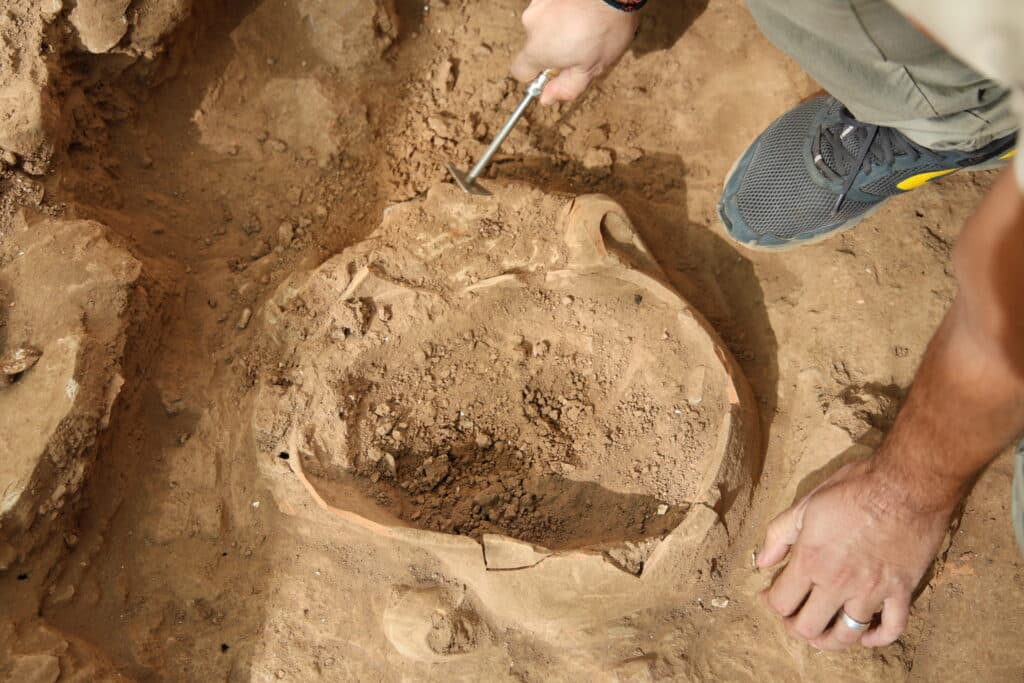
Among the most striking finds so far is a large, possibly unique pot – oval, irregular in shape, and apparently with four handles. No other similar pots are believed to exist in the collection of Silves Municipal Museum. While it is large, it is still smaller than the larger storage ceramics which were common at the time.
According to Francisco Correia, the pot is believed to have been deliberately buried in the corner of an open area that may once have been a square, near the entrance of a room with remains of a ceramic kiln.
While the reason is unknown, the archaeologist is sure it was buried there on purpose. “It’s a surprise, because of the shape, the location, the way it was placed,” he explains. “A stone was even used to wedge it in place. There’s no doubt it was deliberately put there.”
As he explains, such intentional burials are more commonly seen in Roman or earlier contexts. For the Islamic period, Correia believes this practice is rare, though “more research is needed.”
The unusual, buried pot, found 1.5 metres below today’s ground level, is badly damaged and will need careful extraction, but Correia hopes it can be restored.
Nearby, the team has also uncovered what appears to have been a potter’s workshop. In the last two weeks alone, they have recovered four complete pots, along with large amounts of burnt clay, ash, and charcoal.
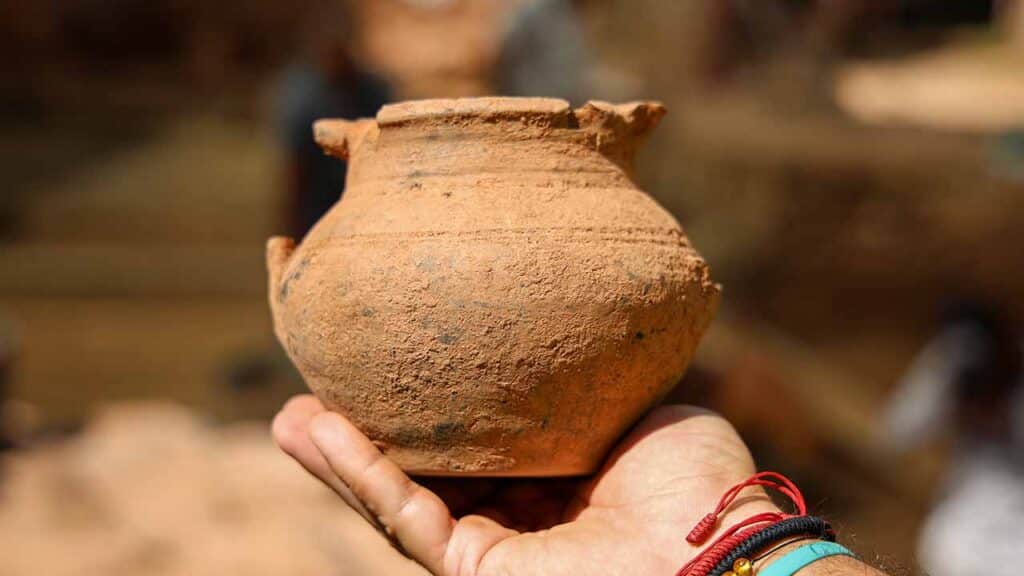
Other discoveries soon followed: a silo under excavation collapsed during cleaning, revealing an Islamic well beneath, “perfectly preserved”, and still holding water that rises and falls with the tides.
This double layer of finds suggests two distinct phases of Islamic occupation in Silves, separated by only a short period, and possibly linked to the town’s turbulent history of conquest and reconquest.
The second defensive wall
Silves was once one of the most important cities of Gharb al-Andalus, with mighty walls, a grand castle, and vibrant economic and cultural life. In 1189, King Sancho I of Portugal, with the help of northern European crusaders, seized the city after a brutal siege that decimated a large part of its population. But in 1191, the Almohads retook Silves, keeping it under Muslim rule for decades until King Afonso III incorporated it into Portuguese territory around 1242.
The excavation reflects this shifting history. On one side, at lower levels, archaeologists have found remains of wells and walls from before the Christian conquest. Later, when Muslims regained control, they reinforced the defences and likely expanded the city beyond the earlier walls.
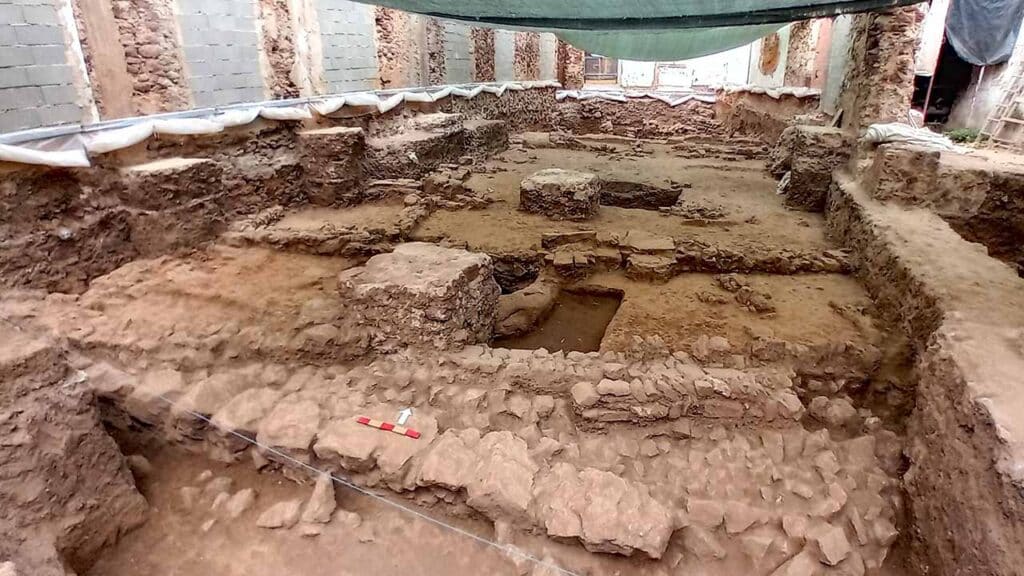
So far, the pottery unearthed paints a picture of everyday life rather than wealth: simple, common ceramics, several intact pots, and a painted oil lamp – mostly from the 12th and 13th centuries. Evidence suggests ordinary people lived here rather than elites, the archaeologist explains.
Another significant finding was the confirmation of the line of a second Islamic defensive wall, previously identified in a 2010 excavation. The wall existed before the first Christian conquest and was reinforced when the Muslims retook the city, expanding the defences toward the River Arade.
Correia believes that such finds challenge the idea that Islamic occupation was confined within the current castle walls. “Traces have already been found near the Municipal Library, Bairro do Progresso, Largo dos Mártires, and now here. So, we know that Islamic Silves goes beyond the wall and extended all the way to the river,” he says.
The developer behind the project, Notorious Paradise Lda., is delighted to be contributing to the understanding of Silves’ history, though Correia also noted the high costs of in-depth archaeology projects. He suggested that tax incentives could make urban rehabilitation in historic centres more sustainable and attractive for businesses and investors.