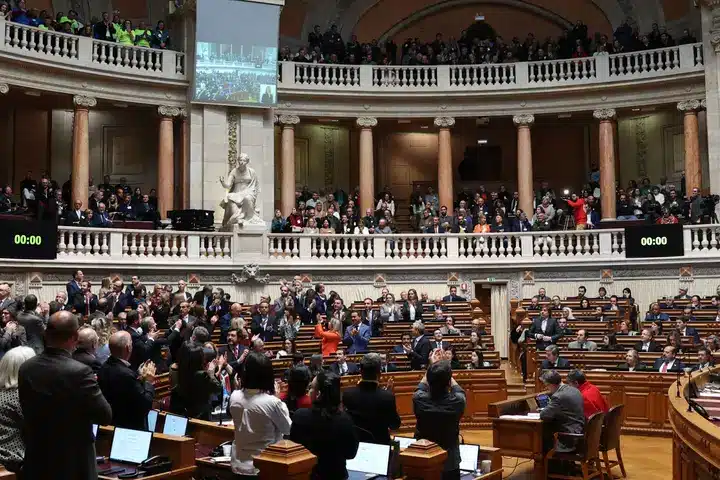
As if there wasn’t already enough going on on the political landscape (municipal elections in less than two weeks time, followed by hotly contested presidential elections), the government is preparing to present the 2026 State Budget.
PCP communists, as they often do, have already declared their votes ‘against’.
This is a budget that has “several measures that affect the margin the government has for possible negotiations and proposals”, explains Lusa – especially as it is aiming for a budgetary surplus.
“The flagships of Luís Montenegro’s government, a reduction in personal income tax (IRS) and corporate income tax (IRC), will once again be a hallmark of this budget, which is due to have its final overall vote on November 27”, says the news agency, presenting a: “here’s what is already known about the budget”:
Budget has measures with an impact of €4.449 billion
The Budget already includes several measures that will impact public accounts, totalling €4.449 billion, according to the invariant policy framework submitted by the government to the Budget, Finance, and Public Administration Committee (COFAP).
Among measures affecting revenue, are the reduction in corporate income tax by one percentage point – which has an impact of €300 million – as well as the updating of the specific deduction, personal income tax brackets and ‘existence minimum’, costing €325 million.
In terms of expenditure, €1.248 billion is baked into personnel costs, €262 million to salary agreements and €1.563 billion to pensions.
Ministry of Finance expects two years of budgetary surpluses
The government expects to achieve a budget surplus of 0.3% of Gross Domestic Product (GDP) this year and, although it has not yet presented new forecasts for 2026, it continues to expect a positive balance, with the latest outlook being for a surplus of 0.1% in 2026, according to the report submitted to Brussels back in April.
These projections are not borne out by the Portuguese Public Finance Council (CFP) which continues to project a budgetary deficit next year (currently of 0.6% of GDP). The Bank of Portugal also points to a negative budgetary balance in 2026.
As far as the ‘macro scenario’ is concerned, in the State Budget, the government had forecasted growth of 2.1% for this year, later revised to 2.4% (in the report submitted to Brussels in April). Lusa maintains that “it remains uncertain whether this estimate will be maintained”.
Government cuts personal income tax rates
In July, parliament approved a reduction in personal income tax for 2025 and a commitment to a further reduction next year, to be included in the 2026 State Budget.
The approved law includes a rule, added to the government’s initial proposal at the initiative of the PSD and CDS-PP benches, so that ‘in the State Budget for 2026’, the government proposes to parliament to ‘additionally reduce the marginal rates of the 2nd to 5th bracket by 0.3 percentage points’.
With this initiative, parliament made the government move forward with a new proposal to reformulate the IRS table, to enshrine a further reduction in the rates of the 2nd to 5th bracket, to be applied to the income earned by taxpayers throughout 2026.
With an additional reduction of 0.3 percentage points, the second bracket would have a rate of 15.7%, the third 21.2%, the fourth 24.1% and the fifth 31.1%.
Minimum wage rises to at least €920
The tripartite agreement on wage increases and economic growth for 2025-2028, signed in October last year between the government, the four business confederations, and the General Workers’ Union, revised upwards the trajectory of the national minimum wage, forecasting increases of €50 a year to reach €1,020 in 2028.
The document therefore predicts that the national minimum wage will rise from the current €870 to €920 in 2026.
In the government programme, the executive has set a new target to cover the entire legislature, aiming for the guaranteed minimum wage to reach €1,100 gross per month by 2029.
The Minister of Labour, Solidarity and Social Security said this week that the government “does not open or close the door” to revising the trajectory of the national minimum wage, which stipulates that the guaranteed minimum wage will rise to €920 in 2026.
Company tax reduction on sidelines of the State Budget
Following a drop in the corporate income tax rate this year, from 21% to 20%, the rate will decrease to 19% next year. For 2026, there is also a reduction in the rate that applies to Small and Medium-sized Enterprises (SMEs) and small and medium capitalisation companies in the first €50,000 of taxable income from 16% to 15%.
Timeline
The State Budget must be submitted to parliament by October10, and COFAP already has a proposed timetable for examining the State Budget, so that the general discussion will take place on October 27 and 28.
Voting on the proposed amendments and the document, paragraph by paragraph, will begin on November 20, with the final overall vote scheduled for November 27.
President Marcelo has already said that he would not see the ‘fall’ of the State Budget as a reason for dissolving parliament (which he cannot do anyway, as he is so near the end of his 10-year mandate). The prime minister also has said he too would not see the budget’s failure to be a sign of government failure.
Source material: LUSA