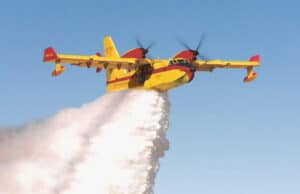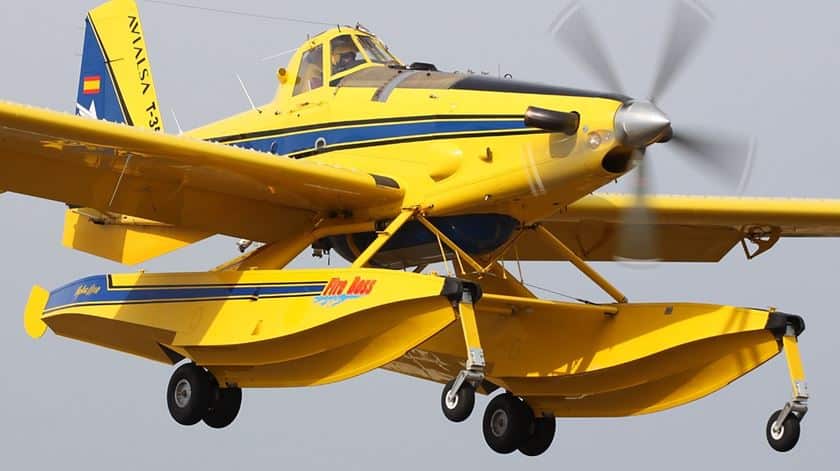
Underscoring firefighters’ criticism of Civil Protection, the entity’s national commander has said today that the two Fire Boss aircraft provided by Sweden under the European Mechanism for helping countries struggling to contain wildfires “will be arriving this afternoon” but won’t be deployed immediately.
First, “we will have to assess, together with the team leader of the team coming with these Fire Bosses, how we can deploy them and for how long,” Mário Silvestre has told today’s ‘midday briefing’.
This means that the mechanism ‘actioned’ with a degree of fandango on Thursday has so far resulted in ‘no change’ where it matters – and where it matters, wildfires are still raging out of control.
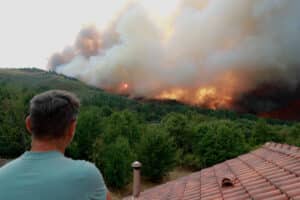
Also around midday, the mayor of Covilhã said the wildfire in his municipality was “completely out of control”.
A little later, Lusa reported that the fire in Fundão has “three active fronts”: the need for fresh resources would appear to be howling – but no, ‘the situation first has to be assessed’.
On Sunday, Secretary of State for Civil Protection Rui Rocha said the two Swedish aircraft were expected to arrive within hours, and begin operations today (Monday).
And on the subject of ‘lack of aerial resources’ generally – and complaints by people who say they do not see aircraft in action, in spite of them being mobilised, Mário Silvestre said: “We have had some difficulty in deploying aerial resources, as the smoke is trapped in the lower layer of the atmosphere. And so there is some difficulty – because pilots have safety rules they must comply with.”
Silvestre also pointed out that the fires still active cover ‘several hundred hectares’ and ‘it is therefore normal’ that in certain locations the population does not see any aircraft in action.
As to the absence of ground resources within villages threatened by the flames, Silvestre guaranteed that these resources are at “interfaces” in the vicinity of the villages to divert the fires from urban areas.
“This does not mean that, at times, due to the very dynamics and speed of propagation that we have seen in the fire, there are moments when the response is a little slower,” he went on.
As of this afternoon, Portugal has a fewer number of fires considered active, but the Trancoso/ Sátão/ Tarouca/ Vila Nova de Foz Côa fire, albeit mostly contained, covers such a vast area and has so many hotspots, that with the high winds there is absolutely no possibility of fire combat ‘relaxing’.
A good way to appreciate the scale of the Trancoso/ Sátão fire is to access fogos.pt, where the area is highlighted in pink.
Source: LUSA/ fogos.pt