This is the second part of a two-part column about Portuguese village life as exemplified by the charming Santa Bárbara de Nexe, with its classic church and bell tower. In Part 1, I discussed what I consider the many charms of village life. Now, in Part 2, I discuss what I believe to be the main concern.
One of the main aspects that I appreciate about village life, as opposed to suburban life back in the States and in most big cities everywhere, is the personal touch that can be achieved by being a resident of a place like Santa Bárbara de Nexe.
Another good example of what I’m talking about is the pharmacy, located on the one-way road into town right next to Célia’s beauty shop, where I get my pedicures. (At 80, I can’t reach my toes anymore.)
At the pharmacy, there is seldom a line and, if so, never more than two or three. You do have to deal with the Portuguese custom of never ending a conversation, with the little old lady in front of you having paid but not yet ready to bring her socializing to a halt.
Worse news and even a longer wait is when a gypsy woman wants to argue the price. I’m retired, so seldom do I need to be elsewhere and instead see it as a local custom to which I have not yet become completely accustomed. Every once in a while, I do go to the big, busy pharmacy in the MAR shopping center, and while I always receive brisk service (that’s where I get my flu shots.), I’ve never ever had the same young lady wait on me or recognized anyone in the store.
Back at the village, behind the counter, there’s “Doc,” whose expertise we rely on; and her gray hair does give her a sweet sense of authority. The main person, however, who we all deal with is Lurdes, who has been in the village for 34 years and conducts business in an absolutely professional manner while still making each transaction feel personal.
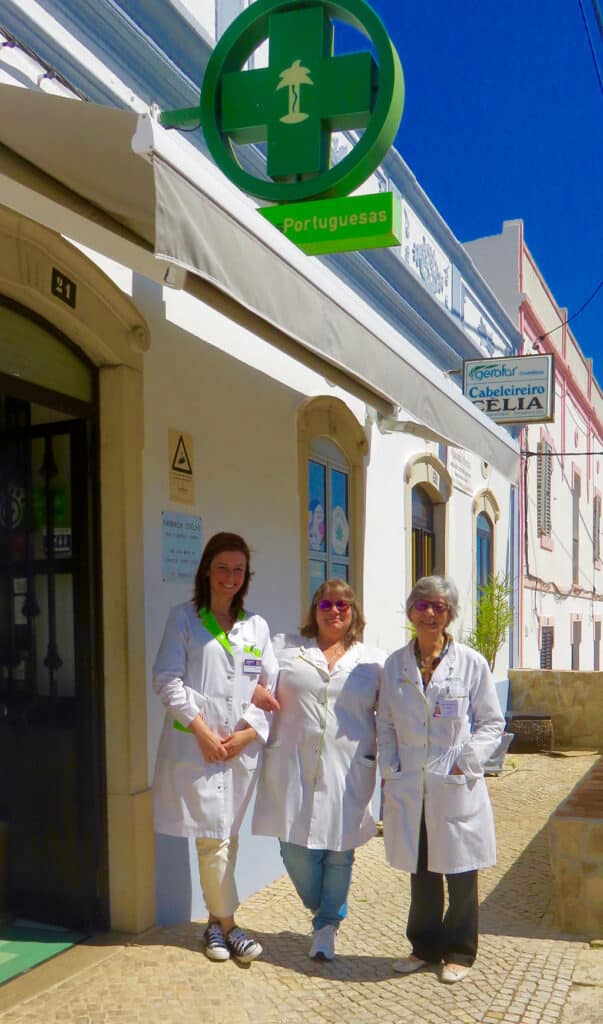
Not at all a source of gossip, she is an excellent person to go to for information about what might be going on in the village. We often see her at festivals and parades or out for a drink at one of the cafés. She’s one of our friends and never like, “oh, I know you, you’re the one with gout.”
I was talking with Lurdes recently and, in preparation for my column, asked her what she thought of Santa Bárbara de Nexe. (There is no short form or nickname for this particular village. Nobody refers to it as Santa Bárbara – that’s a different place – nor SBdN and certainly not “Nexe.”)
Lurdes said that she enjoyed living in a nice village, but (and now we’re getting to the main theme of this column) that she was worried about the growth and how that expansion was going. We could use “a bit more businesses in town,” but she was worried that “only people with money were moving in” and were displacing those less affluent.
Certainly in the last two or three years, after a pause during and after the pandemic, Santa Bárbara de Nexe has begun to experience a building boom. The village’s skyline used to consist of the church bell tower, with the bells ringing two minutes before every hour, and a gigantic Norfolk pine that grew out and above the dining terrace of Angelo’s Italian restaurant called La Piazza.
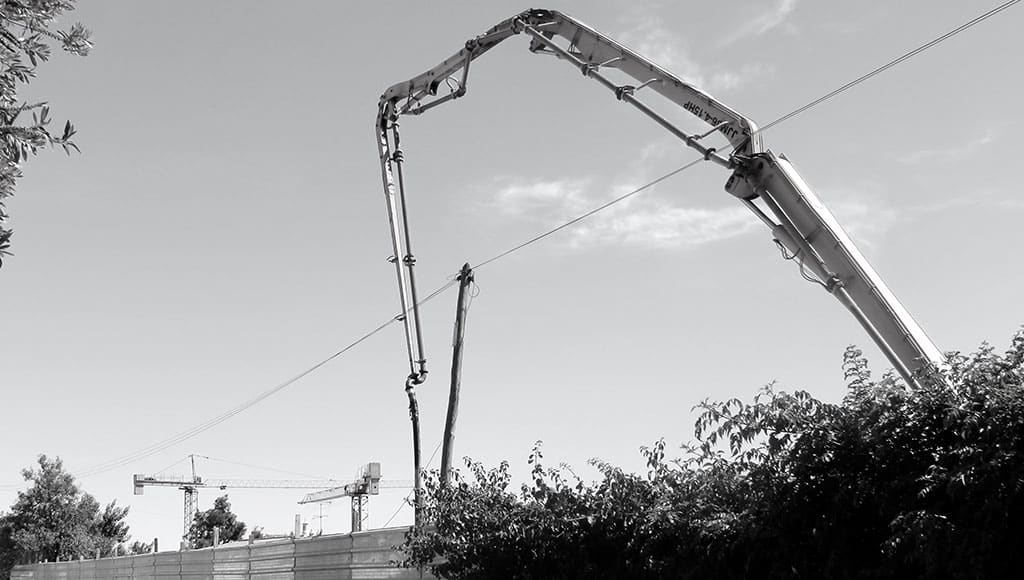
Now there are at least three cranes hovering about new building projects; and not just villas for which the area is known, but rather expansive apartment blocks.
The population, which has hovered at or near 5,000, will soon grow. The question is “by how much?” and the consensus is “a lot!”
When Angelo, who my lovely wife and I consider a dear friend, retired, it was assumed that his two sons, Luigi, a fine chef, and Fabio, the friendly front of the house, would continue with the very attractive and popular garden dining area.
Everyone I spoke to were disappointed and sure “the boys” had made a mistake when they decided they could not afford the rent (that was the story anyway) and opened Cin-Cin Italia on a busy street with hard-to-find parking and an ordinary setting in Almancil.
The local wisdom is that because of the population increase, their business could only grow. Our worry would be having to make reservations days in advance instead of just dropping in as we had become accustomed to doing. We also lost the best take-away pizza in the area.
In fact, since Angelo’s closed, two new fine dining establishments have opened. There’s Mahalo, with a Hawaiian name and a palm tree out front, but it’s really a contemporary Portuguese spot with fresh seafood, good oysters and yummy spareribs. When we first met the very modern, stylish young lady who owns the place, she told us her name was Kelly. “Oh, so where are you from, Kelly?” I asked assuming such a name was international somehow. But no – Kelly is fourth generation Santa Bárbara de Nexe and a nice hometown gal with the last name Salgado.
The other place is Alagoas, really at one time the restaurant we went to the most because, for one thing, they allowed our dog, the legendary Fluffy, inside at our special table. After the waitress, the great Needia, brought Fluffy a bowl of water, she would then take our drink order. Then the lockdown came, and the family couldn’t keep the place going. Now it’s newly-opened with the old name but under new management and we haven’t been yet.
Recently, Kelly told me, while I was wiping BBQ sauce from my mustache, that she’s happy with the growth in as much as it means a steady stream of customers but that she’s worried that too many people will spoil the still pleasant small-town feel of her lifetime home.
Who isn’t worried? As far as I could find out by informally asking my friends and neighbors around the village, everybody liked it better a few years ago and still likes it now but are quite concerned that a small place like where we live will soon be overrun with strangers. Paulina, a patient, lovely woman who runs the corner store and relies on drop-in customers, thinks the village doesn’t need to grow much. Her outgoing assistant Sophia thinks the newer group of people seem more transient and less cordial and/or friendly.
Then there’s Carlos, our local biker dude, who runs Sooner or Later, the local rock ‘n’ roll pub, who also happens to be secretary of the village council. There’s nobody more positive in town and he thinks the population might be headed into negative territory.
While the potential for more customers is probably good for business, the question is “Where are they all going to park?” Not often but sometimes, even now, I have to circle the village a second time before I can find a parking spot on the one-way, single-lane main high street. The plan, according to Carlos, is that the village will buy a relatively large open lot, situated ideally in the middle of town, and convert it into a parking lot. The space is currently where the village festivals are held. Can parking meters be far behind?
So, what are the causes of this potential growth? The Portuguese aren’t buying the villas sprinkled through the surrounding hills, at least not in great numbers. And while Santa Bárbara de Nexe is dominated by British expats, my sources tell me their numbers are also dropping slightly.
Some are giving into demand and selling for tidy profits, mainly, I’m told, to French buyers. That explains Eve’s place in the center of town called O Bar Bara, a nice French café. When you call to make reservations, business is conducted in French.
The American invasion has been slow to materialize, but the local wisdom is that they’re still on the way. For a long time, my lovely wife and I were known as “the Americans” simply because we were literally the only ones.
My lovely wife’s hairdresser Mónica, who runs Célia’s (Celia retired but is still around), has since developed the impression “that Americans are full of themselves.” These must be the same folks who publish Facebook photos of themselves with huge piles of luggage, golf clubs and pet carriers as if it were some sort of accomplishment worthy of praise.
While there are, of course, some citizens of the United States who are trying to escape the negative atmosphere inspired by Don the Con, Putin’s Pal and his horde of hate-filled MAGAS, the problem is even more fundamental and widespread.
The Baby Boom is getting to retirement age and looking for some place to spend their golden years with nice weather, a relatively low cost of living, and a low crime rate. Beautiful scenery, plenty of history, access to European travel opportunities and decent healthcare are bonuses. The point is that population growth is a constant and the Baby Boom is a potent demographic bubble that can’t be ignored.
My lovely wife and I were both born in 1945, which means that we are old but not baby boomers since that particular demographic phenomenon officially began in 1946.
For most of our long life, this has been to our advantage, but it has also meant that growth, with all its implications, has always been a trend in our lives. It’s like we’re barely keeping ahead of a booming bulge that has followed us through life.
Not quite a tsunami of people collecting social security, but lots of older people marching through town in their brand-new Easy Slip-on Sketchers.
For the final 25 years of our careers, we lived on three acres near a small town called Mount Airy, in the rolling hills of Maryland. Our mailbox was along Bill Moxley Road named after a local dairy farmer. Ol’Bill still operated at the other end which came to a stop sign at a “T” intersection. When we first moved in, I considered that sign to be “stopsional” because you could see both ways that nobody was coming. When we finally moved, there was a traffic light at that intersection.
The town was just like it sounded and not unlike Santa Bárbara de Nexe in many ways. There was one main street off the highway, with a small restaurant suitable for breakfast, a liquor store, a library and not much else and it stayed that way for a while.
Eventually, however, housing developments were taking over farmland and I had to start attending county board meetings to fight rezoning of the dairy farm next door for more housing. By the time we left in 2006, Mt. Airy had a Walmart, an Applebee’s, an Olive Garden and every fast-food chain in existence. (We had the meats.)
The attitude I’ve developed over the past 80 years is that the Baby Boom is just too big and can’t be ignored or outrun. The secret to our happiness is to realize how lucky we are and enjoy our lifestyle while we can. There’s never going to be fewer umbrellas on the beach and, pretty soon, you’ll have to call a day ahead for reservations. It was nice though before the boom hit.
If you have any suggestions, questions, concerns or comments about this article or the expat experience in the Algarve in general, please contact me at goodoldpatinportugal@gmail.com. Story suggestions are always considered and happily accepted.