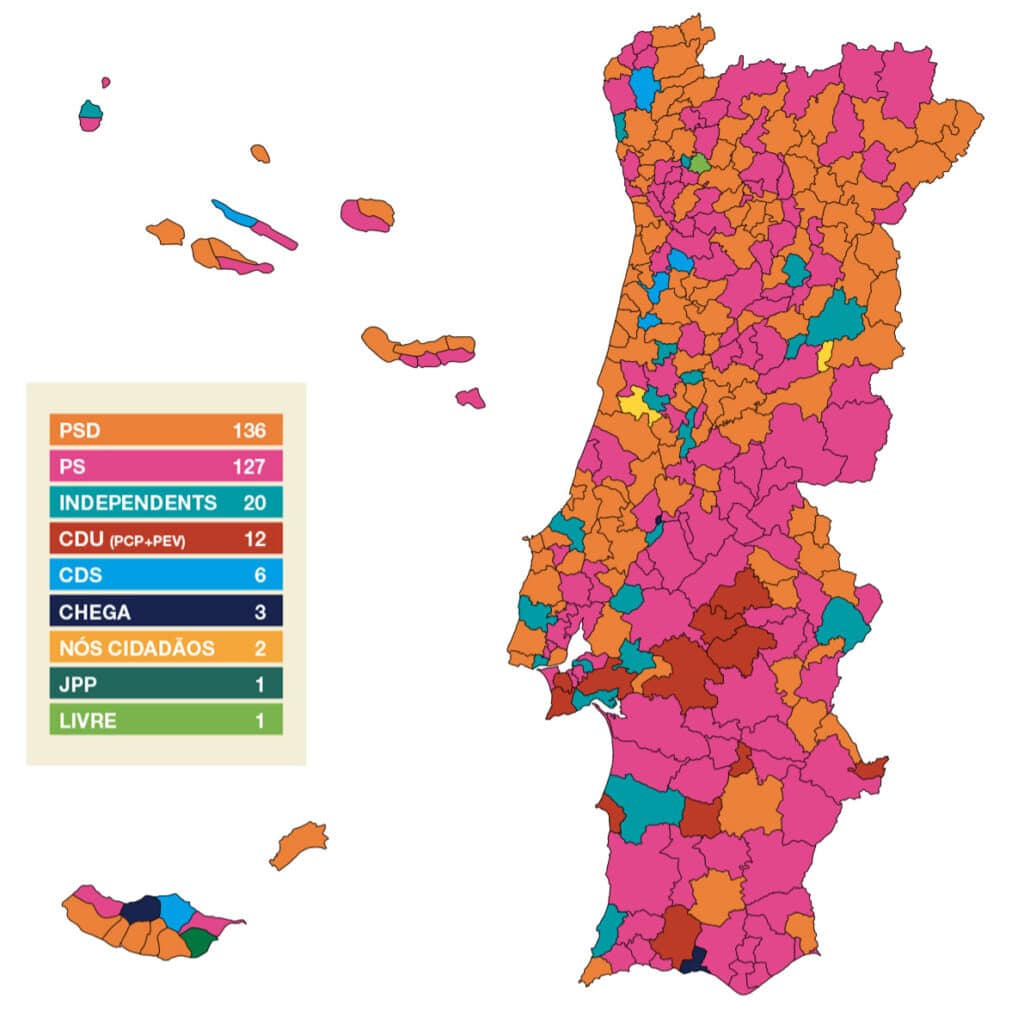
After the ‘unprecedented’ results of legislative elections in May – which saw far-right CHEGA shatter the glass ceiling of the two-party system – Sunday’s local elections restored the balance: the country has remained, at local level, overwhelmingly ‘orange’ (PSD) and ‘pink’ (PS), with just a smattering of other colours denoting independents (turquoise), CDS (blue) and CHEGA (dark blue) – see map below.
The reason, pundits explain, is that these were elections that depend on ‘personalities’ – on how local candidates are seen in their communities. A traditionally Socialist (PS) area, for example, can have pockets where communities prefer candidates from other persuasions – and this is where CHEGA seems to have ‘failed’ – having polled very few ‘well-known’ tried-and-trusted candidates.
On a national level, the elections reinforced the confidence of PSD, the strongest party in government – and now the strongest party in local government. In fact, PSD is now in control of basically every level of local government for the first time since the country became a democracy. It has control of the five largest municipalities in the country – Lisbon, Porto, Sintra, Gaia and Cascais, and it is in the driving seat in the national associations ANAFRE (parish councils) and ANMP (municipal councils).
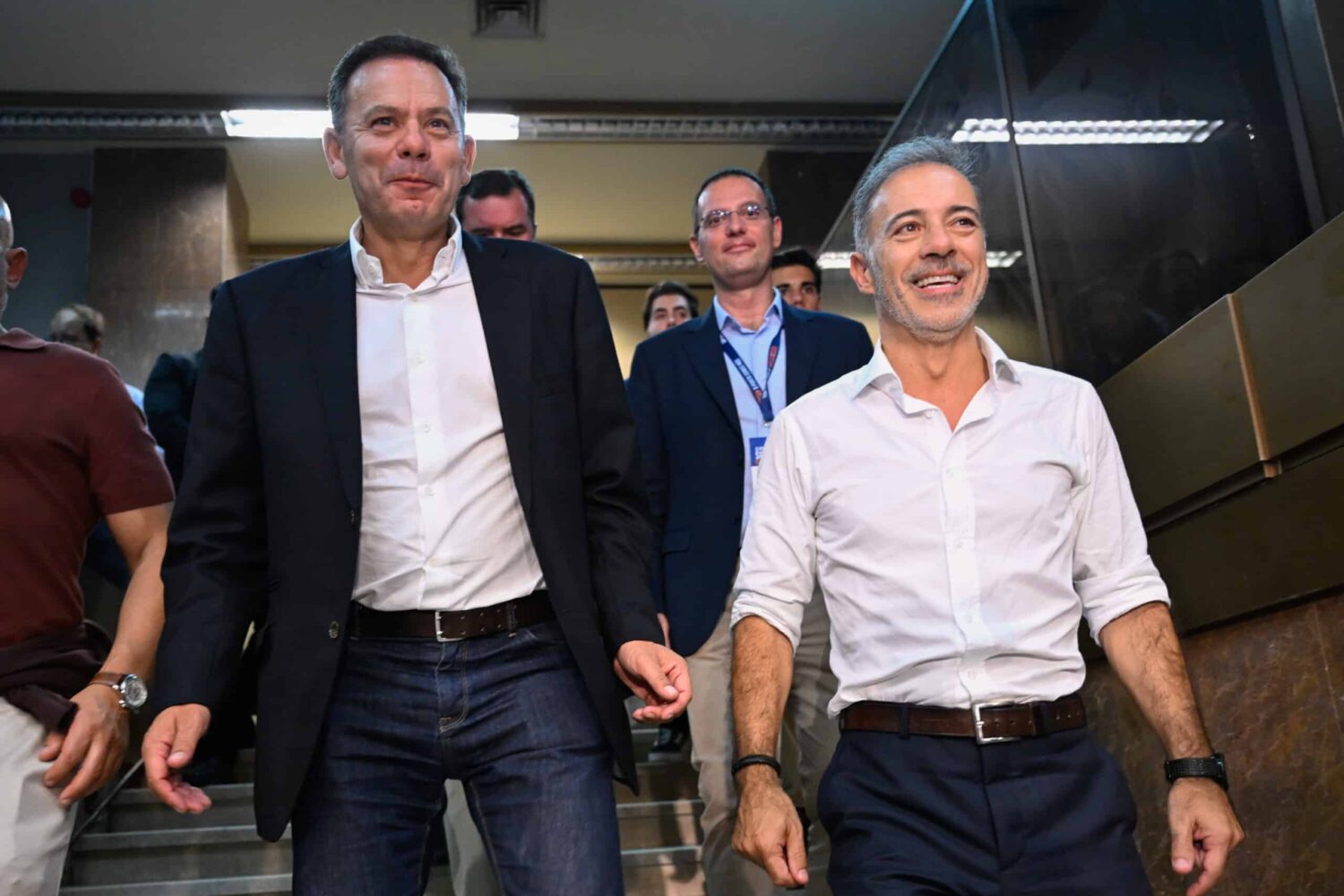
Prime Minister Luís Montenegro remarked: “I won’t say it’s a historic result, but it’s extraordinarily relevant (…) This gives us great responsibility, the responsibility not to fail, the responsibility to translate the trust we have received from people into concrete decisions, objectives, and results.”
The PM’s centre-right party, PSD, won 22 boroughs from centre-left PS Socialists, finishing with 136 overall (out of 308), against the PS’s 127. Twenty-three went to ‘independents’, 12 to CDU, six to CDS (the government’s coalition partner), three to CHEGA and one to LIVRE (these last two celebrating their first borough conquests to date).
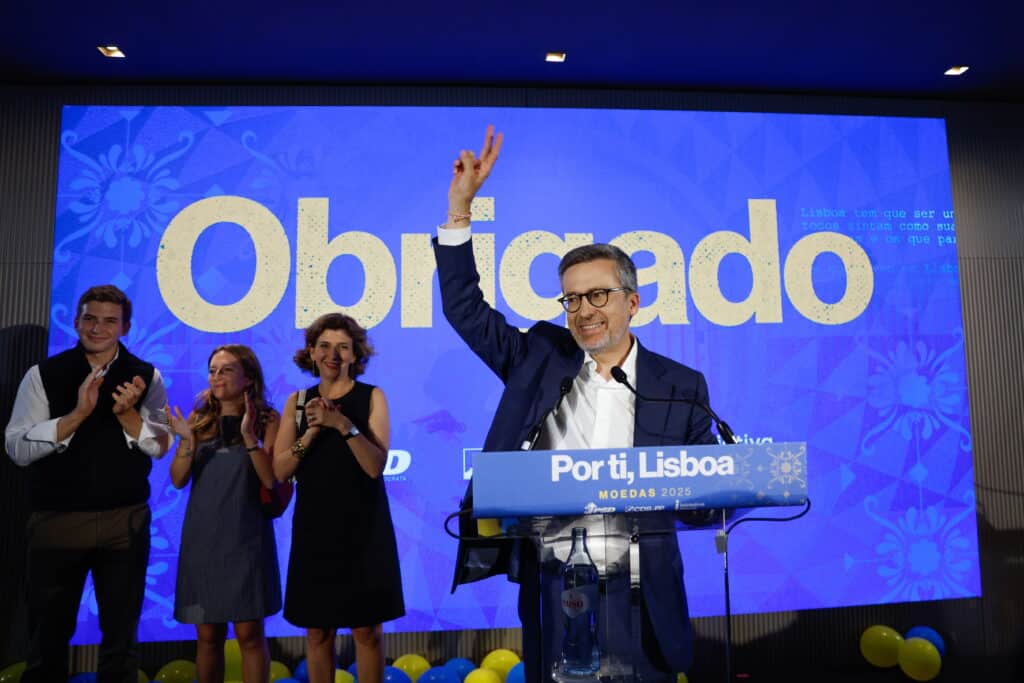
Arguably, the most ‘important win of all’ was in Lisbon where centre-right coalition mayor Carlos Moedas has always had a struggle keeping control (he had no working majority following the 2021 council elections), and was campaigning in the aftermath of one of the worst accidents involving fatalities and injuries in public equipment this century (the derailment and devastating crash of the Glória funicular in September).
Moedas also faced PS rising star Alexandra Leitão – a woman who has made no bones about becoming the first woman to lead her party, and potentially the country – to emerge victorious, scooping almost 30,000 more votes than his closest political adversary, and receiving one extra councillor as a result.
As he quipped late on Sunday, “if I was able to run the council with seven councillors, eight will make the job easier”. But, more seriously, the result showed “Lisbon’s voters want stability”, he said. “Thirty-thousand more votes is absolutely extraordinary. Now, we will succeed: Lisbon is on the right path.”
Similar jubilation came in Porto where pundits had always pointed to former health minister Manuel Pizarro (and candidate for Porto’s mayoral seat in the past) winning for PS Socialists, when this was not to be. Victory was snatched by PSD’s Pedro Duarte, with a little less than 2,000 votes in it, and no working majority. Duarte said the win brings “a new leader for the north of Portugal”, ruling out, for the time being, any kind of coalition with CHEGA.
While PSD celebrated what they view as their truly ‘great night’, PS Socialists were also buoyed by their results, particularly because they buried the monster that rose out of May’s legislative election ‘slaughter’: this is no longer a party heading for obscurity. It is back in what it sees as its ‘rightful place’ in the two-party landscape – and for now that is definitely good enough.
Some of the PS gains have been seen as ‘a breath of fresh air’ (viz the ousting of 28 years of PSD in Bragança by former PS MP and scientist in the agri-food sector, Isabel Ferreira), while others will be a struggle (the win by former minister Ana Abrunhosa in Coimbra, but with no working majority) – but the thrust for party leader José Luís Carneiro is that his party has shown its ‘vitality’, and the fact that hundreds of thousands of people still believe in it.
CDS is equally content with its six municipalities; CHEGA not so with its three (one being São Vicente, in Madeira, where the incoming CHEGA mayor came to blows with a PSD adversary on voting day). CHEGA leader André Ventura had predicted a CHEGA ‘landslide’ in the Algarve (which did not happen) as his party prepared for “the conquest of the country” …
CDU (communists), Bloco de Esquerda, PAN, LIVRE and Iniciativa Liberal could all have done better, and they appear to recognise this – the two former, possibly three former, inexorably seeming to slip further and further down the line of voter preferences.
Abstention this year was almost a taboo subject: no one mentioned it. But it was markedly less than in previous years: down from last year’s almost 47% to just over 40%.
Some regions, however, had a lot more abstention than others – namely Ponta Delgada, Albufeira and Loulé in the Algarve, and Amadora, near Lisbon, where almost 50% of the voters ‘couldn’t be bothered’. Cascais, Funchal, Ílhavo, Odivelas and Sintra were other boroughs where large sections of the local populace showed little interest in the electoral process.