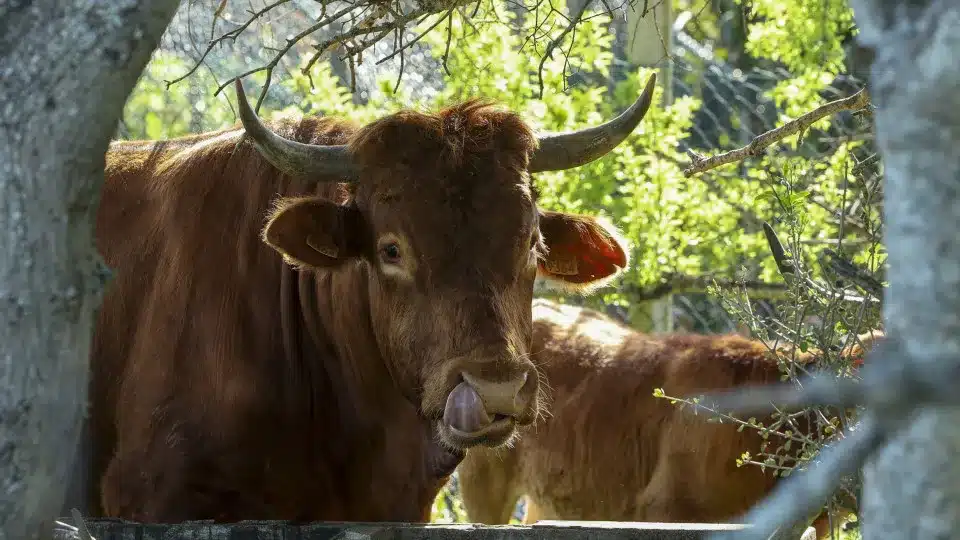
A small group of cattle breeders has managed to bring an Algarve breed, considered extinct, back from the brink – and is now committed to increasing their numbers so they can be sold.
“What we want to do is create a niche market for purebred animals, which will then justify starting to market them,” producer Afonso Nascimento, president of ASCAL, the Algarve Cattle Breeders’ Association, has told Lusa.
In the 1950s, there were more than 20,000 head of these Algarve cattle – which are not very demanding in terms of food and ‘dual purpose’ (good for work and their meat) – but the mechanisation of agriculture, the introduction of exotic breeds, and the progressive abandonment of the fields reduced their numbers, leaving this particular breed very much out in the cold.
In 2005, in a joint effort by ASCAL, the then Regional Directorate for Agriculture and Fisheries (DRAP) of the Algarve, and the Directorate-General for Veterinary Services, a study was carried out that allowed the breed’s recovery to begin.
“It is a breed that was on the verge of extinction. In 2019-2020, we had a very small population and all the investment to rehabilitate the breed disappeared,” Afonso Nascimento explained.
According to figures from ASCAL – which has been responsible for the Algarve Cattle Breed Genealogical Book since 2005 – the number of animals considered to be purebreds of this breed rose from five in 2018 to 27 in 2024 and then to 47 in 2025.
The Algarve Cattle Breed Genealogical Book is the official register for the identification and zootechnical control of animals of this breed.
Part of the desire to recover this very Algarvian bovine was to stop the erosion of traditiona and culture (that otherwise appears to be happening on so many levels).
At least five producers are now involved in the project, with farms located in the municipalities of Vila do Bispo (where the cattle were very predominant in the old days), Lagos, Portimão, Silves, and Tavira.
One of the pioneers of this initiative, António Figueiras, remembers the days of his father when there were “hundreds and thousands of these animals in the Algarve”, saying that he thinks “it is sad that they disappeared just like that, from one moment to the next.”
The Algarve’s CCDR (commission for regional coordination and development) is supporting the project. João Santana, head of the Technical Support and Proximity Division, tells Lusa that the “initial goal now is to increase the number of animals, and later (…) try to add value by giving more value to the meat products that will come.”
The breed is traditionally adapted to the hot, dry climate of the Algarve (much more able to survive long periods without rain than exotic breeds, for example).
Breeders interested in joining this project can apply for annual financial support to maintain the numbers and become part of what is a very regional effort for the conservation of indigenous genetic heritage.
Source material: LUSA