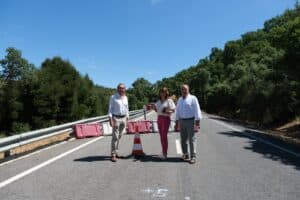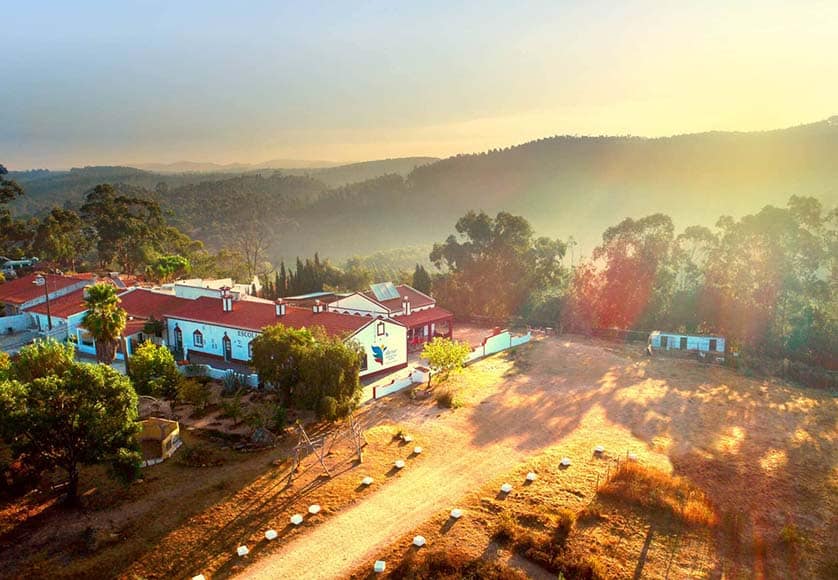
What began as a normal school day at Aljezur International School before the recent mid-term break was suddenly turned upside down when representatives of the Ministry of Education arrived in the company of GNR officers with an order for compulsory closure.
The plan, mid-morning Friday, October 24, was to immediately evacuate the building, and not allow anyone back inside.
Co-director Sílvia Catarino insisted that opportunity be given for working parents to be informed, children to be collected safely, the school bus to return, etc., and thus the closure was ‘delayed’ until 3.30pm.
Since that moment, both the school board and a committee set up by parents have been in consultation with lawyers focused on reversing what they see as an “unpardonable example of institutional bullying”.
The official narrative, spread by Portuguese-speaking media, is that the school is ‘illegal’; its curriculum unrecognised and that the interests of the pupils are not being properly considered.
Talking to Rádio Observador a week after the compulsory closure, Education Minister Fernando Alexandre likened the school to an “unlicensed pharmacy selling medication that isn’t certified”.
The fact that the school, invited to the municipality by Aljezur borough council 15 years ago, follows the British Cambridge curriculum (which is actually accepted by the Ministry of Education, Science and Innovation in other establishments) and educates its pupils to IGCSE level – providing tutorial support to AS and even A levels – appears to have been overlooked by Mr Alexandre who returned again and again to the fact that that school was “disobeying the determinations of the state”.
Pressed as to the contours of this ‘disobedience’, Mr Alexandre’s first example was “the installations” (meaning the building itself). Indeed, he emphasised that education cannot take place in ‘any school’, because Portugal “is not in the third world”.
This was an interview that went out on a national radio station, without the school itself having any input, or indeed the council, which has always supported the initiative as it attracts many families to put down roots in the area.
The Resident has since spoken with the school directors and some of its parents – and it goes without saying that they have a different slant on the official narrative, and actually fear it could be more connected with the wide publicity being given to the arrival in Portugal of ‘large educational groups’ investing millions to bring international education to the wealth of new arrivals.
In comparison with large educational groups, Aljezur International School is a minnow. But that does not mean it will be a push-over.
This closure comes with baggage: the same tack was tried in 2022, when the school was able to reverse the closure through a ‘providência cautelar’ (injunction). Again, the reason was ‘illegality’, centring on a licence (awarded in 2014) which had been withdrawn at some point later, without the school being informed.
The lawyer acting for the school in 2022 said at the time: “There is no doubt at all that a licence existed”, but something very opaque happened afterwards, and, in his mindset, “the ministry has not behaved as the law demands”.
Parents point blank refuse to transfer children into Portuguese system
The official narrative is that Aljezur’s 85 pupils will be placed in state schools relevant to their areas. Again, this has been widely reported by national media almost as if it has already happened – which, parents feel, in itself is quite sinister. If it is reported that the children are moving to state schools and they don’t, would this leave parents accused of ‘failure to educate their children’?
Thus, the parents have hired a lawyer to protect their children’s “higher interests”, which they see as being allowed to complete the school year, at very least, at the Aljezur International School.
“If this all boils down to the height of the ceilings,” quipped one, “we need to have time to find ‘installations’ that are deemed acceptable. The quality of education cannot boil down to the size of door apertures into classrooms…”
One of the mothers told The Resident that she has seen Portuguese education from the inside with her eldest daughter: “Hannah had no Maths teacher for six months; the school was always going on strike; the teachers were unhappy – they seemed to change every year.” Her youngest daughter, however, “can’t wait to get to school everyday. The teachers are always happy. The kids are happy. The school building is beautiful. I cannot see what this government is trying to do, unless it is simply to push out the little people in favour of big business – and if that’s their game, they didn’t bargain on us. We won’t stand for it!”
As we wrote this text, the school directors, and parents, were awaiting the decision of a judge on whether to ratify the government’s position and keep the school closed, or allow it to reopen while whatever stumbling blocks are finally tackled.
As both lawyers and parents have stressed, “if we have to go to the European Courts, we will go there, but there is no justification for what is being done to this school, or for what is being said about it.”
The terrible consequences meted out to Gil Lobo, 19, dropped from college
The worst of this muddle has been visited on a young man by the name of Gil Lobo, who completed his secondary education at Aljezur International School, and then went on to study for a degree in theatre at Leiria Polytechnic. The first year went extremely well, with excellent grades obtained, but when Gil went to sign up for his second year, the ‘administrative glitches’ flagged in Aljezur annulled all his grades, and meant that he was refused entry.
Writing earlier this month, Gil’s father Fernando Lobo, an associate professor at the University of the Algarve, explains that his son attained A-levels that would allow him into almost any university of the world – but the general directorate of education (DGE) in Portugal refuses to issue a certificate (for the purposes of Leiria polytechnic) showing that they are equivalent to the 12th grade of Portuguese education.
In Fernando Lobo’s words, “For the DGE, it matters little that Gil has the qualifications he has. What matters is that the Aljezur International School, where my son studied, is not (according to the DGE) accredited by the Ministry of Education”.
This attitude, says Lobo senior, is absurd, illegal, discriminatory, and a violation of Art. 26 of the Universal Declaration of Human Rights.
More than that, “something smells very rotten”, he writes. In fact, it smells “very very very rotten”.
And so, the little school waits to hear the results of its bid for a judicial embargo (providência cautelar), while the wider media has seemingly accepted that its closure is a fait-accompli.