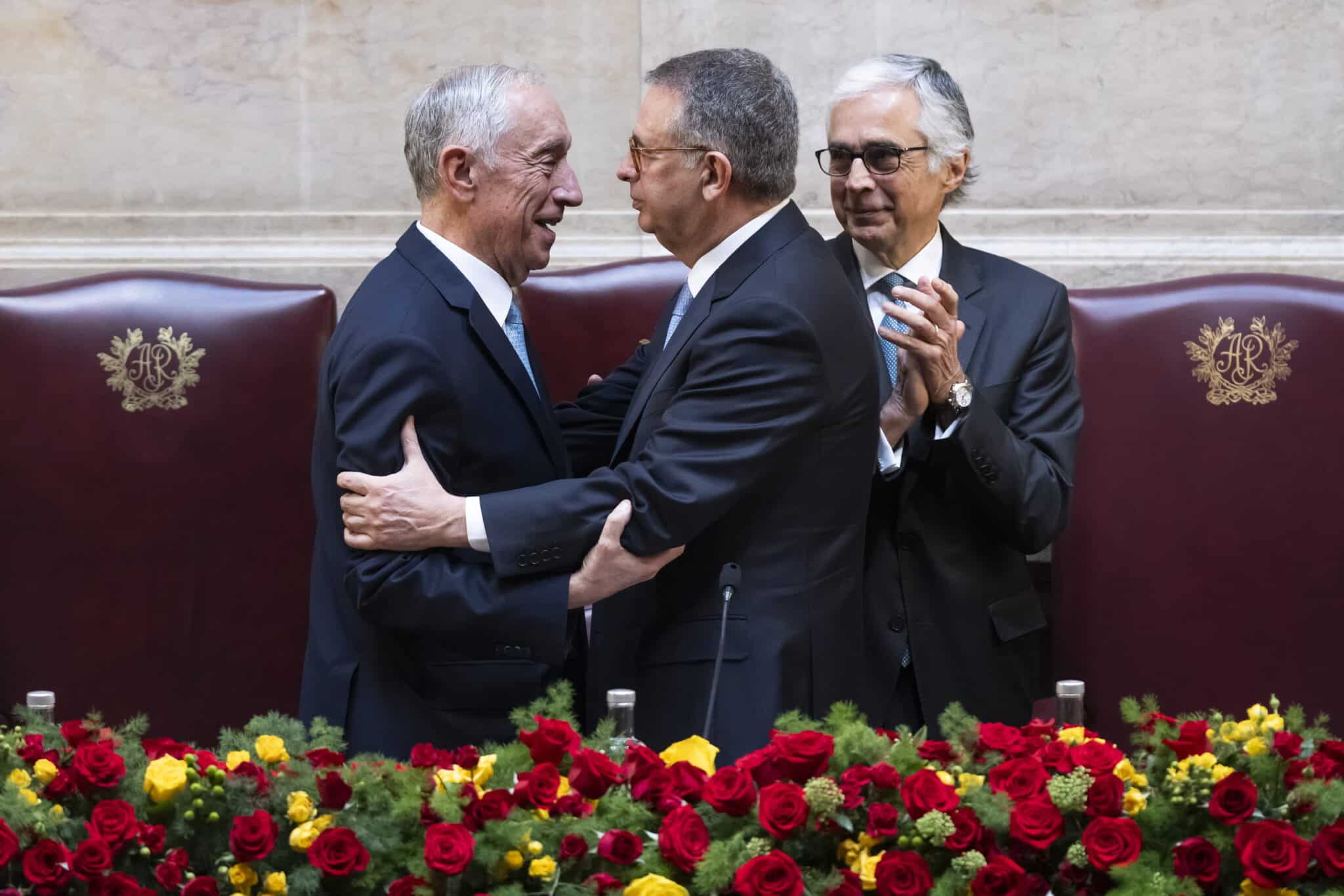
Portugal’s new president, António José Seguro, has given his first speech after being sworn into office this morning – receiving a standing ovation.
It was a speech that included everyone – and underscored this careful man’s desire to ‘be the president of the whole country’ and ‘stem the electoral frenzy’ that has tarnished recent years.
Describing himself as “eternally grateful” for the trust placed in him, President Seguro traced his red lines: he won’t be dissolving parliament if the State Budget is vetoed. “Legislatures are to be completed,” he said. The new cycle ahead of the country of three years before elections is “a golden opportunity” for parties and the government to “find long-lasting solutions to resolve problems that affect the Portuguese.”
And these are very much today problems that have persisted for years (in spite of changing governments): a list “too long and heavy”, led by “low wages, insufficient economic growth, demographic aging and problems in the justice system (…) None of these challenges can be solved with improvisation” or goals geared towards “an electoral calendar of selfish convenience (…) The experience of two-year electoral cycles is not desirable, and I will do everything I can to stop this electoral frenzy (…) to promote dialogue, and encourage agreement between the different party leaders responsible,” he told his audience.
In many ways, it was exactly the speech the country needs at a point where the wider world is careering out of control – and opposition leaders emerging from parliament as the ceremony came to a close showed that they were optimistic.
Mariana Leitão (Iniciativa Liberal) was clearly happy to hear the president refer to a three-year parliamentary legislature – and Rui Tavares (of the more left-leaning LIVRE) also praised what he called the ‘red lines’ over dissolving parliament if the State Budget became an issue.
Other party leaders emerging were all complimentary – intriguingly both centre right PSD and centre left PS Socialists suggesting the new president was speaking very much with them in mind.
On wider matters, President Seguro was like his predecessor in warning how far the world has fallen when it comes to democracy. “The defence of human rights and democratic values requires that we do not give up on multilateralism or on the peaceful resolution of international conflicts“. Bilateral dialogues will continue; Portugal will maintain its alliances and responsibilities. “Europe is a community of values, democracy (…) these values are being tested as never before (…) Portugal must participate in the deepening of European integration,” he stressed.
But this was not the moment to talk too much about matters outside the country. The new president made a point of saying that he wants to “do everything for Portuguese people to have better living conditions (…) access in time to health (…) a pledge that goes beyond government cycles”. And he said he would like this focus to expand to “housing, to swifter justice, to an efficient state, better salaries and salarial equality (…) Stability is not an end in itself. It is a condition for change. Recent history has revealed how much that has been constructed over centuries can be destroyed in very little time (…) One mistake, and in an instant pillars are crumbling.
“Portugal is not immune” to risks which disrupt the democratic system, warned the new man at the top – but stressed that he will never allow the crossing of “red lines that are the existence of our democracy. Caring for democracy has become an urgent task”, to which this particular president “will devote himself by duty and conviction.”
Seguro by name – and ‘seguro‘ (secure) by nature.
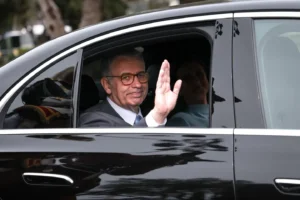
António José Seguro has a packed day ahead of him. He will be visiting the Jerónimos Monastery, Belém Palace, where the gardens are open to the public today, the Higher Institute of Social and Political Sciences (ISCSP) – for a meeting with young people – and Ajuda National Palace, where he will decorate Marcelo Rebelo de Sousa – the man who led the country for the last 10 years, and who is finally today “a normal citizen”, trying very hard to ignore all the press microphones that pursued him as he left parliament after the ceremony.
Source material: Observador/SIC Notícias