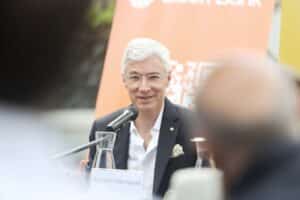
Builders, consultants and designers have expressed surprise at the government’s decision to encourage foreign companies to operate in Portugal in partnership with domestic firms, Carlos Mineiro Aires, executive director of the Construction Foundation (Fundação da Construção), told Lusa.
“I understand that the government is concerned about the capacity of Portuguese companies when it has to make an investment of €50 billion in public works in a relatively short period of time. But the question has been turned on its head,” said the former leader of the Order of Engineers.
“First, the government should have consulted domestic companies,” he said, arguing that they “have the capacity” to build and are “gaining strength” to compete for the major projects the government plans to launch, such as the new Lisbon airport, a third Tagus river crossing, high-speed rail lines, hospitals and housing.
The head of the new Construction Foundation, created in October by three professional associations – economists, architects and engineers – and 14 construction, design and supervision companies, was referring to recent news about contacts between Portuguese ministers and Turkish and Chinese companies to publicise the investments planned for Portugal in the coming years.
In October, a delegation of Turkish construction entrepreneurs travelled to Portugal, with the support of the Secretary of State for Infrastructure and the Portuguese Agency for Investment and Foreign Trade (AICEP), after the Secretary of State himself, Hugo Espírito Santo, and the Minister of Infrastructure, Miguel Pinto Luz, visited Turkey in August.
Recently, during a visit to the Portuguese Association of Designers and Consultants (APPC), Hugo Espírito Santo said, as quoted by the Expresso newspaper, that Portuguese companies should “form partnerships” with international companies, and that the country needs “larger construction companies, capable of taking on these projects, which are projects involving some risk”.
“Portuguese companies have always worked together with foreign companies,” recalled Mineiro Aires, stating that it is desirable that “the leadership of any consortium, of any contract, should always be Portuguese”.
Criticising the government for not considering this possibility, he explained that “foreign companies bring nothing and do not hire Portuguese engineers. They only acquire the bare minimum” to carry out the work.
In addition, “they engage in dumping” and “try to find justifications for revising prices, which translates into increased costs and missed deadlines”.
For the executive director of the Construction Foundation, the biggest problem in the sector “is undoubtedly the lack of labour”.
One of the Foundation’s objectives is precisely to “train specialised labour”.
Recalling that the financial crisis destroyed around 350,000 jobs in construction in Portugal, he pointed to a current shortage of “around 50,000 more or less specialised workers”.
“There is also a shortage of engineers, middle managers and site supervisors, who are of immense value,” he added.
The solution is to “attract workers who emigrated during the crisis” by paying them “sufficiently attractive salaries” and, at the same time, “structuring a migratory flow with the PALOP (Portuguese-language countries in Africa) countries and Brazil”.
“Without prejudice to the use of other nationalities, we have a vast market where our language is spoken and where it is easier to recruit,” argued the former leader, referring to Portuguese Language Countries.
The recent restrictions on the entry of immigrants into Portugal are viewed with concern. “We have gone from 80 to eight, and this, along with hate speech, will discourage people from coming to Portugal.” But “it is unrealistic to think that if we turn off the ‘tap’, the country will continue to grow,” he added.
The Construction Foundation intends to launch a Construction Observatory to provide relevant information on the activity in Portugal, namely on public tenders, awards, prices, deadlines, types of companies, consumption, number of workers, salary levels, among others.
Source: Lusa