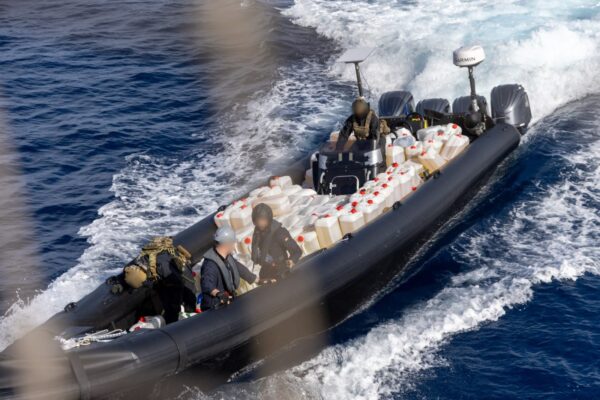
While the north of the country is running ragged chasing wildfires, it is ‘business as usual’ in Lisbon where members of government not in the south on holiday are sending out press releases over matters like… high-speed powerboats.
Lusa reports that “the Portuguese government has proposed to parliament that owners of power boats over four metres in length without a flag or with concealed or falsified identification could be sentenced to between one and four years in prison”.
Spain has already passed legislation on this score in a bid to crack down on the mode of transport favoured by drug traffickers. As a result, authorities here have noticed traffickers increasingly using Portugal as a point of entry, due to the fact that high speed power boats (also known as ‘narco launches’) are not so regulated.
Thus, the changes, approved by the Council of Ministers earlier this month, delivered to parliament yesterday and consulted today by Lusa news agency.
“The law provides for the same criminal penalty of one to four years in prison for ‘anyone who transports, imports or exports’ power boats or ‘enters or leaves Portuguese territory’ in them without authorisation from the Tax and Customs Authority. (None of this applies to the “simple transport of power boats that are already in Portugal and have been duly regularised”, stresses Lusa).
The draft bill also establishes that it will be compulsory to submit projects for the construction or modification of power boats to the Directorate-General for Natural Resources, Safety and Maritime Services.
Anyone who fails to do so will face a penalty of up to two years in prison, as will crew members who carry more fuel in a power boat than is permitted, or use mechanisms such as paint or electronic equipment to prevent vessels from appearing on radar.
Fines for failure to comply with the new rules also face an increase, to a maximum of €25,000 for individuals and up to €100,000 for companies.
The rules are set to apply to boats with a total length of four metres or more and which have a “power unit with three or more engines, the effective power of any of which is equal to or greater than 95 kW (127.4 hp)” or a “power unit with any number of engines”, with a total effective power of at least 130 kW (174.33 hp).
Power boats of at least four metres whose displacement is supported “when at rest or in motion, by a continuously generated air cushion”, or which have a “hull capable of being supported completely above the surface of the water, in gliding mode” by “hydrofoil” structures are also covered by the new rules.
In the draft bill, which aims to get parliamentary approval in the autumn, Luís Montenegro’s executive justifies the need for regulation saying: “new trafficking routes, which include the Portuguese coast, began to be mapped out from the moment Spain generically banned the use of power boats. It is therefore urgent to enact a legal regime that exerts at least the same preventive and sanctioning effect when compared to the Spanish legal regime.”
Source: LUSA