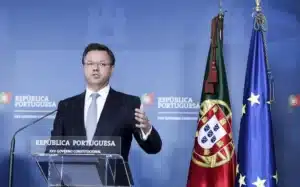
Making the best of it at the close of a conference dubbed “Portugal’s position in a changing global order”, he said that the economy nonetheless is outperforming the eurozone as a whole.
“Our growth has been 2% or more, which is still below the target, the government’s ambition, but it’s still well above the eurozone average,” he said at the close of the conference “Portugal’s position in a changing global order”, held at the Nova School of Business and Economics in Carcavelos, Oeiras.
At the meeting organised by the British newspaper Financial Times, Miranda Sarmento spoke in English, saying “the Portuguese economy has shown enormous resilience and adaptability, especially since the pandemic”.
The finance minister still believes, for example, that the economy ‘would be able to withstand external shocks’, says Lusa.
The country’s Gross Domestic Product (GDP) grew by 1.9% in 2024 – a tad above the 1.8% projected – but in the first half of this year, it slowed, growing 1.7% year-on-year. In the second quarter, this increased to 1.9% year-on-year, which is a far cry from the government’s projections of 2.1%.
The minister cited exports ‘suffering from the international context’, but said that these should continue to increase.
Miranda Sarmento emphasised that “a small, open economy like Portugal’s” is subject to all kinds of threats, particularly “geopolitical shocks”.
“The war in Ukraine continues to generate uncertainty. We are all worried about the escalation of the conflict and the impossibility of a serious war. Secondly, we are confronted with tariffs and trade wars (…) We hope that chapter is now closed and that the uncertainty is over, but tariffs are going to hurt everyone. They are going to hurt consumers and the US economy (and we’re already seeing that), but they’re also going to hurt exporting companies,” he admitted.
Despite this, Miranda Sarmento appears confident in “the goal of reaching more than 50% of GDP in the coming years”.
As a sign of this confidence he stressed how much Portugal is attracting foreign investment. “We’ve managed to attract a Lufthansa Technik factory, a CALB factory – a Chinese battery manufacturer – Volkswagen’s new electric vehicle and also strong investment in data centres, mainly from US companies, but also from European companies,” he said.
In the same context, he mentioned the fact that Novo Banco is being bought by the French group BPCE, “the second largest French bank, the fifth largest European bank”, which he says is “a sign of incredible confidence in the country on the part of investors and the markets”.
Concerning public accounts, the finance minister expects debt to fall to 92% of GDP at the end of this year and to fall back to 88% in 2026 – again remaining “below the eurozone average”.
Forecasts remain in line with those of the Stability Programme presented to parliament on April 15, 2024, which foresaw a reduction in public debt to 91.4% in 2025 and 87.2% in 2026.
The minister reaffirmed that the government hopes to achieve a budget surplus of 0.3% of GDP this year and 0.1% in 2026.
Miranda Sarmento also recalled the intention to move forward with simplifying Portugal’s tax system, “to resolve litigation”, and to reduce personal income tax and corporate income tax.
At the end of the conference, he told journalists seeking further clarifications: “We’ll talk soon”.
Source: LUSA