APREN, Portugal’s renewable energy association, reveals that the Iberian Blackout last April prompted a year ‘marked by a decline in renewable energy incorporation, and an increase in natural gas production‘.
As a result, the slowdown in renewable energy installations has pushed Portugal further away from its climate targets.
According to APREN’s data, the cumulative incorporation of renewables into consumption fell to 68% – below the 86% target set for 2025 and the 93% forecast for 2030 in the National Energy and Climate Plan (PNEC 2030).
This reduction is ‘largely due to increased natural gas production following the April 28 blackout’, says APREN in a statement.
Overall, total electricity production in mainland Portugal reached 48,903 gigawatt-hours in 2025 – 7.2% more than in the previous year – but the share of electricity from renewable sources fell by 4.9 percentage points to 75.6%.
“For the first time since 2022, we are seeing a reduction in renewable incorporation,” says the association, pointing out that between May and August last year, combined cycle production “almost quadrupled” (representing an increase of 391%) compared to the same period in 2024.
With regard to international electricity exchanges, the association notes that there was a reduction in the import balance compared to 2024, with a variation of -11.1%, from 10,442 gigawatt-hours to 9,284 gigawatt-hours – again, a development that was “mainly after the blackout in April”.
As APREN recalls, after the country-wide power outage, there was “a temporary interruption in the use of interconnections with Spain” – which resumed gradually and initially with capacity limitations, contributing to a greater effort in national production.
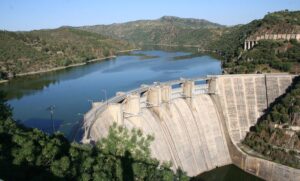
Renewable production was mainly provided by hydroelectric power plants (29.7% of total), wind energy (27.6%), and solar photovoltaic (12.6%), totalling 6,143 gigawatt-hours and an increase of 1.8 percentage points compared to 2024.
Despite this, APREN warns of a sharp slowdown in the installation of new renewable power, noting that, except for solar photovoltaic “other renewable technologies have suffered a very significant slowdown in the installation of new capacity, increasing by only 1.2% from 2023 to 2024, and 0.03% from 2024 to 2025″.
In the case of solar power, between January and November 2025, 893 megawatts were installed – down from 1.34 gigawatts in the same period the year before – although in June this source was, for the first time, the main electricity generation technology, with a 21% share.
For APREN chairman, Pedro Amaral Jorge, “the current pace of growth in the installation of electrical power based on renewable energy sources falls short of what is needed to simultaneously respond to the climatic, socio-economic and competitiveness challenges facing the country’s companies”.
Jorge added that “the energy sector has clear potential to establish itself as one of the main drivers of national development, accounting for between 16% and 18% of GDP in 2035”, but this requires “a strategic vision and consistent decisions“.
The association also notes that the increase in fossil fuel-based electricity production has led to an estimated 36.5% growth in greenhouse gas emissions from the electricity sector, from 1.82 million tonnes of carbon dioxide in 2024 to 2.9 million tonnes in 2025.
Despite the slowdown, APREN stresses that renewable energies will have prevented the emission of 10.8 million tonnes of carbon dioxide equivalent in 2025, and generated savings of €710 million in emission allowances, in addition to reducing fossil fuel imports by €873 million.
The association points to the “persistent inefficiency” of electrical, environmental, and municipal licensing processes as the main obstacles to growth, arguing for the effective transposition of the European renewable energy directive and a “stable and predictable” regulatory framework to accelerate investment.
… and then there is the ‘elephant in the room’: that it was the unreliability of renewable energy output that blew the whole system in the first place – a contention strongly refuted by the European Network of Transmission System Operators for Electricity (ENTSO-E) which conceded at the time that more fact-finding was necessary.
A final report on the full causes for the blackout is expected to be published in the early part of this year – but the Spanish government issued their findings last summer.
Source: LUSA