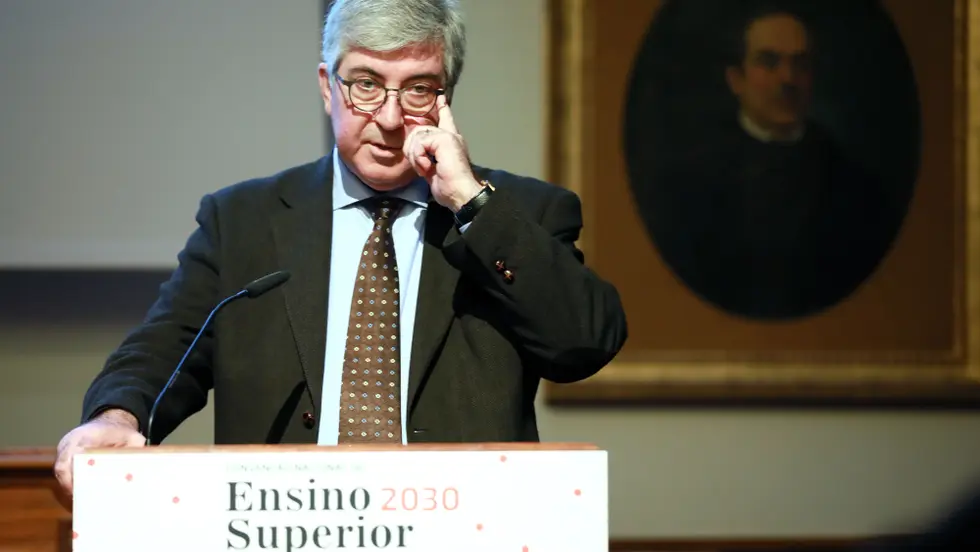
The rector of Portugal’s University of Porto, António Sousa Pereira, currently serving his second and final term, said today that the war in the Middle East is “an opportunity” to rethink Europe and set it back on a path of progress.
“We must view the war not as a threat, but as an opportunity to rethink Europe,” he told Lusa ahead of the University of Porto Day, which takes place next Monday and will be attended by President of the European Council, António Costa.
Mr Costa – a former two-term prime minister of Portugal – will be speaking on “The Future of Europe”, which António Sousa Pereira sees as having reached a crux point.
“We must either rethink and take measures that allow us to be competitive and keep pace with the progress that is occurring at a dizzying speed, or we run the risk of being left behind”, he warns.
In rector Pereira’s view, Europe must make up for “lost time” – and this means taking decisions.
We need to think about the future in a way that is “more focused on the wishes of the people”, because only in this way will Europe be able to move forward, remain competitive and avoid being overtaken by the Eastern bloc, which is developing at a rapid and unprecedented pace, he said.
Europe has already been suffering from “a certain lack of strategic vision”, according to the rector, regarding all developments associated with artificial intelligence and quantum computing.
By way of example, Pereira noted that there is only one factory in the world capable of producing the machines that make the latest-generation chips, located in the Netherlands. There are no other factories in Europe making these chips.
“So, we have the technology; we have everything we need to be at the forefront. But, due to a lack of strategic definition, we have not managed to achieve this,” he emphasised.
According to the rector, the current international crisis is likely to provide the impetus for accepting certain realities that have not been acknowledged until now.
“Europe is very much held hostage by the search for consensus, which is largely artificial,” he said.
Europe will have to accept that it is made up of diverse nations and countries with very different interests – and these very diverse interests will mean that each has very different objectives and expectations regarding what they expect from Europe, he added.
“I think that what has been discussed regarding a multi-speed Europe will be inevitable, and I think it will be inevitable that there will be a single market Europe, a single currency Europe and a common defence Europe,” he concluded.
The ceremony marking the 115th anniversary of the University of Porto will, in addition to speeches by the rector and the president of the European Council, feature the presentation of awards and tributes to students, lecturers, researchers and retired staff.
It comes when a number of entries on social media regarding the conflict in the Middle East urge people to consider that some things will never return to the way they were before the United States and Israel launched their ‘Epic Fury’ military attacks on Iran: the free passage of oil tankers through the Strait of Hormuz, for example: that reality may be over – particularly considering the words of Iran’s parliamentary speaker, Mohammed Bagher Qalibaf, who told Iranian state television today that use of the strait “cannot be as it was before”. This has been interpreted as Iran ‘publicly telling the world: even after this war ends – the rules of the Strait are changing’.
Everything is changing – and thus people like António Sousa Pereira are trying to urge their countries to ‘seize the day’ (and not look back).
Source material: LUSA