Has south got three years of water thanks to welcome winter rain, or just two?
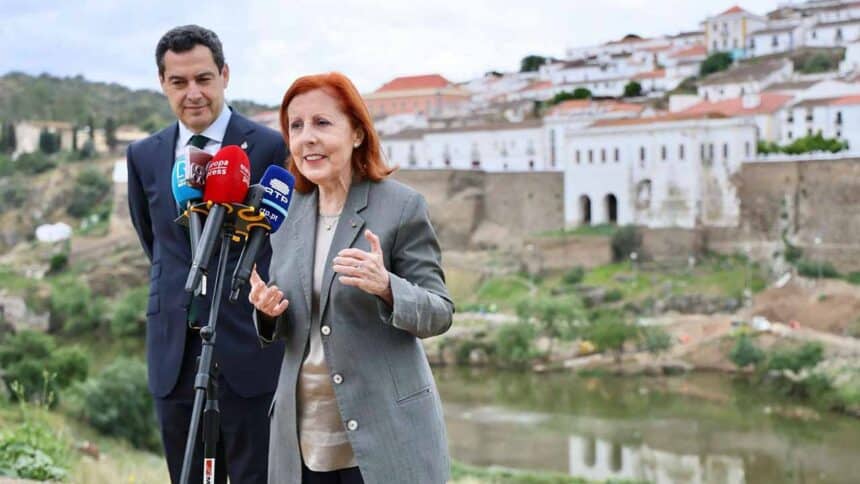
A visit to Mértola by the minister for the environment yesterday has opened a new controversy: suggesting that “more infrastructure” is still needed in the south to cope with water scarcity, Maria da Graça Carvalho said that Portugal’s Alentejo and Algarve regions only have enough water for the next two years, thanks to the “unusually wet winter”. Yet, only a matter of days ago, an official source for Águas do Algarve put reserves in the south as enough for “at least the next three years”.
This is not the first time Maria da Graça Carvalho has said something to ostensibly push a political agenda.
This time, her calculations appeared geared to impress the need to continue with projects to boost water resilience – namely the Pomarão water intake, the desalination plant in Albufeira, and a water ‘highway’ between the west and east Algarve.
The first two projects – both locally contested – were initially part of Portugal’s PRR (Plan for Recovery and Resilience), and as such they were time bound. As a result of these time limits (imposed by Brussels), Maria de Graça Carvalho told Expresso that a government decree was passed to ensure no judicial challenges put up by locals/ local organisations could stop works progressing. But once both projects were removed from the PRR, so too was the effect of the government’s decree – meaning legal challenges cannot be swept to one side.
Now, the minister has said that the Algarve has only two years water stored. Who is telling the truth? And why are we constantly being told that last winter was unusually wet? Talk to anyone who farms in the Algarve, and they will have described last winter as “a typical Portuguese winter, at last!” Rainfall was only ‘unusual’ given the recent long stretch of comparative drought – and again, elderly farming folk will also tell you that “it used to be like this: ten years of good rain, ten years of drought”.
In short, no-one can accurately predict what the weather will be like next winter.
But according to Minister Carvalho, authorities’ mantra is that projects that many do not agree with for environmental reasons, have to be forged ahead with. Indeed, we have to “speed up the works we have underway”, she told reporters at the end of a bilateral meeting of the plenary council of the Euroregion Alentejo – Algarve – Andalusia (EuroAAA).
The meeting at Mértola’s Biological Station was also attended by the president of the government of Andalusia, Juan Manuel Moreno Bonilla. Its stated aim, explains Lusa, was to “deepen dialogue in strategic areas such as water resource management, biodiversity and energy, with a focus on common challenges and opportunities for collaboration to promote sustainable development in the southern region of the Iberian Peninsula.”
Regarding the new Lower Guadiana Strategy, the minister said that this was the result of cooperation between the three EuroAAA regions, in which the River Guadiana – which forms much of the border between the two countries in this region – is a link that unites them and has several dimensions.
“There’s the environmental dimension, biodiversity, the preservation of the river, the naturalisation of the river banks, but there’s also the transport part, making this river more navigable [and] the need to do some work in relation to [its] desilting,” she argued.
The meeting also made it possible to analyse the Euroregion’s 2023/2024 activity report and to mark the passing of the EuroAAA presidency to the Algarve, which is to hold it until 2027.
The presidency of this working community rotates for two-year periods between each of the regions, writes Lusa, making no mention of the various court actions in place challenging the institutional plans for the future management of water in the Algarve.
In Pomarão, Amigos de Pomarão have filed a lawsuit to challenge the Environmental Impact Declaration over the intake strategy, which they say is based on ‘false data’ and will destroy local biodiversity.
In Albufeira, there are three lawsuits pending (even while authorities work behind the scenes on compulsory take-overs of people’s land, and the felling of protected trees): one challenging the Declaration of Public Utility, another the process of ‘improper execution of land expropriation’ and a third calling into question the Environmental Impact Statement (EIS).
In short, all the legal challenges (which Maria de Garça Carvalho has stressed mean little to the government: “We are going to continue with the works, even with these cases in place”, she said in Faro in January) are based on what people see as ‘mis-truths’ – situations where political leaders with clear agendas are not giving the full picture. ND
Sources: LUSA/ Público