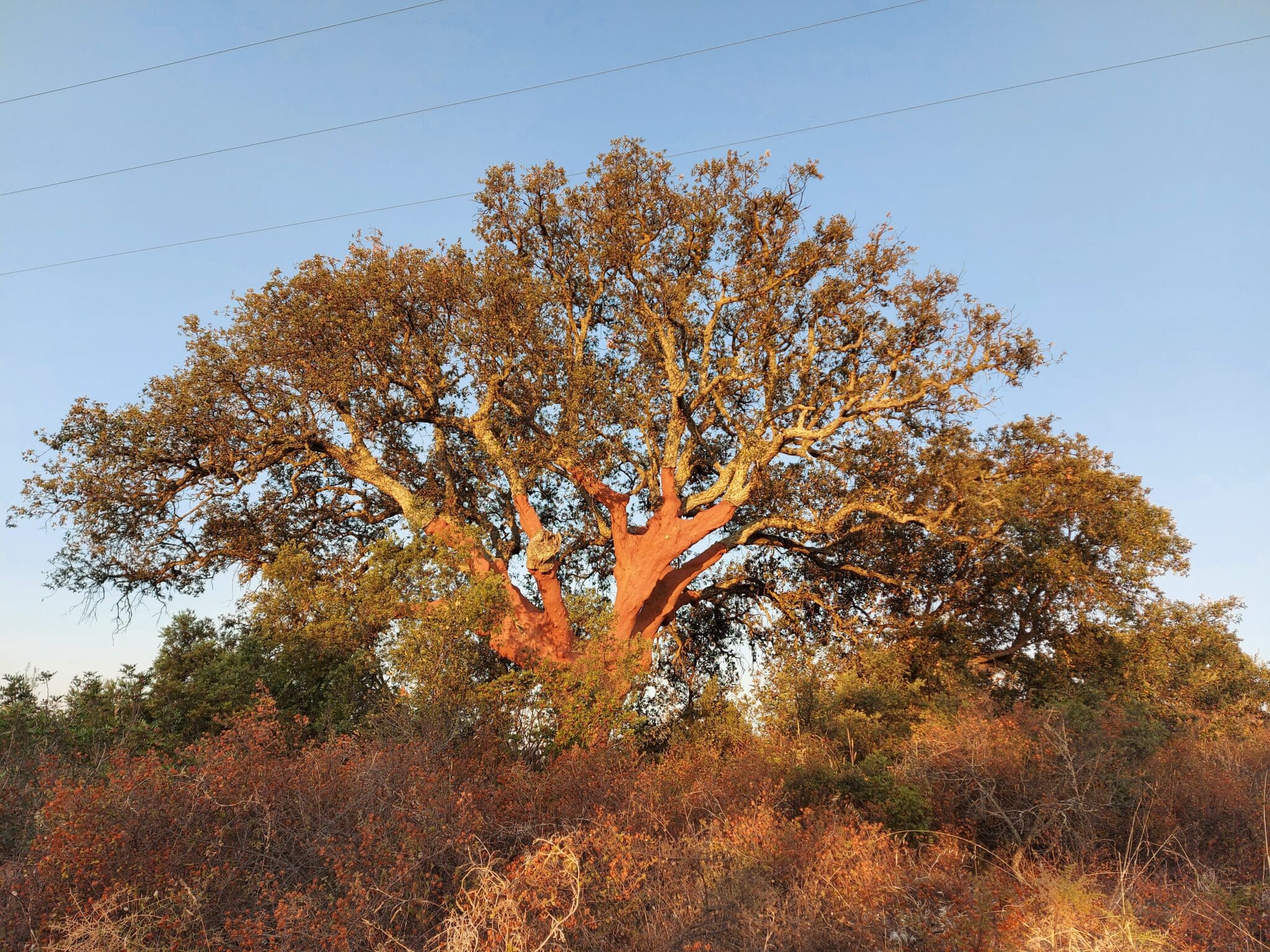
In the space of just two months, Portugal’s centre-right government has authorised the felling of more than 9,000 trees – many of them protected species of cork and holm oaks.
Just in the last week, writes Expresso, the government has given its authorisation for the felling of “another thousand protected trees, the majority being cork oaks, for the development of a pair of energy projects. But in the preceding weeks, it made other decisions in a similar vein. In total, just in two months, declarations of “essential public utility”, have paved the way for the felling of more than 9,000 trees”.
The most recent declaration was last Friday, in state gazette Diário da República. The dispatch was signed a few days earlier between the secretaries of state for the environment and forests – and authorised the company Lestenergia (controlled by the Masdar group from Abu Dhabi) to fell 451 cork oaks (the majority young trees) and 304 holm oaks (again, mostly young trees).
These particular tree fellings are to allow the installation of four wind turbines as part of the Penamacor Wind Park 2. The four turbines will have a total potential of 18 megawatts, elevating the current annual production of the park from its current 23.48 gigawatts to 88.44 gigawatts.
To compensate for these fellings, Lestenergia has pledged to plant trees over almost 12.7 hectares of land. But the reality is that the authorisation came just days after the announcement of others: in Oliveira do Hospital the government has also authorised Sonae Arauco to raze 508 cork oaks (172 of them being mature trees) in order to realise an €8.5 million solar project to power a factory (producing products in wood). Again, Sonae Arauco has had to agree to a tree planting ‘pay back’, over 6.35 hectares.
And in the last weeks of 2025, there were various imilar ‘green lights’ given: 127 cork oaks and 525 holm oaks are to go in Nisa, to make way for the ‘International Bridge over the River Sever’; 75 mature cork oaks are going in Vila Nova da Gaia, to make way for a housing project – and no less than 7,471 cork oaks are to be removed (almost 2,000 of them mature trees) for the €204 million goods railway upgrade, connecting Vendas Novas with the Port of Sines…
This enormous loss of established trees has been justified by the government due to the “relevant public, economic and social interest of the project”.
Yes, all the projects include ‘compensatory plantings’ in different areas – but they represent a real ‘acceleration’ in the pace of tree felling.
Expresso explains that if recent authorisations are totted up, between December 2025 and January 2026, the government green-lighted the felling of 9,464 trees (8,632 of which are cork oaks) when in 2023, the ICNF reported that in the previous six years, the total number of authorisations to remove cork oaks came to only 13,000.
The paper continues: “In November, there were other felling authorisations, involving a national road, a business park, a project for warehouses and a cemetery. But all these were of smaller dimensions than the following two months.”
Cork oaks and holm oaks are protected species and their felling requires authorisation from the ICNF and the government, which must issue a declaration of ‘essential public utility’ for said projects. Compensation must be at least 1.25 times the area affected, i.e. the new area of forestation must be at least 25% larger than the area that has been depleted.
The latest ICNF National Forest Inventory, published in 2019, indicates that in 2015 (the year of the last survey in the country) cork oaks covered 720,000 hectares, with an estimated 51 million trees.
In recent years, the expansion of large-scale projects in Portugal has generated “some controversy due to the felling of these protected trees”, admits Expresso – “even though the number of trees to be cut down is residual compared to the total number of cork oaks and holm oaks in the country”.
The largest felling permits were associated with rail and road infrastructure, as well as dams and large-scale solar power plants, the paper concludes.
Source: Expresso