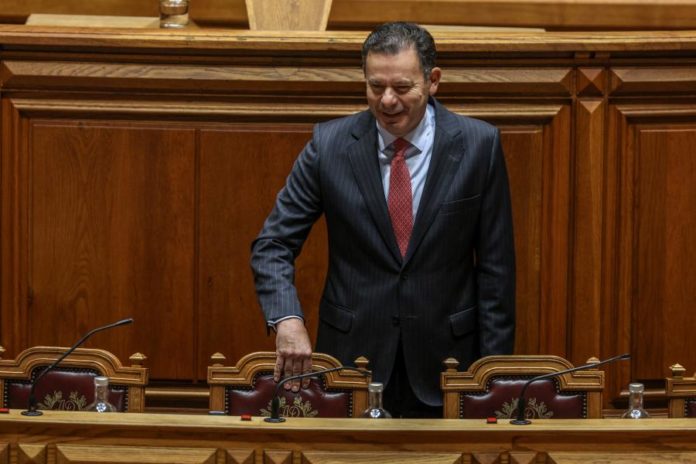
In a phrase that left a great deal to unpack, prime minister Luís Montenegro today welcomed the fact that the State Budget for 2026 had been approved, denying that combined ‘interferences’ from CHEGA and PS Socialists had ‘distorted it’. What the two parties normally at loggerheads with each other achieved was ‘a violation of the principle that the PSD/ CDS-PP government has the decision-making power’, he said.
To be fair, the fact that the parties were able to do what they did, suggests the government does not have decision-making power. It certainly didn’t have the power to stop CHEGA and the PS adding another €100 million to their spending for next year.
Speaking to journalists at the end of the debate, this is what Mr Montenegro estimates as the financial impact of measures approved in parliament ‘against the government’s will’ (these were measures to abolish tolls on certain motorways and not increase costs for university education).
“I would say that, overall, the budget is not distorted – but from the point of view of the functioning of the political and democratic system, unfortunately, and regrettably, the two largest opposition parties did not resist the temptation to invade the decision-making sphere that belongs to the government,” he said.
“This arbitrary way in which some parties and some MPs choose to manage the budgetary process every year, auctioning off proposals “à la carte”, does not seem to me to be a mature way of approaching the budgetary process,” the PM added, particularly criticising parliament’s rejection of the proposal ‘to update university education fees in line with the inflation rate’, as this boiled down to the equivalent of one extra euro per month, he said, and would have been a contribution towards “strengthening social action”.
Regarding tolls, the prime minister said that he has long advocated that there should be “coherent management of the entire mobility system”, reconciling its financial sustainability with environmental policy and the projection of new investments, in light of “concessions that are coming to an end and those that may be launched.
“Attending an annual auction in which MPs decide to exempt tolls here and there, forcing all Portuguese people to pay the cost of that decision, is not good public policy; it is invading the sphere of decision-making that the Portuguese people wanted to endorse the forces that lead the government,” he returned again to his opinion that the government, and only the government, should be in the driving seat.
As for the budget as a whole, the PM suggested that it allows his government to face 2026 “with optimism”, considering it “a demanding year from a budgetary point of view, but full of opportunities”.
“Portugal today has a stable financial situation, a very promising economic situation and a stable political situation (sic). It therefore has all the ingredients for economic growth and to attract more investment,” he told reporters.
“It is a budget of confidence, confidence in Portugal, confidence in attracting more investment and also in complying with the public investment plan we have before us, with a major financial effort, within the scope of the Plan for Recovery and Resilience.”
The draft State Budget Law for 2026 was approved today in a final overall vote with votes in favour from the two parties that support the AD (Democratic Alliance) government, PSD and CDS-PP, the abstention of the PS, and votes against from all other parties (CHEGA, Iniciativa Liberal, LIVRE, PCP, BE, PAN and JPP).
Source: LUSA