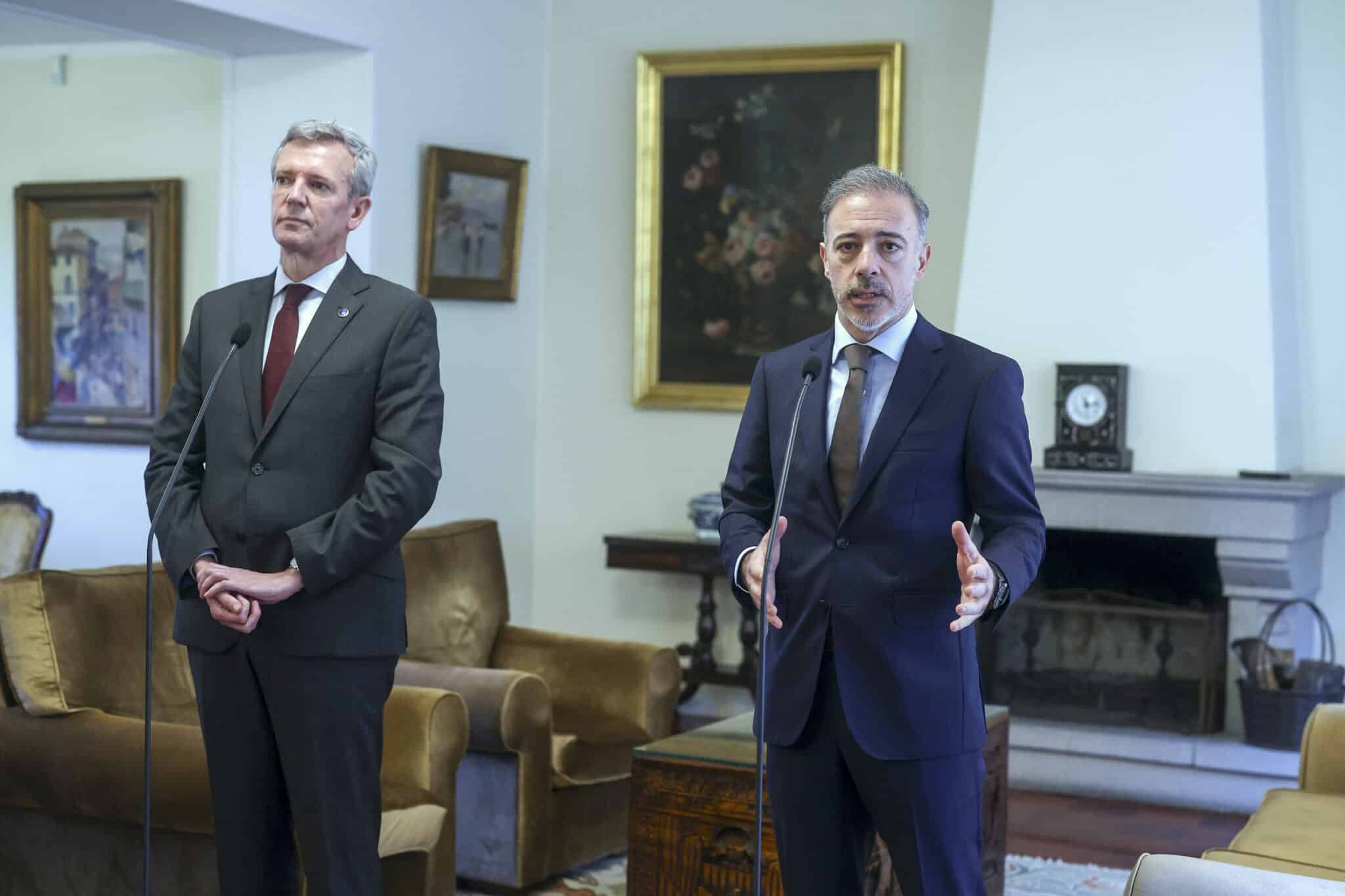
The Mayor of Porto, Pedro Duarte, and the President of the Regional Government of Galicia, Alfonso Rueda, have called for the completion of the high-speed rail link between Porto and Vigo by 2032, irrespective of relevance given to the Lisbon-Madrid connection. The two leaders met in Porto last Wednesday to reinforce their shared commitment to the project.
Duarte reaffirmed that the Portuguese government has pledged to complete the Porto-Vigo rail line by 2032, with no reason to doubt this deadline. “We are working with the clear timetable set by the government,” Duarte said. “We have no reason to believe it will not be completed on time.”
Rueda stressed the need for Spain to fulfil its part of the project. He highlighted that the remaining section of the high-speed rail, connecting Vigo to the Portuguese border, is around 60 kilometres long. “Now, it is up to the Spanish government to act,” Rueda stated. “We must ensure that any delays in Portugal are not used as an excuse to delay progress in Spain.”
Both leaders emphasised that the two rail lines are not in competition. Duarte explained that the Portuguese government’s approved timetable aims to complete both the Porto-Lisbon and Porto-Vigo lines by 2032, with the Lisbon-Madrid link following in 2034. “For Porto, the connection to Vigo is at least as important as the Lisbon link, if not more so,” Duarte said. He added that the Porto-Vigo line could open up broader and more significant economic opportunities for the region.
Rueda echoed this view, arguing that the Lisbon-Madrid route should not hinder the Porto-Vigo project. “Galicia will also benefit from this commitment to connect Portugal,” he noted.
However, Rueda raised concerns about the environmental approval process for the Porto-Vigo link, which is still pending and expected by the end of 2025. He praised Portugal’s progress on the project, acknowledging that the process in Spain is more costly and complex. “Political pressure” from Galicia is aimed at urging Spain to act and avoid using delays in Portugal as an excuse for inaction.
On the current rail service between Porto and Vigo, operated by Celta on the Minho Line, Rueda noted that the rolling stock is outdated and subpar. “This needs to improve,” he said. “Demanding high-speed rail doesn’t mean we stop advocating for improvements to the existing service.”
The Porto-Lisbon high-speed line, with stops in Gaia, Aveiro, Coimbra, and Leiria, is also set to be operational by 2032. Similarly, the Porto-Vigo line, which will include stations at Porto Airport, Braga, Ponte de Lima, and Valença, is expected to be completed by the same year.
Source: Lusa