Portugal’s government is already anticipating the economic rollercoaster coming down the line of spiking oil prices as a result of the war now raging between the United States, Israel and Iran.
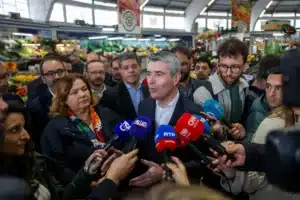
Admitting today that the increase in the price of oil (this far only relatively marginal) is “not good news”, economy minister Manuel Castro Almeida “assured that the government will, if necessary, take appropriate measures to keep the economy functioning”.
“It is clear that the increase in the price of oil is not good news,” he said – adding the caveat that “Portugal is now much better able to withstand increases in the price of oil than in the past.”
Speaking on the sidelines of a meeting in Faro of the Regional Council of the Coordination and Development Commission (CCDR) of the Algarve, the minister of the economy and territorial cohesion recalled that 70% of the electricity consumed in Portugal comes from renewable sources and, therefore, the country is “less dependent on oil (than in the past), which is a competitive advantage”.
The government “will always be vigilant”, he stressed. Its “obligation is to be vigilant in order to take appropriate measures at each moment to ensure that the economy functions, that people have decent living conditions, and that public finances remain balanced.”
Brent crude oil prices rose today following the U.S. and Israeli attacks on Iran, and the worrying repercussions throughout the Middle East.
The suspension of traffic in the Strait of Hormuz – which separates Iran to the north from the Emirates and Oman to the south, just 30 kms away – will also have an impact on oil prices, which could exceed $100 per barrel, albeit analysts believe the effects depend on the duration of the closure, and whether the conflict spreads.
“We have significant reserves that I hope will last beyond the announced timeframe and the duration of this war. At this moment, there is nothing to fear in this regard,” said Castro Almeida, dismissing the possibility, for the time being, of a budget revision now that the country is dealing with the fallout not only of bad weather that has caused billions of euros in damages, and an unpredictable war certain to further increase fuel prices.
“At this moment it is too early to take a position” on whether or not there will have to be a budget revision. “If it is necessary, it will be done (…) At this moment there are no indicators that allow us to make a decision now, but it will be reassessed later and we will see later whether or not it is necessary,” the minister added.
Today also the European Commission has said that it has no “immediate concerns” regarding the security of energy supplies to the European Union (EU) – despite the impact of the conflict on the Strait of Hormuz, through which 20% of the world’s oil passes.
It is now a question of whether armed conflict gives way to renewed attempts at diplomacy – or how long it takes for the United States and Israel to consider they have achieved their goals.
Source: LUSA