Tensions are rising between the government and trade unions after Portugal’s Confederation of Workers (CGTP) announced a general strike for December 11, a move soon to be ratified by the General Union of Workers (UGT), potentially marking the first joint nationwide strike since the austerity-era protests over a decade ago.
The strike, announced on Saturday by CGTP leader Tiago Oliveira at the end of a national march in Lisbon, targets what he called “one of the biggest attacks ever made on workers” – in other words, the government’s new proposed labour reform package, “Trabalho XXI”. Oliveira denounced the “over 100 changes” proposed by the executive, which he said would “tilt power toward employers”.
Prime Minister Luís Montenegro quickly dismissed the strike as “incomprehensible” and politically motivated.
“Frankly, I can’t see any reason for this decision except to serve the interests of PCP (Communist Party) and PS (Socialist Party),” Montenegro said, accusing both parties of trying to reassert their presence through their respective union links – PCP with CGTP and PS with UGT.
Montenegro argued that the strike is “extemporaneous and even anachronistic,” since no legislation has yet been approved by the Council of Ministers.
“No one can understand it, and in my opinion, it doesn’t look good for the trade union movement,” he said. “When the reality of the country is not the reality of the unions, something is wrong, and it’s not the country.”
The prime minister also insisted there is “no objective reason that could justify a general strike.”
“The government has done everything to avoid all strikes,” he said, recalling that Portugal “was, among the 38 OECD countries, the one where people’s incomes rose the most in 2024.”
Montenegro maintained that the government remains open to talks.
“We are in the middle of negotiations. The proposal hasn’t even been approved in the Council of Ministers, nor sent to Parliament,” he insisted.
President Marcelo Rebelo de Sousa also commented, calling for restraint and patience, noting that discussions are still at an early stage.
The head of state recalled that the government’s proposal will “probably only be discussed in Parliament at the end of this year or next year.”
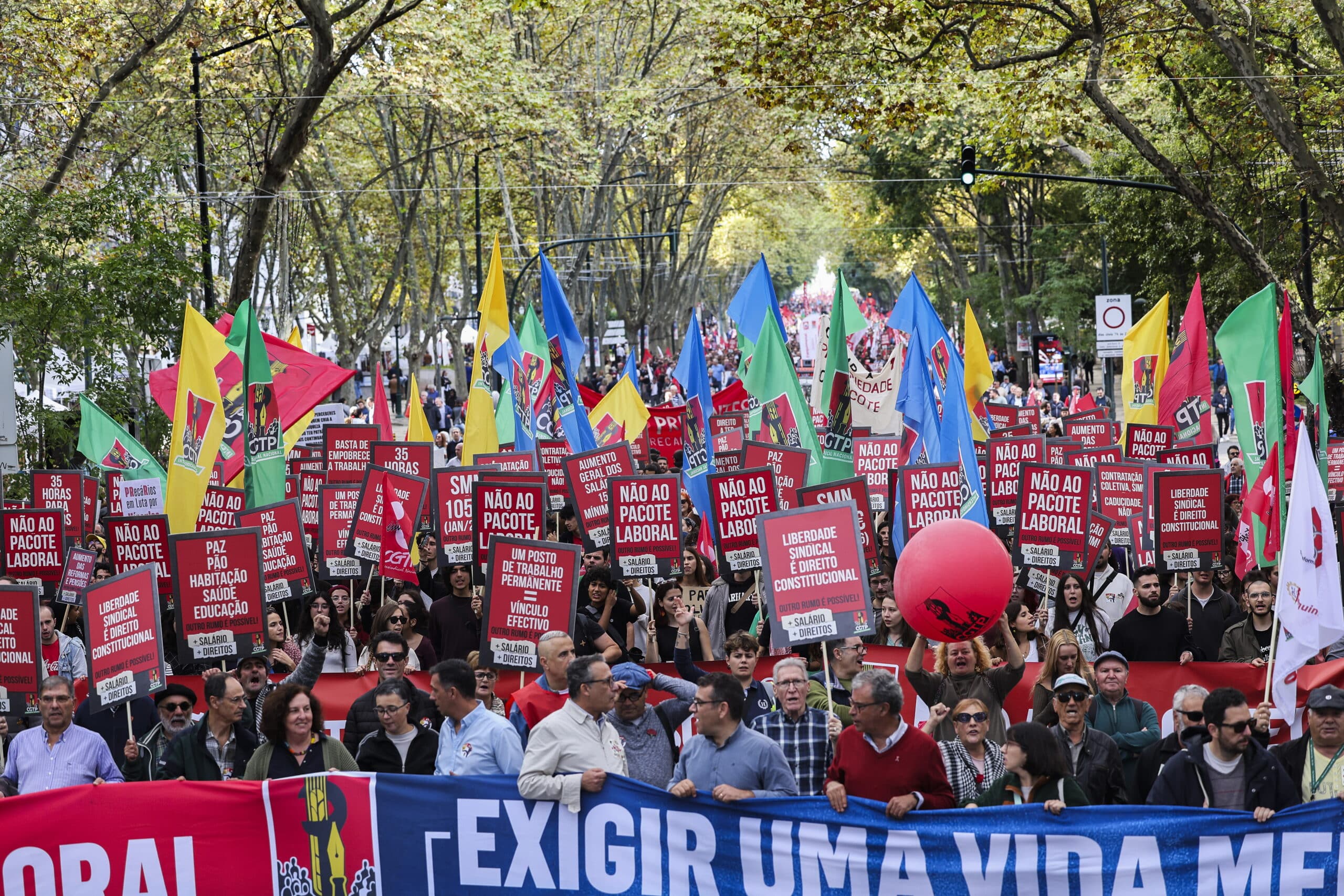
Saturday’s march organised by CGTP brought thousands of workers to Lisbon’s Avenida da Liberdade, protesting against the labour reform package announced by the government in July.
The reforms cover areas such as parental leave, flexible work arrangements, professional training, and trial periods for new contracts, while also expanding the sectors required to provide minimum services during strikes.