Slowly, slowly countries appreciate importance of two-state solution
With so much pressure now on countries to agree on the importance of a two state solution to secure the future of the Palestinian people, Portugal has at last said that it “may recognise the State of Palestine” at the United Nations General Assembly in September.
French president Macron powered this new impetus to fully recognise Palestine; his efforts have seen the UK also agree, yes, with conditions, it too will do so (as have already a number of other European countries, including Spain, Norway, Ireland, Romania, Bulgaria, Sweden, Slovenia – not to mention vast swathes of the rest of the world). And now 15 heads of diplomacy meeting in New York yesterday have signed a joint statement to say ‘so will they’.
Among signatories was Portugal’s foreign affairs minister Paulo Rangel, who only recently appeared to suggest President Macron’s stand ‘didn’t change a thing’.
It has: in a joint statement signed by the various foreign ministers, countries that have not yet done so are urged to “establish normal relations with Israel and to express their willingness to begin discussions on the regional integration of the State of Israel”.
The signatories also affirmed their determination to “work on an architecture for the ‘day after’ in Gaza that ensures the reconstruction of Gaza, the disarmament of Hamas and its exclusion from Palestinian governance”.
Condemning the “heinous anti-Semitic terrorist attack of October 7, 2023” perpetrated by Palestinian Islamist movement Hamas on Israeli territory, the so-called ‘New York declaration’ demands “an immediate ceasefire, the immediate and unconditional release of all Hamas hostages, including remains of any dead, as well as the guarantee of unimpeded humanitarian access” into Gaza.
The statement expresses “deep concern over the high number of civilian casualties and the humanitarian situation in Gaza”, underlining the “essential role” of the United Nations and its agencies in “facilitating humanitarian assistance.”
For months, Israel has restricted humanitarian aid from entering Gaza. Food deliveries by a private organisation supported by the Israelis and the Americans have been marked by dozens of deaths (a purported 1,000-plus) at the hands of Israeli forces.
The UN and other organisations have denounced the resulting famine in Gaza, which has generated a growing global outrage over Israel’s policies and practices. (Israel has sought to deny the wealth of independent testimony and images emerging from Gaza about what has been happening.)
The 15 countries also reiterate their “unwavering commitment to the vision of a two-state solution, in which two democratic states, Israel and Palestine, live side by side in peace within secure and recognised borders, under international law and relevant UN resolutions”. And they stress the “importance of unifying the Gaza Strip with the West Bank under the Palestinian Authority”.
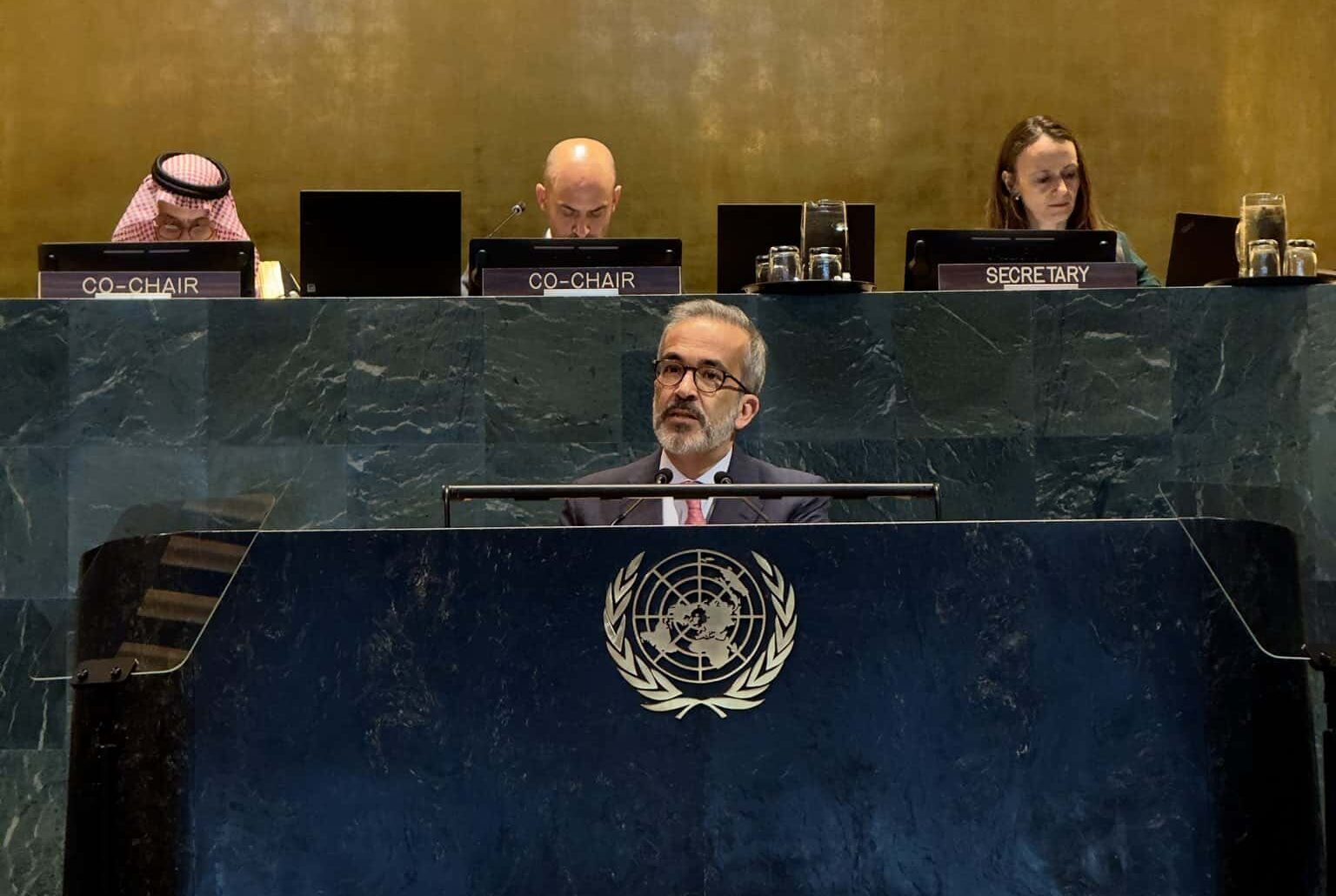
Speaking at the two-day conference convened by France and Saudi Arabia, Minister Paulo Rangel highlighted some of the commitments made by the Palestinian Authority in June, which he considered “a new step towards the realisation of the two-state solution”. (The Palestinian authority called for the release of hostages; the disarmament of Hamas; it committed to carry out school reform and call elections within a year – as well as accepting the principle of a demilitarised Palestinian state.)
For the head of Portuguese diplomacy, the Palestinian Authority’s statement, combined with “a new position of so many states in the region regarding Israel and its right to exist”, marks “a turning point”.
Israel, and its close ally the United States, have not viewed yesterday’s developments favourably. But as the map of countries recognising Palestine’s right to exist as a state shows, they are now very much in the minority.
Source material: LUSA