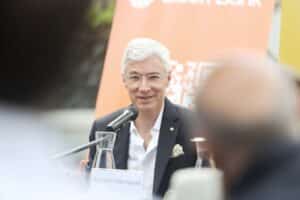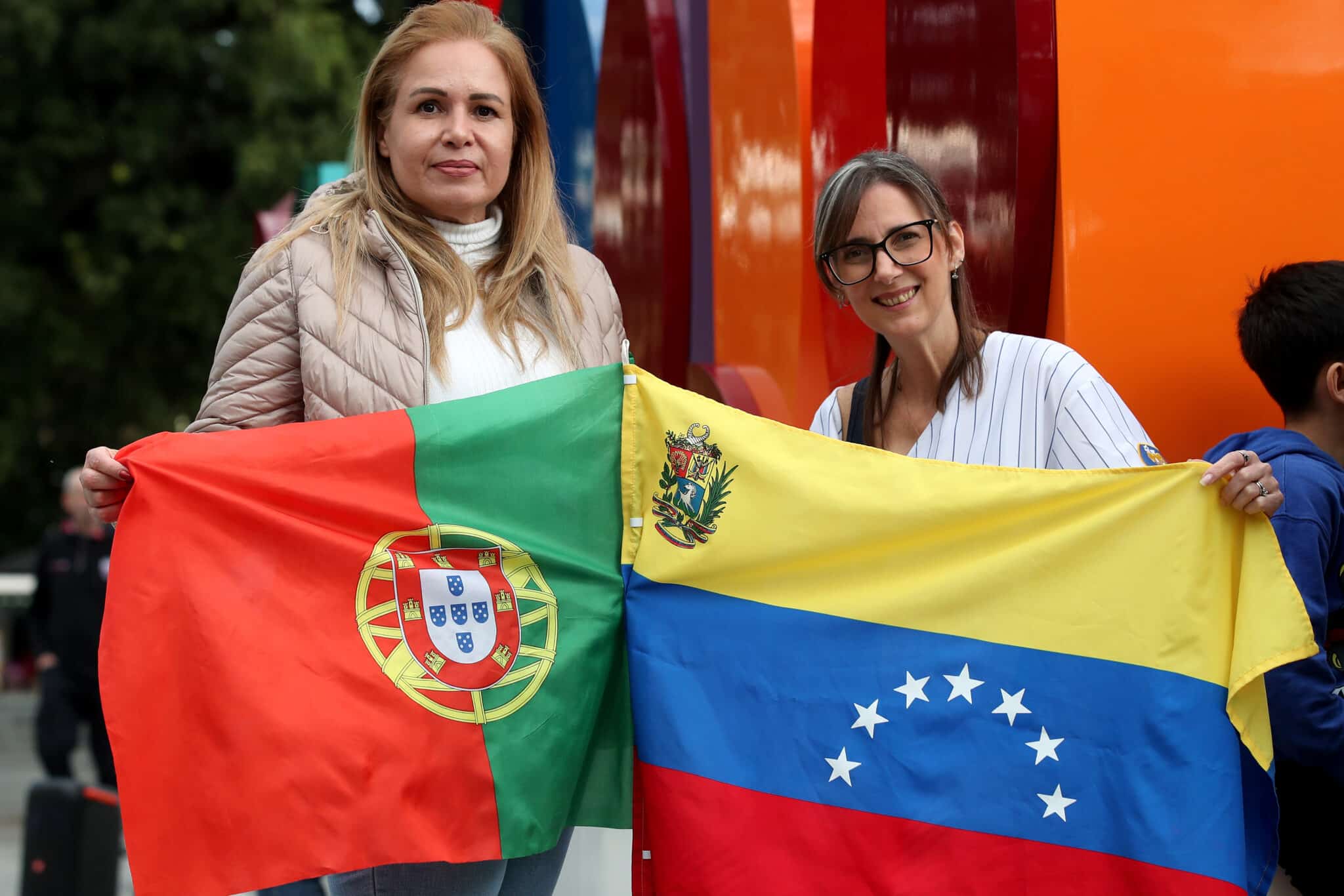
Two days after the extraordinary US attack on Venezuela, and exfiltration of its president and first lady to answer criminal charges in the United States, Portugal’s minister of foreign affairs, Paulo Rangel, said that he has received “reassuring news” from the Portuguese community living in the South American nation.
He told journalists on Monday: “We continue to have reassuring news about the situation of the Portuguese community (…) some of the businesses run by Portuguese nationals are already opening and operating, which is a good sign.”
Venezuela is home to a Portuguese community of roughly 500,000 people. Some are Venezuelans of Portuguese descent, others Portuguese citizens. Their lives have not been easy for many years, Rangel stresses – recalling that “the Portuguese community lost a lot under the governments of (Hugo) Chávez and Maduro, (…) so much so that many were forced to return.”
The majority of Portuguese making their lives in Venezuela hail from Madeira whose governor Miguel Albuquerque has already said that he will travel to the country “in the coming months” if needed.
Government channels have been monitoring events in the country since the US assault and understand that, in cities outside Caracas, life is going on ‘almost as normal’, albeit there is “some fear, some apprehension”, and a distinct lack of information on the ground.
Miguel Albuquerque told reporters on Sunday: “At this moment, there is still no defined exercise of power” and this, in itself, brings its own risks of a possible ‘polarisation of society’.
“There must now be a change, and no one knows how it will be done: whether negotiation is necessary, or whether there will be further military intervention.”
And another two days on, and still no-one really knows what is happening, what the Americans intend (beyond ‘running the country’ and exploiting its oil) or how Venezuela will be returned to the democracy that people have been clamouring for for the best part of three decades.
Portugal’s approach is ‘sit tight, look after the Portuguese community as much as possible’ given that commercial flights in and out of the country are still suspended.
In some ways, Portugal’s reading on the US attack has been controversial: while reiterating the importance of respect for international law and the United Nations Charter, Paulo Rangel stressed early on the boon of the ‘fall of Maduro’.
“Many consider this intervention, carried out in these terms regardless of the intentions – which are benign – to be inconsistent with international law, but given the illegitimacy of Nicolás Maduro and a narco-state elite, some believe there may be some degree of legitimacy involved,” he told reporters in Lisbon.
“We must draw conclusions that will enable us to create a democratic process that will bring greater well-being to the whole of Venezuela and to the Portuguese people living there,” he added, suggesting the presidency should (eventually) be handed to Edmundo González Urrutia (the candidate in the last presidential elections who won the overwhelming number of votes) – but clearly this cannot happen in the short-term.
Rangel stressed that he hopes countries like Portugal, Spain and Italy, which all have significant communities in Venezuela, will have “important influence” in “creating conditions so that, as soon as possible, a democratic solution, endorsed by Venezuelans, can become the governing solution.”
The minister also expressed concern for current political prisoners in Venezuela (believed to number around 1,000 and include at least five Portuguese-Venezuelans).
By quirk of coincidence, President Marcelo Rebelo de Sousa has called a Council of State for this Friday (January 9) – originally to discuss the situation in Ukraine. Now it will certainly be used to discuss Portugal’s position on what is going on in Venezuela (where the ‘regime’ is still very much in place, in spite of United States’ President Donald Trump suggesting he is ‘in charge’).
Meantime, the government’s statements this far have created ‘outrage’ within the left-wing, members of which have already led a protest in Lisbon.
PCP communists and Bloco de Esquerda (BE) particularly criticise the government for ‘seeking to legitimise something that is illegal’ – and being ‘subservient to criminal actions’.
Alexandre Abreu, for BE, said that, “unfortunately”, both Europe and Portugal have shown “total complacency, lukewarmness, true cowardice, an inability to speak with a little more coherence and backbone regarding these gross violations of international law.”
“It is an imperialist aggression that does not even seek to disguise its motives. Donald Trump has already been explicit about the goal of appropriating natural resources. Venezuela has the largest oil reserves in the world and, ultimately, that is the only thing motivating this aggression.”
And then there is the uncertainty over America’s intentions regarding Cuba, Colombia, even Greenland…
For Portugal, this is the moment to do what this country has always done best: sit quietly and wait and see. There really doesn’t appear to be a better option.
As for the ‘presidential candidates’, this is what some have said over the events of the weekend:
Luís Marques Mendes (PSD/CDS-PP): “There is no doubt that there has been a violation of international law”, but there is equally “no point in being hypocritical”.
Mr Marques Mendes admits to being “a little disappointed” with Donald Trump, “who seems more interested in oil than in democracy” (…) the United States cannot replace Venezuela’s sovereignty.”
João Cotrim de Figueiredo (Iniciativa Liberal): “What seems most important to me at this stage (…) is to say that there is, in fact, a gross violation of international law to depose a dictator that the international community has failed to depose through normal diplomatic and political means – so there is a responsibility on the part of the international community.”
Henrique Gouveia e Melo (independent): “No country can control another (…) We have to wait, we have to be patient, we must not rush into anything. The United States is our ally. We are European and Atlantic. (…) And, therefore, we have to be careful, we also have to show some sense of statehood.”
Catarina Martins (Bloco de Esquerda), who has described the Portuguese government’s position as “shameful”: “This is not about defending or not defending Nicolás Maduro’s regime, it is about issues of international law.”
Jorge Pinto (LIVRE) defends that the Portuguese people deserve a government that is “categorical in condemning all invasions”: “It seems to me, from what has been said by government representatives, that this condemnation was not complete, perhaps even non-existent, and I think the Portuguese people deserved more.”
António Filipe (PCP) labels Paulo Rangel’s position on a new Venezuelan government as “intolerably arrogant”: “I think it is shameful for our country that the Portuguese government has not uttered a word of condemnation in the face of such a brutal and gross violation of international law.”
André Ventura (CHEGA) welcomed the US action, saying he wants to see an “end with dictators in the whole world”.
António José Seguro (PS): “I want to affirm with total clarity that what happened in Venezuela was a clear violation of International Law and the United Nations Charter. It is also clear that this action of President Trump had nothing to do with the love of freedom or defence of democracy.” Seguro’s overriding concern, he stressed, was with the Portuguese people and Portuguese descendants who live in Venezuela – which puts him in line with the concerns of the Portuguese government.