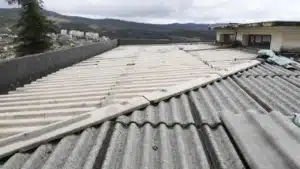
Twenty years since the European Union outlawed asbestos in buildings – due to the fact that it is responsible for 75% of professional cancers – and Portugal’s schoolchildren are still being exposed to the potentially deadly building material on a daily basis.
At the end of 2025, there are still 1,404 state buildings with asbestos within them – almost 400 of them belonging to the Ministry of Education.
According to SIC, where asbestos removal has been done as the country tries to conform to European standards “it has not complied with European law for the protection of workers”.
There was a time when headlines screamed about the dangers of asbestos, and how schools containing it needed to be given urgent attention. But over the years, the sense of urgency has diminished. This could easily have something to do with the fact that it takes decades for the damages caused by asbestos to become obvious – and by the time this happens, it is invariably too late.
Today, SIC remarks that of the scores of buildings owned by the state in line for asbestos removal work, 1404 are still waiting: 226 of them are schools.
Teaching federation Fenprof has already lodged two complaints with the European Commission over the government’s failure to comply with EU law over asbestos removal (in 2014 and 2019): the country is not only taking too long, when it does effect removal works, these go ahead “without the necessary protection to workers”.
SOS Amianto – the Portuguese Association for Protection against Asbestos – has also warned of Portugal’s non-compliance with the European Directive that obliges countries to reduce the limits of exposure of workers to asbestos, warning that without this compliance further dangers will persist.
But this far the European Commission has simply “reminded countries that exposure to asbestos is responsible for 75% of professional cancers in the European Union”.
In other words, for all the laws, directives and deadlines, people in Portugal are not being adequately protected against exposure to asbestos. Jornal de Notícias for example carries a photograph today showing asbestos cladding around water pipes plainly exposed and in poor condition in a classroom. This suggests asbestos particles will be in the air/ will have been in the air for some time and will already be within the lungs of pupils/ teachers and cleaning staff.
As explained earlier, it can take decades for asbestos to cause disease within the body – and by the time it does that disease cannot be reversed.
A note issued by the commission last week read: “The Commission urges Member States to take measures to ensure that workers diagnosed with colon, rectal or stomach cancer can receive compensation when a link to asbestos exposure at work is proven.” But SOS Amianto has warned that even in its ‘diagnostic work’ Portugal lags behind, often transmitting a false sense of security to those whose health is being put at risk.
“Portugal seems to prefer the risk of European sanctions and heavy fines to the urgent need to protect the lives of those who deal with this carcinogen on a daily basis,” said the association said in a recent press release, dubbing the legislative silence, “a disrespect for workers and asbestos victims, who remain invisible to the Portuguese State”.
Source: SIC Notícias/ Público