Brussels meantimes has rather different view of government’s projections
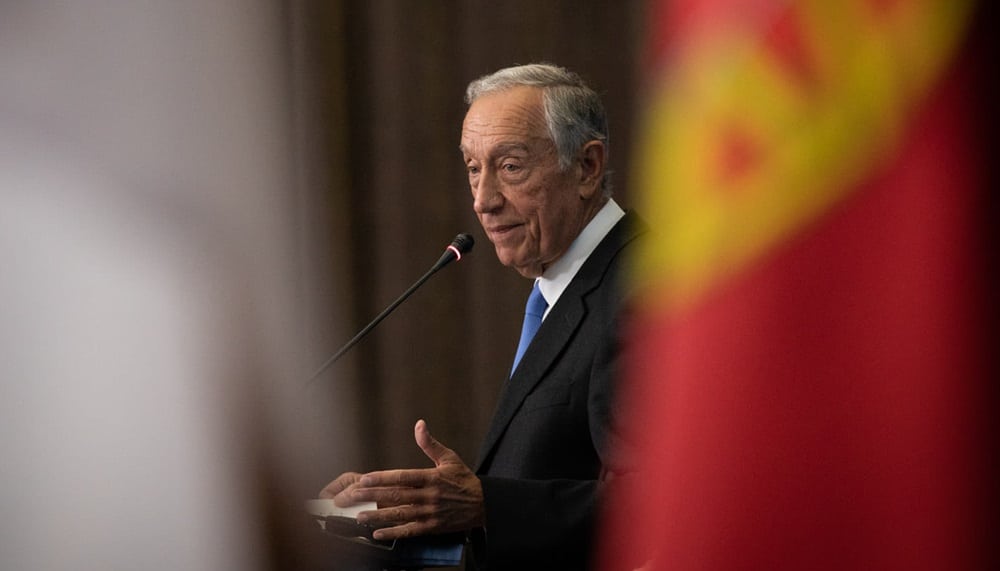
President Marcelo will begin hearing Portugal’s new-look political parties tomorrow, with hearings starting with the PSD at 11am, and going in descending order of votes polled in the snap elections on Sunday.
Brussels meantime has given the government little time to catch its breath, releasing its economic forecasts today, very much reducing its own November forecasts and being considerably more pessimistic than estimates included in the State Budget for 2025.
As Lusa explains, in the State Budget “In OE2025, Luís Montenegro’s government pointed to a surplus of 0.3% of GDP, and AD included a balance of 0.1% of GDP for 2026 in its electoral programme.
“However, Brussels is more pessimistic and points to a reduction in the general government balance to 0.1% of GDP in 2025.
“Current expenditure is expected to continue to grow after fiscal policy measures that increase civil service salaries and pensions,” says the document, adding that public investment is expected to increase significantly in 2025.
A slowdown in public revenue growth is also expected, with “direct tax policy measures, such as the extension of the personal income tax regime for young people, likely to weigh on tax revenues”, while social contributions are expected to remain resilient, “driven by sustained economic activity and rising household disposable income”.
Brussels expects Portugal’s fiscal stance to “remain expansionary in 2026, based on a no-policy-change assumption”. It therefore forecasts that the general government balance will turn into a deficit of 0.6% of GDP next year.
This forecast reflects the impact of fiscal policy measures, such as the reduction in the corporate income tax rate and public investment financed by loans from the Plan for Recovery and Resilience (PRR), explains the European Commission.
Risks to this budgetary scenario are mainly related to requests for financial rebalancing of public-private partnerships and financial vulnerabilities in the state-owned enterprise sector.
It should be remembered that the Bank of Portugal also forecast that Portugal could return to a deficit situation in 2025, with a deficit of 0.1% of GDP, while the Public Finance Council estimates a zero balance this year and a deficit of 1% of GDP in 2026.
Up till now, the government’s stance has been to deny any possibility of a deficit.
Regarding public debt, Brussels expects Portugal to continue reducing the ratio, after it stands at 94.9% of GDP in 2024, almost 3.0 percentage points below 2023.
The ratio is expected to reach 91.7% in 2025 and 89.7% in 2026, “driven by primary surpluses and favourable differentials between growth and interest rates,” Brussels notes.
This forecast also differs from that of the government, by being more optimistic: the 2025 State Budget estimated public debt at 93.3% of GDP this year.
As for the hearings tomorrow of the principal political parties, the president is giving them a great deal of time: the PS meeting is not scheduled until four hours after the PSD’s (clearly giving Marcelo time for lunch as well), while CHEGA’s is scheduled for 5pm-
The hearings of the remaining seven parties that obtained parliamentary representation yesterday – IL, Livre, PCP, CDS-PP, BE, PAN and, for the first time, the Madeiran party JPP – have not yet been announced.
Under Article 187(1) of the Constitution, the prime minister is appointed by the president after consulting the parties represented in parliament and considering the election results.
Eleven days ago, President Marcelo said he wanted to appoint a government with the certainty that its programme would be viable in parliament, which he considered “the fundamental issue”.
“The president is at liberty to appoint a government with the certainty that the government will not be rejected immediately. He is not at liberty to appoint it without that certainty,” he told journalists.
The Constitution establishes that the Government Programme is submitted to parliament “within a maximum of ten days after its appointment” and any parliamentary group may “propose the rejection of the programme or the government may request the approval of a vote of confidence”.
A year ago, following the early legislative elections on 10 March, the president heard the parties and coalitions over nine days, starting with the PAN and ending with the AD coalition (at the time made up of PSD/CDS-PPand PPM).
Source material: LUSA