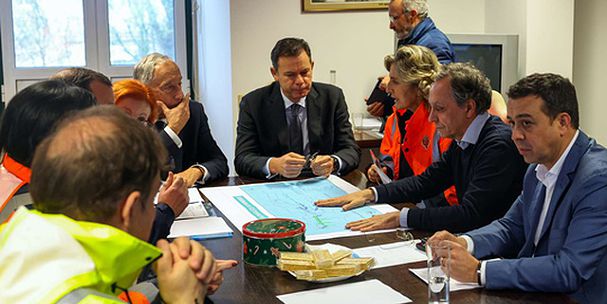
Prime minister Luís Montenegro travelled to Coimbra today, on the first day in his dual capacity as minister in charge of internal administration.
He stressed after a meeting at the headquarters of environment agency APA: “I want to say that no-one will be forgotten. No one will be left behind. We are leveraging all the capabilities we have on the ground, from the parishes and local areas to Central Administration, so that we can, firstly, be there at this time – which is the peak time when people need help – but also to prepare for the day after.”
“We know that we are at a level of very intense demand on people and families. There are people who are faced with the fact that they cannot access their homes, they cannot carry on with their lives/ take their children to school/ go to work or look after other members of their family.”
The PM acknowledged that ‘some still do not have power’ (today’s miserable tally is down to 39,000 homes still without power, some who have not had electric light or water for over two weeks).
He said he wanted to express “great confidence in those who are on the ground leading all operations aimed at safeguarding people’s lives and property, namely the municipal and parish councilors. If there is a time when we can also conclude that our administrative organisation needs this network, which the parishes add to the territory, it is now,” he admitted.
In the prime minister’s view, all state entities, security forces and services, particularly the PSP and the GNR police, “have done an outstanding job of contacting the population, explaining preventive measures that need to be taken, raising awareness and then helping people, particularly to leave their homes.”
“Entities in the social and health sectors are all on high alert to ensure nothing is lacking in the management of a situation that is, in some ways, never 100% predictable, because things happen at a very rapid pace,” he added.
It may not have been a message of ‘great hope’ – but it was a message, nonetheless: which is more than people have been getting up until now from the (former) Minister of Interior Administration.
President Marcelo, accompanying the prime minister and various others on this visit, added that everything is being done to protect communities from the possibility of a major dyke collapse.
“We are on the limit,” he admitted: everything depends on the rain – the more that falls, the less chance of averting disaster.
“Tomorrow will be a little better, the next day worse…” he warned – explaining that the situation changes incredibly rapidly. “We were there discussing the situation, and while we were discussing it, the level of tension escalated: we were at a certain point, and it rose within an hour.”
Locals who remember the dyke bursting back in heavy rains of 2001 are naturally full of apprehension – dreading a return to the awful consequences that some say were never truly eradicated from homes and buildings.
The next 48-hours will be ‘crucial’. We all need to pray for the communities under threat.
As President Marcelo admitted, there has been so much damage in so many areas that it will take years to fix. Mayors who only recently took office will necessarily see all their priorities have to change, he said: they will need to work out their mandates just getting municipalities back to where they were before it started raining so endlessly.
Source material: LUSA/ SIC