Portugal and Spain will develop public warning systems for cross-border areas to address risk scenarios such as floods and dam failures, the two governments have announced today.
The “implementation of public warning systems” is one of the points in a memorandum of understanding “on civil protection and emergencies” signed by Portugal’s new minister for internal affairs, Luís Neves, and Spain’s minister for internal affairs, Fernando Grande-Marlaska, at the end of the 36th Iberian Summit, which took place in Huelva, southern Spain, close to the Portuguese border.
“Public warning systems are an essential tool in improving preparedness for risks. In this context, the development of cross-border public warning projects in the context of rapidly developing risks, such as floods and dam failures, is particularly important,” the document reads.
The memorandum also provides for “cross-border risk assessment and emergency planning” by the two countries, which emphasises that they “share various risks in their territory, such as seismic risk, tsunamis, forest fires, dam failures, and floods.”
“The assessment of cross-border risks, based on common methodologies, will contribute to improving the level of preparedness, reflected in the creation and/ or revision of emergency planning instruments,” say the two countries in the document.
Both have agreed to share “good practices in the field of risk education and public information” and to promote “coordination between the National Platforms for Disaster Risk Reduction in Portugal and Spain” – two policy coordination bodies chaired by Portugal’s minister for internal affairs, which “aim at medium- and long-term strategic objectives.”
Portugal and Spain said that coordination between the platforms will contribute “to strengthening the preventive and preparedness pillar, particularly in the case of shared risks.”
In the preamble to the agreement, the neighbouring countries highlight the “excellent collaboration” that already exists between them in terms of civil protection, stressing that “climate change is contributing to an increase in the frequency and impact of natural disasters”- making it desirable to “strengthen bilateral cooperation, particularly in border regions, with a view to reinforcing prevention, preparedness, and response actions.”
This agreement is one of ten legal instruments signed today at the 36th Luso-Spanish Summit, along with two action plans covering areas such as the environment, civil protection, health, cybersecurity, social inclusion, and consumer protection.
The 36th Luso-Spanish Summit, which took place after months of major fires and storms across the Iberian Peninsula, was dedicated to the impacts of climate change in Portugal and Spain and featured the theme “alliance for climate security”.
Alongside the joint final declaration of the two governments that usually comes out of Luso-Spanish summits, this year, there was a joint declaration by the two environment ministries dedicated to the “climate emergency.”
In the document, the two governments “reaffirm their willingness to deepen enhanced Iberian cooperation on climate action, understood as a strategic pillar for common resilience and sustainable development.”
In this context, “Iberian cooperation” will include areas such as “the exchange of experiences and good practices in mitigation, adaptation, and just transition” and “coordination on policies, plans, and programmes that streamline the response to the risks of climate change in terms of water management, nature conservation and restoration, forest fire prevention, and civil protection in the face of extreme events.”
The two governments also intend to “jointly promote the development of hydrological plans in shared basins, coordinate assessment and response systems in the event of drought and scarcity, collaborate in flood risk planning and management, promoting, among other aspects, real-time hydrological information exchange systems, and strengthen the protection of water status and quality.”
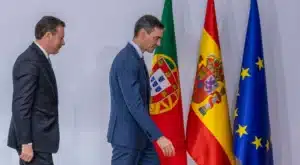
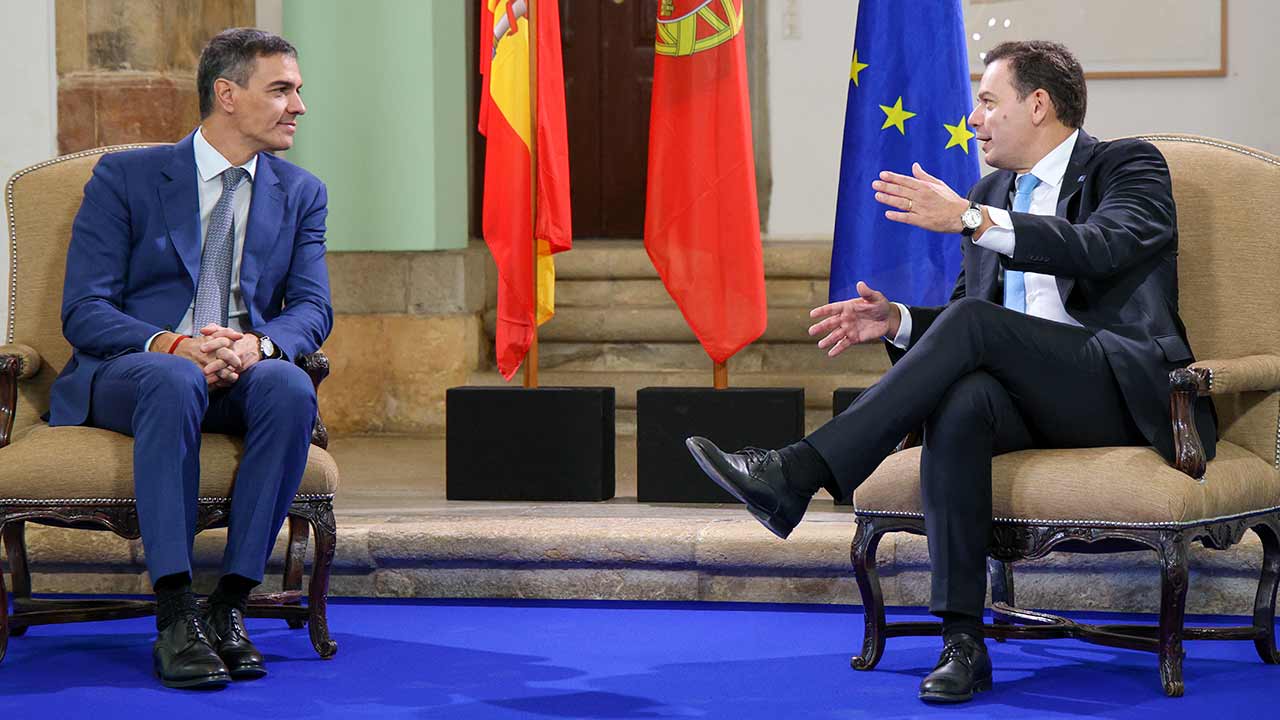
This was a moment for the two prime ministers – Pedro Sánchez and Luís Montenegro – to discuss how the peninsula can become better prepared for climate changes. º
In all, 18 ministers – seven Portuguese and 11 Spanish – took part in today’s summit.
Source: LUSA