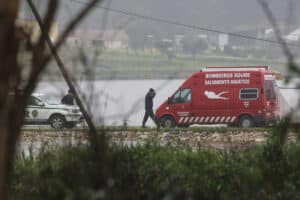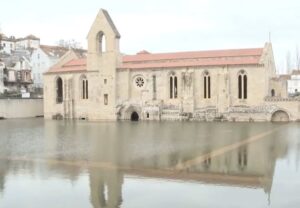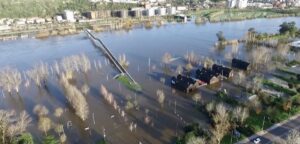
One of the ‘surprises’ of the last few weeks of persistent rain was the ‘flooding’ of Alcochete Shooting Range, the site chosen (after 50 years of dithering) for Lisbon’s long-awaited ‘new airport’. And with this, the ‘news’ that to build the airport – that will consequently work out more expensive than the original €6.1 billion estimate – water courses will need to be diverted.
SIC Notícias has brought this little-publicised detail in the context that the government has “defined the location of the runways for the future terminal”.
Limits have been put on future construction in the immediate area, and in nearby municipalities “to ensure that alterations do not compromise the project or make it (even) more expensive”, says the station.
The story was presented as essentially inclined towards aspects like the location of the runways – which will now be ‘more to the right’ of the site, into the parishes of Santo Estevão and Canha, effectively running parallel with the EN 10 national road and the A13 motorway.
Expert Jorge Paulino told SIC that in moving the airport “further to the west”, its “characteristics” would be “much more favourable (…) not only in hydrogeological terms, but also in geotechnical terms, as well as in terms of protecting the aquifers and water lines that are involved there.”
It then emerges that “beneath the Alcochete Shooting Range lies one of the largest freshwater reserves in the Iberian Peninsula. Several experts admit that the airport could contaminate the water and endanger the region’s water resources”.
Bizarrely, this inconvenient detail was not mentioned in the various ‘presentations’ given by this government, and the last Socialist administration, to highlight Alcochete’s ‘great advantages’ as the site for the airport to assure the country’s/ capital’s future growth and general importance.
Now that the site has been doubly-confirmed, the risks appear to be being mentioned ‘almost in passing’.
“It is clear that anything that occupies the surface of all these areas that function as a storage reserve, that large water table down there that contains good reserves of fresh water, will ultimately have an impact,” Jorge Paulino, professor at IST (the Instituto Superior Técnico) admits. “But when you build something, it always affects something…” This last quote coming at the very end of SIC’s story.
Earlier on in the article, Paulino suggests that “in engineering terms, not political terms, we can build the airport wherever we want. If we want to build the airport on top of the Sintra hills, we can do it; if we want to build the airport in the middle of the Tejo River, we can do it. In terms of engineering, there are solutions for that,” he said..
But certainly, as a result of the flooding earlier this month, decisions have been taken to try and minimise impact. “It will be necessary to divert the water to allow the construction of the airport, for this reason it will also be more expensive,” writes SIC (not referring to the €6.1 billion price tag given in earlier announcements).
A quick consultation on ‘other opinions’ freely available online, it is clear that a number of people fear the Alcochete decision is yet another instance of authorities failing to take Nature into account.
An environmental impact study has been commissioned and will “take a year to be done”, SIC concludes.
Source material: SIC Notícias