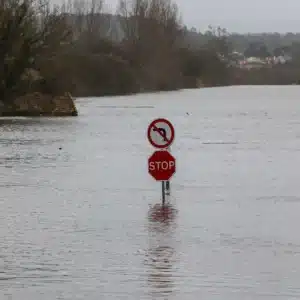
Coimbra is braced for a ‘hundred year flood’ which would inundate the Baixa district, reaching its peak at around 3pm tomorrow.
Mayor Ana Abrunhosa has explained authorities will only get ‘confirmation of the flood’ early tomorrow morning. That will give them the window they need to effect evacuations.
“It is raining a lot in the regions that channel water to the Aguieira dam. The flow of the Ceira river is increasing and at the ‘bridge-dam’ in Coimbra the red line is 2,000 (cubic metres per second),” the mayor told a press conference this evening.
“There is the probability that we will reach 2,500 to 3,000 (cubic metres per second), and when we reach those values, we will have water that starts to recede and spread”, hitting the urban area of the municipality.
The last few days have already seen the municipality oversee the evacuation of around 3,500 people – including residents of three old people’s homes – from the rural areas of the municipality.
Tonight, they will be ‘preventively evacuating’ all those who are bedridden, and any rough-sleepers, from the various areas potentially at risk.
“We will transport them to places that are right for them – other elderly care homes, or continuous care units,” said the mayor, who has been working on contingency plans for the city since the heavy rains began at the end of January.
All Coimbra’s schools will remain shut tomorrow – and Ana Abrunhosa admits there is “a great probability” that teams (made up of parish council personnel and other authorities) will start asking people to leave their homes between 8am and 9am.
As she explained, by this time, confirmation of the size of the impending flood will have come.
Areas under threat are the Torres de Mondego riverside, Ceira, Conraria, Portela do Mondego, Quinta da Portela, Rossio de Santa Clara, Baixa de Coimbra and riverside areas of Coselhas, Eiras, Fornos, Covões and Casais.
The Santa Clara bridges and the Complementary Route 2 (IC2) viaduct may have to be closed to traffic if the flow rate at the bridge dam becomes too high, as this will jeopardise its safety (in the same way that yesterday’s dyke burst caused the A1 motorway to suffer a partial collapse).
This scenario could also lead to flooding at the Coimbra-B and Casa do Sal railway stations and on National Road 111, said the mayor – urging people to take special care with cars in car parks and garages.
Consistently saying that everyone should remain calm, the mayor stressed the obvious: no-one should be making any unnecessary journeys tomorrow. People should “follow authorities’ advice”. Businesses should have staff on ‘remote working from home’, if possible. “We will keep updating: Civil Protection will send out messages to mobile phones, and we will modify those messages and the restrictions in place as the situation develops (…) We are acting as a precaution, because up till now we have had zero victims, and our objective is to continue like that and only have material damages.”
Concerning the dyke rupture on the Mondego, the mayor explained that “there are fragile parts” and “the probability of (further) breaches is high”. But these would come in areas that are already flooded; where the population has already been evacuated. “Montemor-o-Velho and Soure will be greatly affected,” she admitted.
The mayor – who is already emerging from this crisis as something of a ‘heroine’ – announced a new evacuation zone covering areas of São Martinho de Árvore, Quimbres (São Silvestre) and São João do Campo, with the São Silvestre School already prepared to receive people who may have to be evacuated from the north-western part of the municipality, near the border with Montemor-o-Velho.
Source material: Expresso