ISCTE report concludes government “contributed to diffusion of disinformation”
At a point where Portugal’s centre-right government needs ‘all the help it can get’ on the election trail, a new report released by investigators of the ISCTE MediaLab has added to criticisms already voiced over its handling of communication to the population during the energy blackout last month.
According to the report, the “absence of efficient institutional communication” contributed to speculation and the diffusion of disinformation regarding the causes of the roughly 12-hour outage.
Compiled by ISCTE in conjunction with the national elections commission, the bottom line is that the government created “an information vacuum exploited by viral content” the impact of which was “amplified by media errors”.
The report also highlighted contradictions between statements by members of government – namely Minister for the Presidency António Leitão Amaro, and Minister for Territorial Cohesion Castro Almeida – which reflected “different initial responses within the scope of government communication and in a very short space of time”.
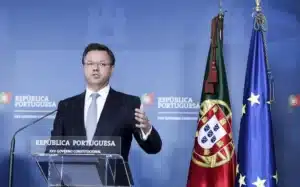
Leitão Amaro was the first minister to speak out, announcing the creation of a working group to resolve the situation – as well as insisting that the source of the problem was outside Portugal.
Shortly afterwards, Castro Almeida said on RTP3 that there was a possibility that a cyberattack was at the root of the blackout. He also mentioned that the phenomenon was “affecting other countries”.
ISCTE’s researchers interpreted Leitão Amaro’s statement as “a posture of restraint and communicational prudence”, in an attempt to avoid ‘speculation as to the origin of the incident’, while Castro Almeida’s introduced “an unconfirmed hypothesis of a Europe-wide cyber attack”, which contributed to the “amplification of uncertainties and fuelled speculative interpretations into the public and media space”.
On April 28, 25 media reports were published on statements made by Castro Almedia, as opposed to only 18 on the statements made by Leitão Amaro.
Over Facebook, the news hypothesising over a cyber attack got three times more interactions than the news saying that the government was monitoring the case and the source was outside Portugal.
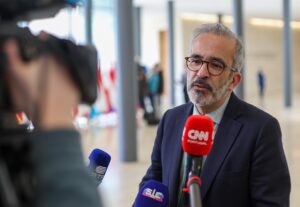
The MediaLab/CNE mini-report ‘Disinformation about the blackout on social networks and impact on the campaign’ analyses the period between April 28 and May 4 was drawn up by researchers Gustavo Cardoso, José Moreno, Inês Narciso and Paulo Couraceiro.
Meantime, on the election trail, insults continue to fly, with PS secretary general Pedro Nuno Santos still focused on the prime minister’s family firm, Spinumviva. It is a line of attack that commentators have stressed may have mixed results, as ‘typical voters’ do truly appear to have ‘moved on’ since the Spinumviva brouhaha. ND
Source material: LUSA/ SIC Notícias