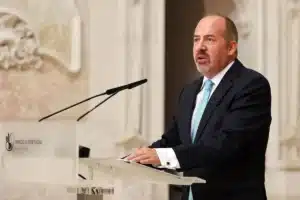
Centeno’s successor as Governor of Bank of Portugal to be announced next week
Central Bank governor Mário Centeno has been tipped to be leaving his post next week in less than ideal circumstances: a law he created in 2020, in his capacity as finance minister of the then ruling PS Socialist party, has been deemed unconstitutional – and requires the state to repay the country’s banks €200 million.
In times when costs of hundreds of millions/ billions of euros are frequently bandied about, this may not sound particularly dramtic – but it is just one of the ‘less than ideal’ situations that the country’s centre-right government has had to deal with under Centeno’s watch, which, when all is said and done, was one of the crassest examples of ‘revolving doors’ in recent political history.
Mário Centeno went straight from being the country’s finance minister (and head of the Eurogroup), to governor of the country’s central bank, the Bank of Portugal. It was always a dubious move in terms of optics. According to Expresso’s Ricardo Costa – half-brother of former Socialist prime minister António responsible for the appointment – “Mário Centeno should never have gone directly from Minister of Finance to the Bank of Portugal. This cloud has never ceased hovering over his head”.
Centeno’s frequent criticisms/ warnings over government policies since then (and since the centre-right won legislative elections) have not helped.
This latest blow (to state coffers), however, really takes the biscuit.
The Solidarity Supplement (full name: Additional Solidarity on the Banking Sector – ASSB) was created as a temporary contribution during the Covid-19 pandemic, with the aim of reinforcing Social Security funding and compensating for the VAT exemption on financial services.
Right from the start, banks contested the ASSB, which quickly went from being a temporary contribution to a permanent one.
Now, five years on, the Constitutional Court has ruled that banks had very good reason to complain. The supplement violated the principles of prohibition of fiscal retroactivity, tax equality and the ability to pay.
As a result, the state will have to return €200 million to the various banks, including compensatory interest at the legal rate of 4%, reports DV.
The Constitutional Court came to its decision in a series of rulings. With regard to ‘violation of the principle of the prohibition of fiscal retroactivity’, this was due to the fact that the law was considered retroactive, given that it applied to tax events that had already taken place before the law came into force.
As for violation of the principles of tax equality and the ability to pay, the court considered that the justification of the tax as compensation for a VAT exemption was arbitrary and incoherent, given that the tax base – bank liabilities – did not adequately reflect the banks’ ability to pay.
As a result of these decisions, the AT Tax Authority “will have to stop collecting the ASSB, annul pending assessments and respect the court’s decision in all legal proceedings”, says DV.
With the coalition AD government known for some time to be intent on replacing Mário Centeno, this now appears to be imminent.
Prime minister Luís Montenegro told journalists in Funchal (Madeira) today that he will be naming Mr Centeno’s successor on Thursday or Friday.
“We’ll make a decision on Thursday and then we’ll announce it to the country,” he said, listing briefly “and with few details” (in the words of Diário de Notícias) what the choice will be based on. “It has to be an independent person”, he said.
Seven words that seemed to say everything (see story to come).
The naming of a successor however may not mean that he/ she walks straight into the Bank, ready to take over. DN suggests Mário Centeno could remain at his post until “at least September”, meaning he will still be representing the country at the next two meetings of the European Central Bank.
Source material: Dinheiro Vivo/ Diário de Notícias/ Expresso