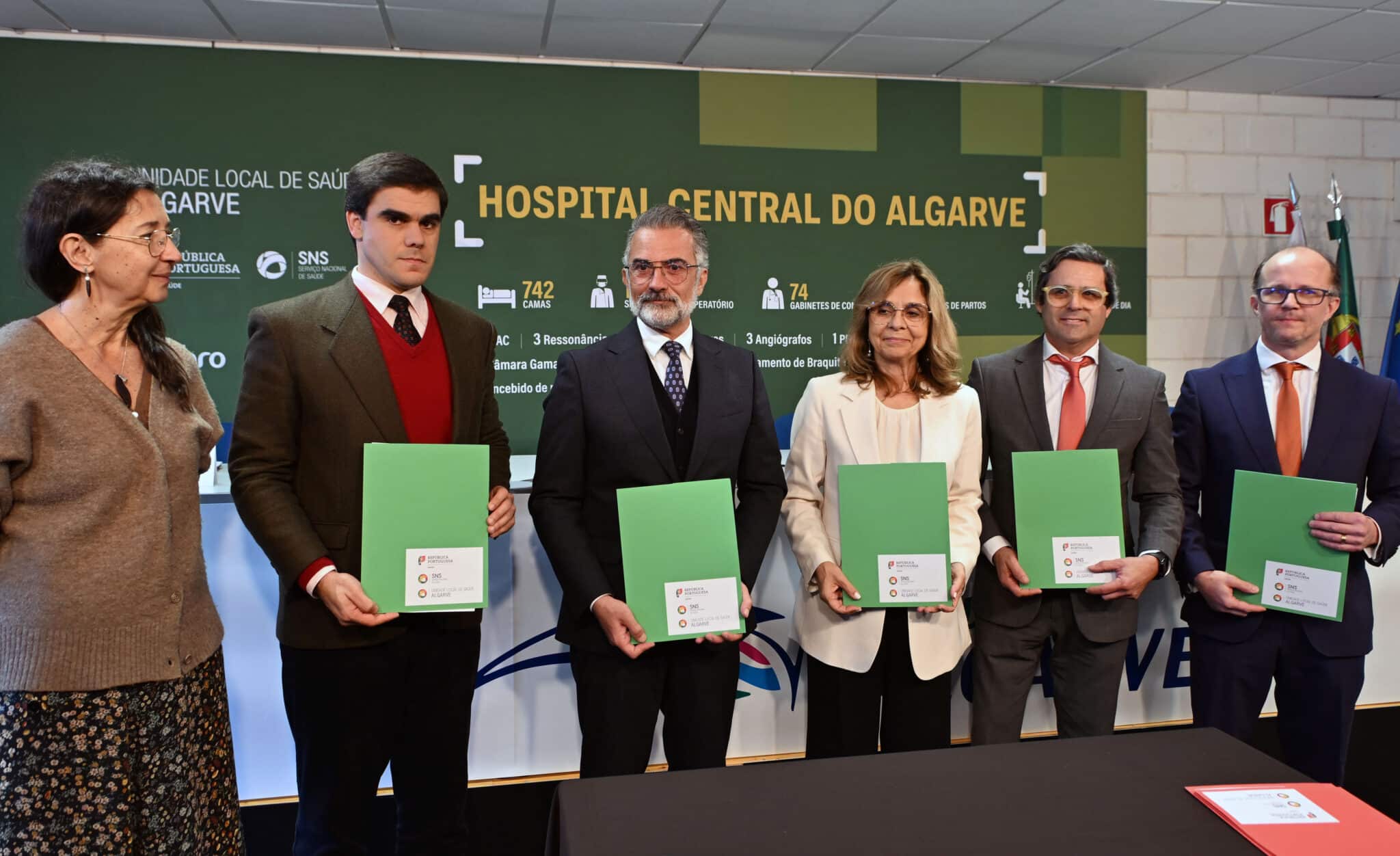
Health Minister Ana Paula Martins has hailed what she called a “historic decision” for the Algarve after the government formally approved the long-delayed construction of the Algarve Central Hospital, a project promised for two decades and symbolised by repeated, unrealised promises.
The approval to launch the public-private partnership (PPP) for the new hospital was published this Monday in the Diário da República state newspaper, formally authorising the project’s next phase. The hospital will be built at Parque das Cidades, on land spanning the municipalities of Faro and Loulé, and will be constructed and operated under a PPP model.
The hospital is expected to begin operating in 2031.
“After 20 years, after eight first stones, the construction of the Algarve Central Hospital will finally move forward,” the minister said during a visit to the region. “This is a historic decision for the people of the Algarve, for the region and for the country.”
Under the resolution, the Central Administration of the Health System (ACSS) is authorised to launch the tender for the design, construction, financing, maintenance and operation of the new hospital. The total cost will be spread over 27 years, with annual expenditure capped at €50 million.
Speaking at the Estádio do Algarve (Algarve Stadium), near the site of the future hospital, Ana Paula Martins said a Council of Ministers resolution detailing the long-term spending schedule would be published “within the next two or three days”.
According to the minister, the new hospital will be a “state-of-the-art” facility, with 742 beds, 18 operating theatres, 74 consultation rooms, 10 delivery rooms, several day hospitals and advanced diagnostic and treatment equipment, including CT scanners, MRI machines and linear accelerators.
The hospital will fully integrate oncology services, as well as palliative care, adult psychiatry, and child and adolescent mental health services, the minister said.
Beyond healthcare provision, the project is also seen as crucial to the development of medical education in the Algarve, supporting the region’s medical degree and other health sciences programmes.
“This hospital will strengthen specialised healthcare in the Algarve and significantly improve accessibility, quality and safety for patients,” the minister said, adding that it will also offer better working conditions for healthcare professionals.
First identified as a priority investment in 2006, the Hospital Central do Algarve has become a symbol of unfulfilled political promises since the original cornerstone was laid in 2008, only for the project to stall repeatedly over the years.