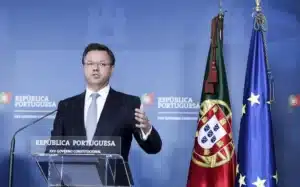
As the Middle East conflict enters its fourth week with a global fuel crisis already prevalent, Portugal’s minister for foreign affairs, Paulo Rangel, has said the government will resort to ‘structural measures’ to help families and businesses cope with the collateral effects (which threaten galloping inflation).
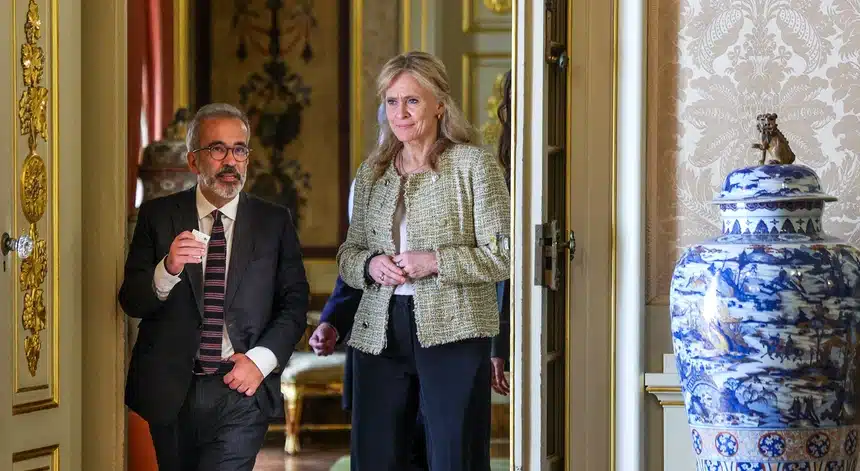
The overall objective, Rangel said in Lisbon today, flanked by his Icelandic counterpart Porgerdur Katrín Gunnarsdóttir, is to ensure that growth and investment are not affected, as they would be without government intervention.
If there is a relatively quick solution to the conflict, he said, “I think we could easily accommodate the negative impact of these recent weeks, and return to a kind of normality. If this is not the case, naturally we will take some more concrete structural measures to alleviate the stress on families and businesses.”
Spain has already moved in this regard, slashing IVA on fuel, electricity and natural gas (from 21% to 10% – a move that will instantly cut 30 cents per litre on the price of fuel at the pumps). The country that ‘stood up to Donald Trump’ over the use of its military bases has seen prime minister Pedro Sánchez bring in a raft of measures, costing the country €5 billion. In comparison, Portugal’s measures this far look like extremely small potatoes).
Paulo Rangel’s ‘announcement’ came by way of his answering of questions at today’s press conference – and he did admit to being “very worried” about the direction in which the conflict is going (in spite of the recent ‘about-turn by President Trump’ regarding his threat to obliterate Iran’s energy infrastructure. Since announcing over social media that the United States was having very productive conversations with Iran, the Iranian regime has blasted back that this was just an attempt to “manipulate the markets”. No negotiations have been held with the US, and fakenews is used to manipulate the financial and oil markets and escape the quagmire in which the US and Israel are trapped, wrote Iran’s parliamentary speaker Mohammad-Bagher Ghalibaf over ‘x’ this afternoon).
The government is analysing “the situation with a great deal of care, every day – sometimes twice a day – to understand what the best policies are to mitigate this situation,” Rangel said, pointing to the “economic consequences of this conflict” which will have “an enormous impact not just in transports, but in the whole chain of production and distribution”, as well as on agriculture – given that many of the fertilizers used globally pass through the Strait of Hormuz, which is still effectively blocked by Iran.
It was an interesting press conference in another way: the Icelandic minister explained that her island country is sustainable when it comes to energy. It has hydroelectric and geothermal power generation. But it also has “the weakest currency in the world” and thus it too is feeling the impact from inflation.
The explanation served to show how extraordinarily wide-reaching this conflict has become, even without Iranian missiles reaching Europe.
It also showed that Iceland shares Portugal’s view (and that of the majority of European countries): the Iranian regime is “a terrorist regime that has harmed its citizens, violating their rights to life and human rights. But, on the other hand, Iceland is also a country that underscores the importance of order based on rules and international law”, said Porgerdur Katrín Gunnarsdóttir, thus identifying how both these values have been absent from the approach taken by the United States and Israel.
Source material: LUSA/ Euronews/ ECO online/ X.com