Five crew members from the Russian sailing ship Shtandart were intercepted off the Algarve coast this week after being spotted in a motor dinghy near Baleeira, Sagres. The vessel, officially described as a “training ship” but blacklisted under EU sanctions, has been repeatedly barred from docking in Portuguese ports, according to multiple reports in national press.
National tabloid Correio da Manhã reports that the men – European nationals, not believed to be military personnel – were flagged by the Portuguese Navy and Maritime Police on Wednesday and taken to GNR police, which carried out checks that confirmed their documents were in order. They were then released. However, authorities suspect the manoeuvre was an attempt to illegally rotate the crew in defiance of sanctions, CM adds.
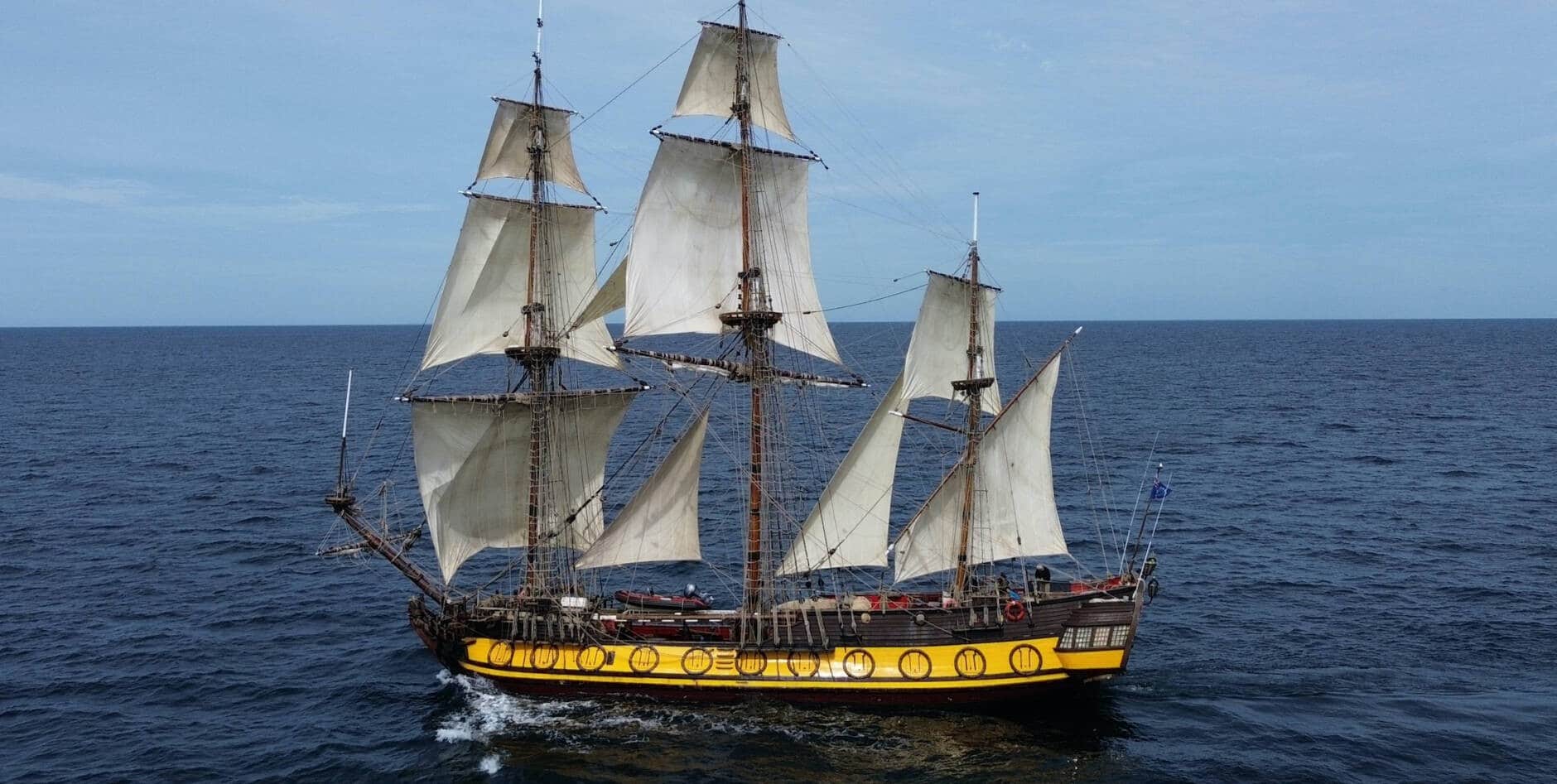
The Shtandart, a 35-metre replica frigate built in 1999 in St Petersburg and inspired by Peter the Great’s original 1703 warship, has long drawn suspicion of being part of Russia’s so-called “ghost fleet.” In some countries it is accused of covert operations, with reports of the vessel switching off its tracker and making unexplained detours. Its passage south also cut across a NATO naval exercise, raising fresh speculation about spying.
In Portugal, the ship has tried to dock several times this month – in Porto, Cascais, Aveiro and Lisbon – each time being turned away. In Porto, its captain allegedly cited a mast problem to justify entry, but with no proven emergency the request was refused.
The ship’s captain, Vladimir Martus, rejects the suspicions and insists the ship is non-commercial, European-operated, and has not been back to Russia in over 15 years. On its website, the crew claim they abandoned Russian waters for “political reasons” and accuse EU states of “harassment.” In an email sent to Jornal de Notícias, Martus says EU sanctions are under legal challenge in several courts, including France’s Supreme Court, and argues Portugal violated international maritime labour rules by blocking a crew change.
The sanctions at issue – under EU Regulation 2022/576 – prohibit access to European ports not only for Russian-flagged ships, but also for those that switched flags after February 24, 2022. The Shtandart, which re-registered under the Cook Islands flag, falls under that rule.
Crew members have also launched a petition, denouncing the EU’s June 2024 move to specifically include “replicas of historical ships” in the sanctions – a measure they say singles out the Shtandart alone. They argue the frigate is a cultural treasure, run by volunteers from across Europe, including Ukrainian refugees, and used as a training vessel for French maritime students.
“The goal of the sanctions is to weaken Russian economy and to prevent Putin’s regime from financing military invasion into Ukraine. From this point of view, targeting ‘Shtandart’ is absolutely meaningless, as this ship does not bring any money to the Russian government,” the petition says.
“Rejections to enter the harbours put the ship in a desperate position. Without being able to shelter, dock, refuel and feed its crew, the ship practically cannot exist,” it adds.
For now, the Shtandart remains under sanctions – and under surveillance – as it still lingers off the Algarve coast.