The red flag went up over three Castro Marim beaches yesterday, due to presence identified in the water of E-coli, a widely-feared bacteria.
The beaches closed to swimmers (officially, that is) are Altura-Alagoa, Praia Verde-Lago and Praia Verde.
The problem is that a lot of people couldn’t care less about the ban, and are going in the water regardless.
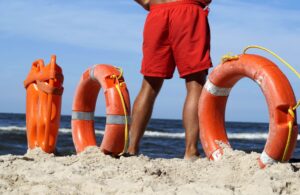
Lifeguards are tasked with encouraging people back onto the sands, but it is a fairly thankless exercise. As Franco Araújo has told Correio da Manhã, “people insist on entering the water…” And so they might, as hydrobiologist Adriano Bordalo e Sá has explained, analysis of water can change by the moment/ by the tides/ from day to day. One sample may show E-coli; the next might not.
He also stressed that ‘E-coli contamination’ is invariably associated with the impression that sewage is somehow entering the sea, “when this is often not the case”. He told SIC yesterday, that roughly half the incidents of so-called E-coli investigated by hydrobiologists in Porto did not have human origin.
So, what can be causing this contamination? According to Bordalo e Sá it could be something as simple (and natural) as seagull poop – a source that, he claims, ‘official entities’ do not appear to be appreciating, or possibly even understand.
Indeed, Adriano Bordalo e Sá ventured that the feared identification of E.coli, may not be correct. He suggests the findings are more likely to be ‘enterococcus’ which is related to the feces of creatures “that may even be microscopic”, but that live in the sea…
Added to this professional uncertainty is the laborious process of ‘taking samples’ and then reporting their results. Bordalo e Sá suggests it is completely out of date: a system imposed by Europe that prejudices people who just want to get back into the water.
Hence, very possibly, why lifeguards in Castro Marim are blowing their whistles in exasperation.