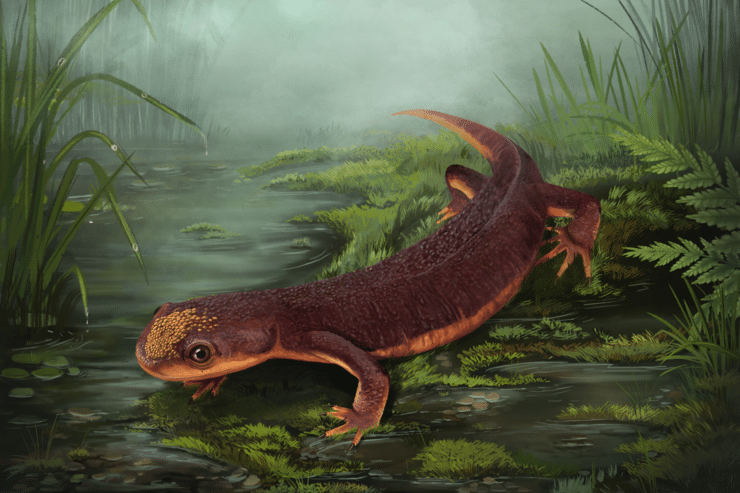
A new species of Jurassic amphibian has been identified in Portugal after researchers analysed more than 400 tiny fossils collected in Lourinhã, in the district of Lisbon.
The species, named Nabia civiscientrix, lived around 150 million years ago during the Jurassic period alongside dinosaurs. Belonging to the extinct family Albanerpentontidae, it resembled a miniature salamander, measuring less than five centimetres long, with a head smaller than once-cent coin.
The discovery was made as part of research led by Alexandre Guillaume, a palaeontologist at NOVA University Lisbon and the Lourinhã Museum, and has been published in the Journal of Systematic Palaeontology. The fossils were collected through a citizen science project, inspiring the species name civiscientrix – meaning “citizen scientist”.
According to a statement from NOVA University, the research began when isolated skull bones, vertebrae and post-cranial remains were recovered from Jurassic deposits in Lourinhã.
Albanerpetontids looked like small salamanders but had distinctive features, such as dry, scaly skin, keratin-like claws, eyelids, and a ballistic tongue used for feeding, similar to that of modern chameleons.
“Some of the more familiar bones, like jaws or frontal skull elements, were easy to recognise,” explained Miguel Moreno-Azanza, one of the study’s supervisors and a professor at the University of Zaragoza. “But Alexandre Guillaume later realised we had a much more complete vision of the anatomy with rarely found bones, such as quadrates and hip bones.”
The best-preserved specimens were sent to London for high-resolution micro-CT scanning, while comparisons were also made with fossils from Guimarota, another Portuguese Jurassic site of the same age.
Until recently, research into this group was limited by the absence of complete skeletons and the difficulty of identifying small, fragmentary bones. Many fossils were simply overlooked or misclassified.
By combining new observations with previously known material, the researchers have now proposed an updated set of anatomical markers that will help guide future studies, described one of the key scientific outcomes of the project.
“I invite everyone to look at these tiny bones, which are often ignored more closely, so that together we can understand what these small amphibians were. This is just the first step,” Guillaume said.