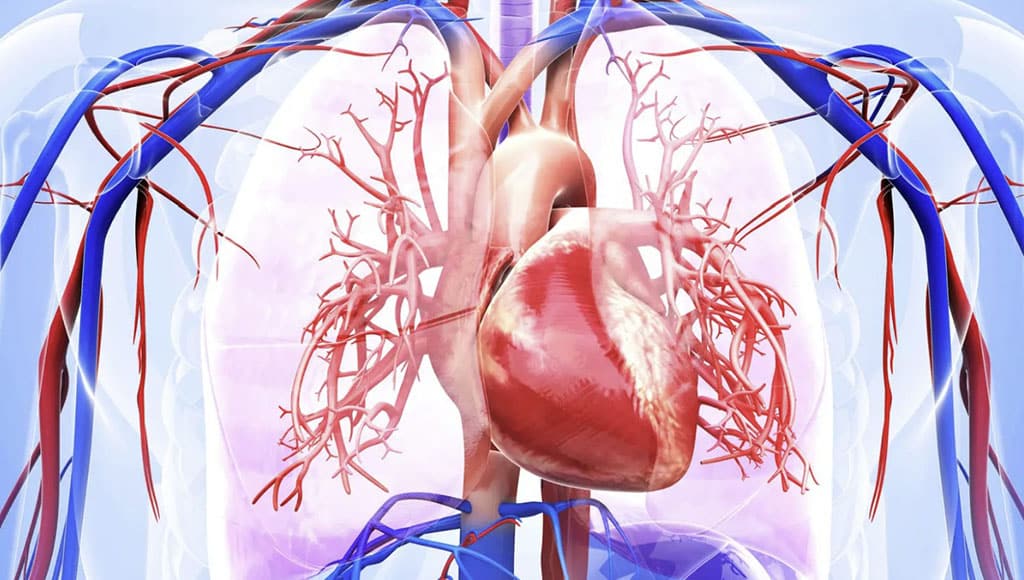
The cardiovascular system, also known as the circulatory system, is a network made up of your heart, blood vessels (arteries, veins, and capillaries), and blood.
Blood vessels transport blood cells, nutrients, hormones, and oxygen to your body’s tissues, while also removing waste products and carbon dioxide. The heart pumps to sustain life, blood vessels carry what we need to survive, and blood delivers and collects what is necessary. All three components – heart, blood vessels, and blood – are vital for the proper functioning of the circulatory system.
There are three types of blood vessels: arteries, which carry blood away from the heart; veins, which return blood to the heart; and capillaries, tiny vessels that connect arteries and veins and control the exchange of oxygen, nutrients, and other substances between the blood and the body.
Our bodies contain approximately 96,000 km of blood vessels. Damaged blood vessels can cause high blood pressure, stroke, and aneurysms. Prolonged chronic stress damages blood vessels, potentially leading to these illnesses.
Blood flow through the body starts from the heart, where deoxygenated blood is pumped to the lungs to receive the oxygen you breathe in. When oxygenated, the blood flows back to the heart, where it is pumped through your body to deliver oxygen, nutrients, cells, and hormones, while collecting waste products for disposal.
The blood is a delivery and collection system that flows in a continuous cycle. Every time you breathe in, you trigger a chemical reaction that lets you take in oxygen, release carbon dioxide, and transform glucose from the food you’ve eaten into energy. Your blood then carries the carbon dioxide to your lungs, where you exhale it. Consider how quickly this happens, within a single breath.
Notice that this process depends on the food you’ve consumed. A healthy diet becomes essential to your physical and mental health, especially when chronic stress is involved.
Your heart is a muscle roughly the size of your clenched fist, located in your thoracic cavity between your lungs. Its main function is to pump blood through two main circuits – the pulmonary circuit, which carries deoxygenated blood to the lungs and returns oxygenated blood to the heart, and the systemic circuit, which distributes oxygenated blood from the heart to the entire body and returns deoxygenated blood.
The average adult heart beats about 100,000 times a day and pumps approximately 5 litres of blood per minute when at rest.
Your heart has four chambers: two atria, which are the upper or receiving chambers, and two ventricles, the lower or discharging chambers. This separation divides the pulmonary circulation (to and from the lungs) from the systemic circulation (to and from the body).
Your right atrium receives deoxygenated blood from the body via the superior and inferior vena cavae, and your right ventricle pumps this deoxygenated blood to your lungs through the pulmonary artery.
Your left atrium receives oxygenated blood from your lungs via the pulmonary veins, and your left ventricle pumps oxygenated blood throughout the body via your aorta, which is the strongest and thickest chamber. Valves separate the atria and ventricles, ensuring one-way blood flow.
The heart’s tissues support its walls, which consist of three layers. The epicardium, along with epithelial tissue, protects the outer layer and secretes pericardial fluid to reduce friction. The myocardium, the middle layer, is a dense muscular layer containing cardiac muscle cells that enable electrical conduction and provide mechanical strength. These cells are responsible for contractions that pump blood and allow the heart to contract as a coordinated unit. The endocardium, the inner layer, is a thin sheet of endothelial cells that forms a smooth lining for the heart chambers and valves, helping to reduce friction and prevent blood clotting. Connective tissue provides structural support and anchors muscle fibres, valves, and blood vessels.
All these walls, tissues, and cells of the heart are essential for proper functioning. However, when it comes to chronic stress, it is crucial to understand that your heartbeat depends on a specialised conduction system within the cardiac nervous system. This system includes the nervous tissue of the heart, which not only transmits electrical impulses and controls heartbeats but is also directly linked to the sympathetic and parasympathetic divisions of the autonomic nervous system (ANS) – our stress response system – where everything is unconscious and automatic, and heart rate, contraction strength, and blood pressure are controlled.
This is where prolonged chronic stress becomes a very serious problem because the autonomic nervous system (ANS), which automatically activates our stress response, reacts instantly when you perceive something or someone as a stressor, and you trigger a stress response that signals the ANS to adjust your heart rate, blood pressure, and release stress hormones.
Every time you trigger a stress response, the rhythm of your heartbeat is disrupted.
Prolonged chronic stress significantly impacts all the systems mentioned above, leading to conditions such as high blood pressure; heart attack (myocardial infarction), a blockage in the coronary arteries causing heart tissue damage; stroke, a disruption of blood supply to the brain; atherosclerosis, a build-up of plaque in arterial walls that reduces blood flow; arrhythmias, irregular heartbeat; varicose veins, swollen or twisted veins caused by faulty valves, and more.
We consume food to generate energy, and we breathe to inhale oxygen. From these two vital resources, we sustain the intrinsic conduction system that ensures our heart beats in a coordinated, rhythmic manner and enables blood to circulate through its chambers and the rest of the body.
It is crucial to understand that this system is directly linked to our stress response and endocrine (hormonal) systems, which release stress hormones that are carried in the blood through the arteries to the heart; over time, leading to cardiovascular illnesses when chronic stress is prolonged. We can prevent this with one rule: think first, trigger later – only if necessary.
Read Joan Maycock’s last article: Your stress response system