The European auto industry is in dire straits. The electric car uptake is not living up to the politicians’ expectations, and it seems the 2035 ban on combustion engines may not be as inflexible as it once seemed.
Ursula von der Leyen has agreed to a new set of rules for an e-car segment (that’s ‘e’ for environmental) that will create small, petrol-powered cars, made in the EU with EU parts. The inspiration comes from Japan’s kei cars, which seems to make sense.
This addresses a problem which is, there are no small, inexpensive cars made by the traditional constructors anymore – the politicians seem to have legislated them out.
John Elkann, Stellantis boss, spoke at the Future of the Car Summit to remember the powers that be that “Our roots are in small cars”, whereas Luca de Meo, recently departed Renault CEO, added: “They were really the driving force of our prosperity (…). The medieval streets in Salamanca, Siena and Heidelberg haven’t changed dimensions in 20 years. And there’s no space to make the garage bigger.”
De Meo backed up his opinions with numbers: the proportion of cars under four metres built by European makers has shrunk from 50% in the 1980s to 5% today.
The reasons are plenty but can be divided into two main groups: one is greed and the need to appease the stockholders, which led to a desperate path to succeed in China and America, and the production of cars better suited to enormous new Chinese cities than old, smaller European ones, as well as to US interstates and boulevards instead of the traditional European back road.
Second is our moronic European legislators and their silly, hypocritical rules, and the false claim of wanting to help the environment. In all certainty, they killed off what is very likely the most energy-efficient car from ‘cradle-to-grave’ and the lowest lifetime carbon emitter – the small petrol hatch.
Tougher emissions tests made it too expensive and unprofitable to engineer small petrol (or diesel) cars. Constructors focused on bigger and more profitable products, all the while having to come up with new electric cars – mostly big, as batteries are not advanced enough to offer enough range on smaller cars with smaller battery packs.
Legislators know so much about cars and the environment, they created laws that favour big cars and measure tailpipe emissions instead of lifecycle impact. This is beyond ridiculous. The result is, the VW Up!, for example, is gone without a successor. As is the Peugeot 108, the Citroën C1, the Opel Adam or the Renault Twingo. Even the Ford Fiesta is gone.
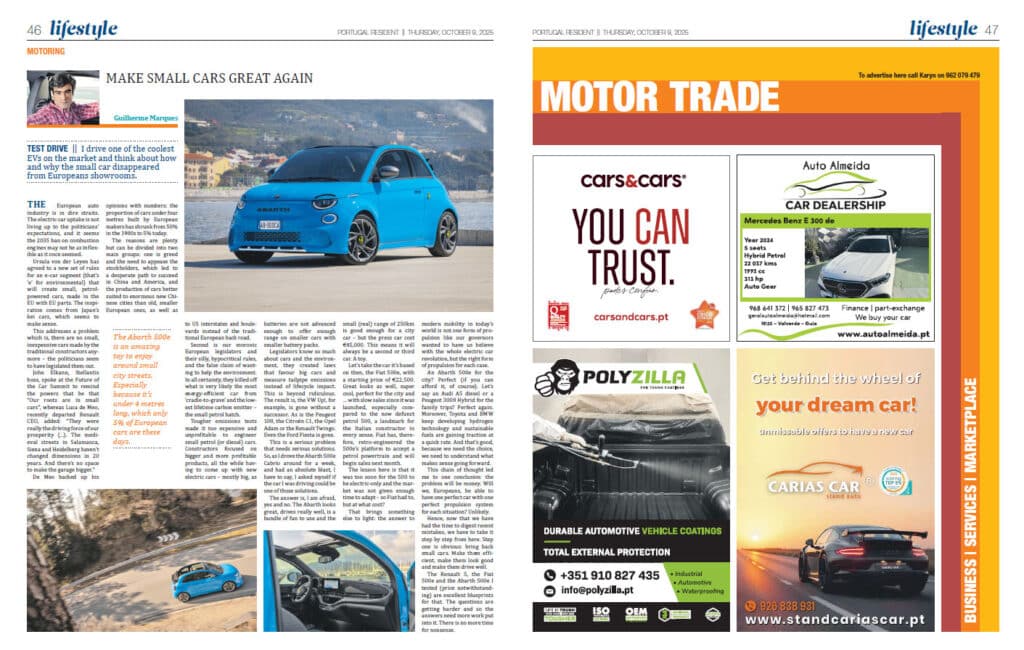
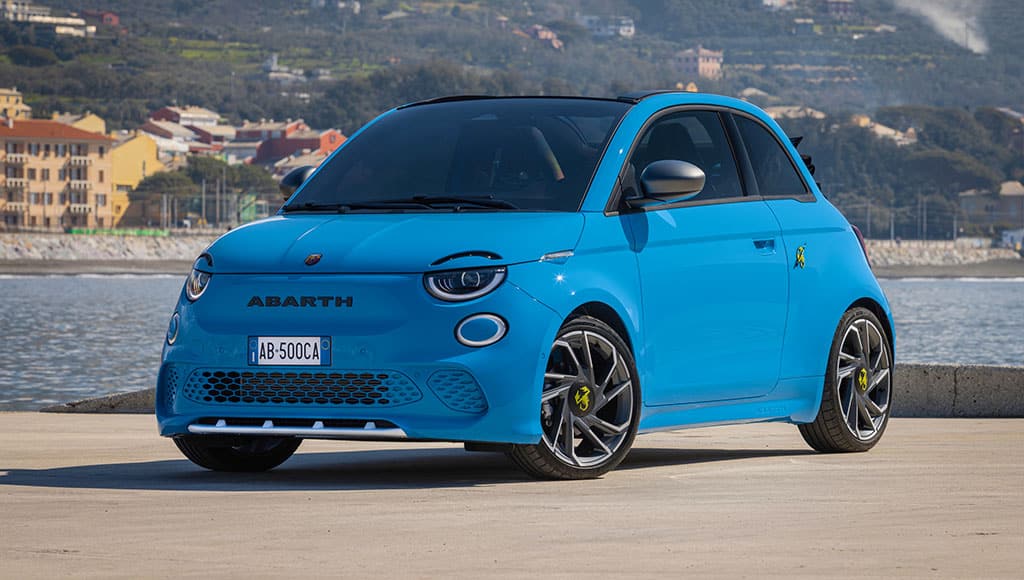
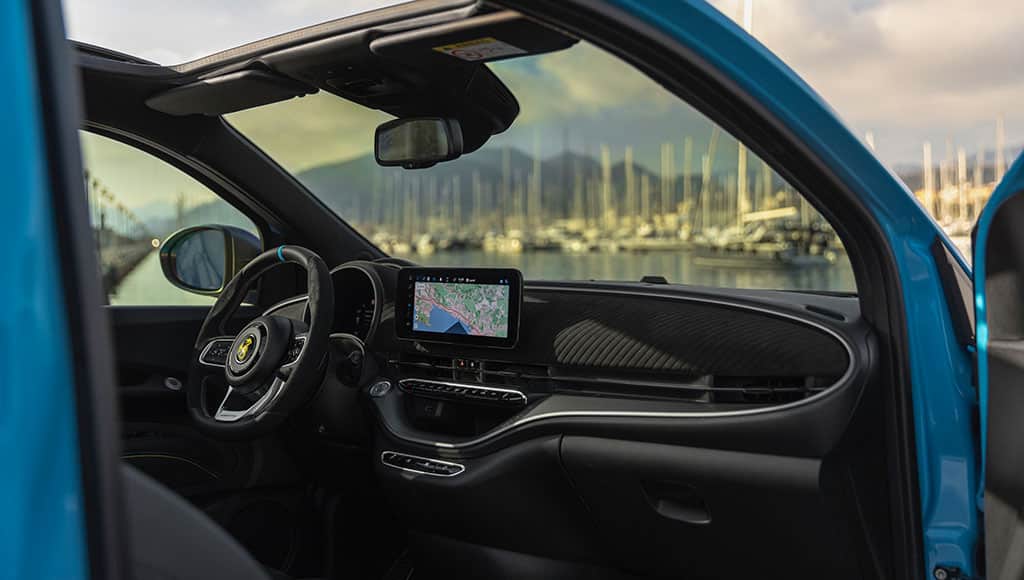
This is a serious problem that needs serious solutions. So, as I drove the Abarth 500e Cabrio around for a week, and had an absolute blast, I have to say, I asked myself if the car I was driving could be one of those solutions.
The answer is, I am afraid, yes and no. The Abarth looks great, drives really well, is a bundle of fun to use and the small (real) range of 250km is good enough for a city car – but the press car cost €45,000. This means it will always be a second or third car. A toy.
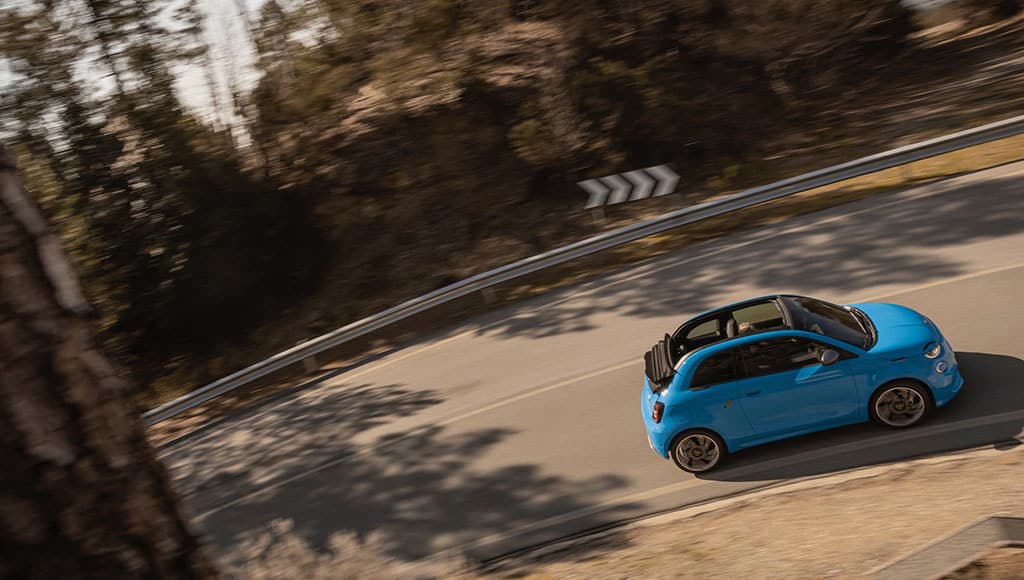
Let’s take the car it’s based on then, the Fiat 500e, with a starting price of €22,500. Great looks as well, super cool, perfect for the city and … with slow sales since it was launched, especially compared to the now defunct petrol 500, a landmark for the Italian constructor in every sense. Fiat has, therefore, retro-engineered the 500e’s platform to accept a petrol powertrain and will begin sales next month.
The lesson here is that it was too soon for the 500 to be electric-only and the market was not given enough time to adapt – so Fiat had to, but at what cost?
That brings something else to light: the answer to modern mobility in today’s world is not one form of propulsion like our governors wanted to have us believe with the whole electric car revolution, but the right form of propulsion for each case.
An Abarth 500e for the city? Perfect (if you can afford it, of course). Let’s say an Audi A5 diesel or a Peugeot 3008 Hybrid for the family trips? Perfect again. Moreover, Toyota and BMW keep developing hydrogen technology and sustainable fuels are gaining traction at a quick rate. And that’s good, because we need the choice, we need to understand what makes sense going forward.
This chain of thought led me to one conclusion: the problem will be money. Will we, Europeans, be able to have one perfect car with one perfect propulsion system for each situation? Unlikely.
Hence, now that we have had the time to digest recent mistakes, we have to take it step by step from here. Step one is obvious: bring back small cars. Make them efficient, make them look good and make them drive well.
The Renault 5, the Fiat 500e and the Abarth 500e I tested (price notwithstanding) are excellent blueprints for that. The questions are getting harder and so the answers need more work put into it. There is no more time for nonsense.
Motoring Trade | Business, Services, Marketplace – click here