Socialists wanted former governor Mário Centeno to remain in place
On cue today, Portugal’s AD government announced its choice for Governor of the Bank of Portugal – and contrary to some theories (and standard practice), the decision was ‘out with the last government’s pick’, former Socialist finance minister Mário Centeno, after only one five-year term (usually, governors stay in place for two).
Even before the announcement that AD has chosen someone from its own political stable – former economy minister Álvaro Santos Pereira – Socialists were making their displeasure clear.
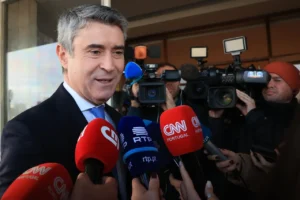
Party leader José Luís Carneiro, in Setúbal to meet with Bishop Américo Aguiar, said it was “an unwise decision that breaks a historic commitment to reappoint the incumbent”.
As Carneiro stressed, Mário Centeno was internationally recognised for his “merit, competence and prestige”, indeed, according to Carneiro, Mr Centeno is “one of the most prestigious figures in the European banking system” – but even more, said the PS secretary-general, “the Bank of Portugal has fulfilled its primary functions and today we have a properly consolidated financial system” (suggesting that before Mr Centeno took over at the central bank, the country didn’t).
This was certainly the first of many criticisms that will be coming, particularly since last weekend prime minister Luís Montenegro intimated that whoever was appointed as governor of the Bank of Portugal “has to be an independent person”.
It is very difficult to call Álvaro Santos Pereira independent (he was economy minister in the PSD government of Pedro Passos Coelho), but AD appears to have finessed its way through this difficulty by saying that the intervening years mean Santos Pereira has not come (into his new role) ‘from government’.
Minister for the presidency António Leitão Amaro actually said: “Professor Álvaro Santos Pereira has not been a government minister for more than a decade, is not a member of any political party, has never been a candidate for a political party, and has served Portugal.”
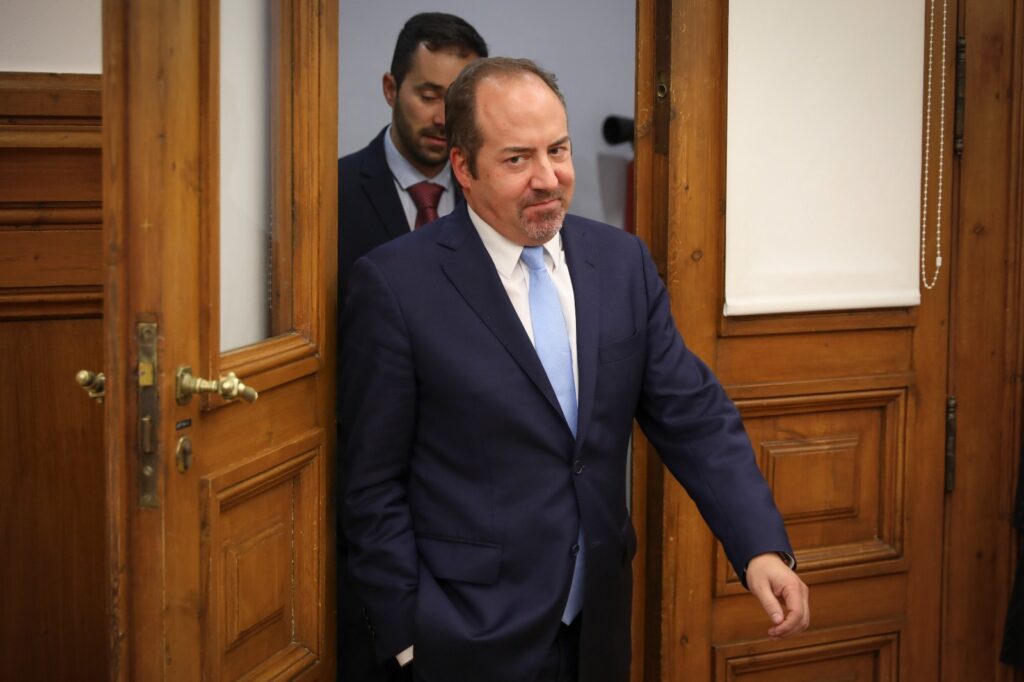
Confused? Almost everyone will be. Leitão Amaro’s explanation requires AD’s audience to jump through too many virtual hoops. But the rankling that the government clearly still feels over Mário Centeno’s appointment in the first place is very clear.
Leitão Amaro “argued that the proper preservation of independence” would have recommended a “minimum period of two to three years” between a job in government and a position as governor of the Bank of Portugal, writes Lusa.
“Experience in government positions can be an asset, provided that conditions of independence are guaranteed and there is no transition that is almost like changing boats without getting your feet wet,” he went on.
Centeno certainly didn’t get his feet wet. He essentially didn’t even change his shoes. He simply ‘stepped down as finance minister on 15 June 2020’ and was proposed by the government he left as governor of the country’s central bank 10 days later.
“We have chosen someone who we believe is best for the job, naturally”, Leitão Amaro told his audience. “We believe that Professor Álvaro Santos Pereira is better suited to the objectives of a central bank, which include supervisory authority, research, and statistical responsibilities, and is part of the Eurosystem and the European Supervisory Mechanism. The characteristics that led us to make this choice are the ones I mentioned. It is the best choice because he is independent: his background lies outside both the bank and any government.”
In a statement released after the press conference, the Finance Minister’s office also justified the choice of Santos Pereira – and the appointment of Gabriel Bernardino as president of the Insurance and Pension Funds Supervisory Authority (ASF) – saying that both have “independence, competence and experience” for the positions, as well as “technical knowledge of the areas under their supervision”.
Lots of words, but it won’t stop the criticism – and it may well compound divisions within the Socialist Party, which is not said to be totally convinced that José Luís Carneiro is actually the best man for the job. Now that Mário Centeno is free, things may start changing (again!)
Source material: LUSA