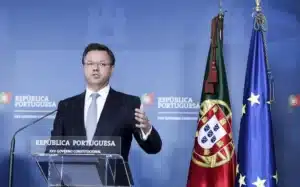
Government tipped to remove current governor – but perhaps it’s best it doesn’t…
There is a high-political game afoot over the decision on whether or not the current governor of the Bank of Portugal, Mário Centeno, remains in place for a second mandate (as he has intimated in the past that he wants).
For weeks, the media has been telling us how much the government of Luís Montenegro wants to see the back of Centeno. He has been something of a thorn in their sides for months – and it is now clear that a decision he made while Socialist Minister Finance has come back to bite the state sharply in the backside.
The whole ‘revolving door’ issue hanging over Mr Centeno is very much key to the current ‘game’. He has shimmied once from the bosom of the Socialist Party to the heart of the central bank, what is to stop him doing the reverse?
This is, apparently, the question that is now causing the government – more pertinently, prime minister Luís Montenegro – a great deal of thought.
Over the weekend, Mr Montenegro first appeared to say that he would be replacing Mário Centeno before the end of the week; then, surprisingly, he changed his tune, admitting that the former Socialist minister “had all the qualities” for the job.
At the same time, Socialist leader José Luís Carneiro appeared to be pushing for Centeno to remain where he is – suggesting his “national and international prestige” puts this option as very much in the national interest (which “must prevail”).
Correio da Manhã editorial director general gives an intriguing reason for ‘all the fuss’ (and apparent change of attitude of the prime minister): At a time when the “heirs of (António) Costa” (the more ambitious side of the PS Socialist Party) are preparing Mário Centeno to succeed José Luís Carneiro (whose choice as leader has not united the party), a second mandate at the central bank would mean he could not leap back through that revolving door for at least five years, says Rodrigues.
“If confirmed, Centeno’s appointment for a new term will be above all a high-political move”, he concludes.
The beauty of the situation is that, on other levels, the decision to maintain Centeno at the Bank of Portugal could be seen as the government ‘showing good will’ to PS Socialists (even though it is anything but…) – particularly as José Luís Carneiro has said Mr Centeno remaining at the bank is in the national interest (without admitting that it may also be in the interest of Carneiro’s own political future).
A decision to awatd Mário Centeno a second mandate would also make Luís Montenegro look ‘magnanimous’, suggests Rodrigues, as he would be nominating someone from ‘another party’, even in the face of criticism.
Criticism has been there since Mr Centeno’s appointment (essentially for the lack of any grace period between politics and running a state entity). On Sunday, political commentator Paulo Baldaia considered it will be “an enormous failure for the government” if Mário Centeno remains in place, as it shows that all the figures they had in mind to replace Centeno have balked at the invitation.
Whatever ends up happening on Thursday/ Friday, this is ‘fascinating stuff’, as it suggests ‘knives are out’ in all directions – but for the time being, everyone appears to be saying ‘positive things’.
There is one potential problem with Rodrigues’ theory, however. Back in 2023 when António Costa ‘resigned’ because there was the whiff of corruption blowing his way, his plan had been to put Mário Centeno in his place, and avoid the need for the country having early elections. It didn’t work: elections were called – and PS Socialists lost. But to say a position as governor of the Bank of Portugal precludes a leap back to politics at any point might not be totally correct. ND
Source material: LUSA/ Correio da Manhã