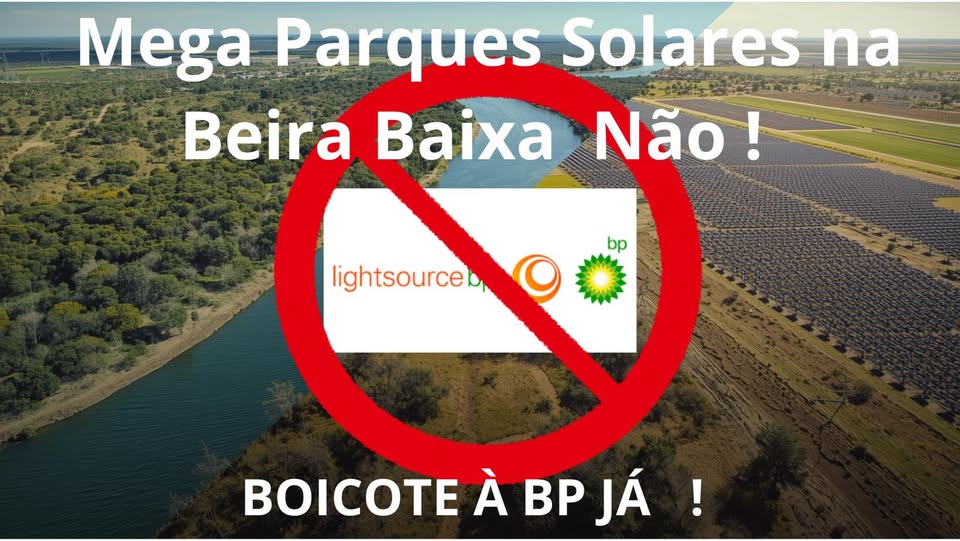
APA, Portugal’s Environment Agency has once again rejected the Beira photovoltaic power plant in Castelo Branco – much to the delight of communities that have rallied against it (and have an even larger project still in their sights).
As the social media post of the ‘Platform for the defence of the Tejo International Natural Park’ stresses “this is an important step, but not the end”. The end will be when APA rejects the much larger Sophia Photovoltaic Park – the project that straddles no less than three municipalities and involves what locals refer to as a ‘suffocating black blanket of solar panels’ plastering the landscape.
The platform concedes that the Sophia challenge involves “powerful interests that will not give up easily”. Therefore the fight is a long way from over: “Because of this, beyond celebrating (the Castelo Branco coup) it is important that we remain attentive, active, visible and united. The future of the Beira Baixa is built with participation and persistence. The Beira Baixa is not for sale,” the group affirms.
This strength of feeling is what will ultimately shape Portugal’s future: environment minister Maria da Graça Carvalho admitted as much earlier this year when she said projects cannot be pushed through against the unanimous will of the people. Up till now this is something that has (and still is) being attempted – particularly when it comes to mining in the north. But this latest ‘victory’ would seem to be drawing an important line.
For now, the Platform for the defence of the Tejo International Natural Park recognises that even the promoter of the Castelo Branco project may try ‘a third time’: “If this happens experience has shown us that being aware early is fundamental…”
The group’s focus is not solely on rejecting photovoltaic mega projects; it is on ‘defending the Beira Baixa landscape and territory for all those who defend a just and sustainable future for the region’. It is an ethos that is crossing European boundaries and uniting platforms throughout the bloc.
So, what has APA ‘rejected’ exactly? In comparison to the Sophia project, which seeks to cover 2,000 hectares in photovoltaic panels, the Castelo Branco project set out to lay just 500 hectares through the municipalities of Idanha-a-Nova and Castelo Branco. It envisaged the installation of more than 400,000 photovoltaic modules (panels), with 22 kilometres of very high voltage lines, in protected landscapes and classified areas.
Whatever made anyone think this could have been a ‘winning idea’? Here we go back to Brussels and the arguments for the ‘energy transition’ that appear to involve destroying Nature in order to be green.
APA’s veto is indeed a moment for celebration – but there is so much more where the Castelo Branco project came from, warns the Beira Baixa platform, which fully acknowledges that this ‘good result’ “was only possible thanks to many people, from the Beira Baixa and beyond, who became involved, participated and did not look the other way. Collective effort makes all the difference”.
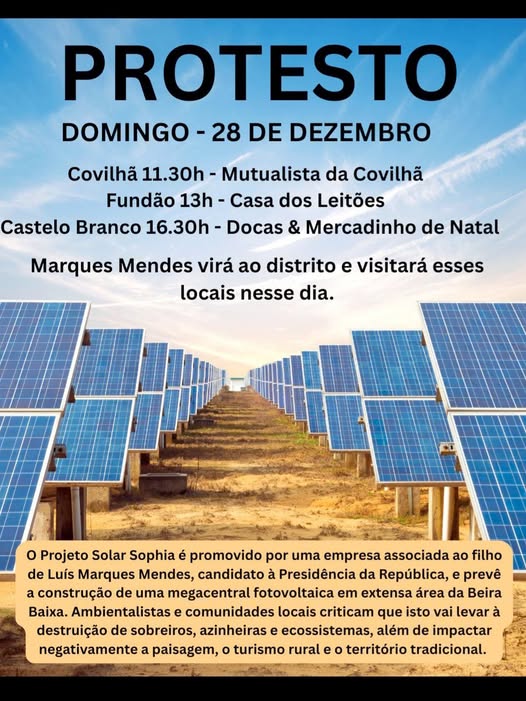
The Sophia project (affecting the municipalities of Fundão, Penamacor and Idanha-a-Nova) is still ‘undergoing environmental assessment’ and is awaiting the opinion of APA. It recently saw hastily convened protests in Covilhã, Fundão and Castelo Branco, to question presidential candidate Luís Marques Mendes whose son is believed to be associated with the company behind it.
Sources: SIC/ Platform for the defence of the Tejo International Natural Park