As the country’s ‘presidential race’ enters the final strait, the reality is that the presence of CHEGA leader André Ventura has helped make it remarkably unprecedented.
Never before has the country been subjected to such ‘unpresidential’ behaviour by numerous candidates. In fact, contender António José Seguro (PS Socialist) said he “detested” the final debate – between former Naval Chief of Staff Henrique Gouveia e Melo and former PSD leader/ political commentator Luís Marques Mendes – for the simple reason that it was so blatantly ‘low’, and focused on political muck-raking.
Correio da Manhã tabloid carried a cartoon after the debate showing Gouveia e Melo’s retreating back, leaving Marques Mendes in the heap on the floor with his spectacles askew, and the words: “I’ll be back…” – suggesting the paper might not hold with the view more widely expressed that Gouveia e Melo’s campaign is losing traction.
Polls aside, the presidential race remains ‘wide open’ with all involved eschewing acceptable ‘niceties’ in order to try and score points.
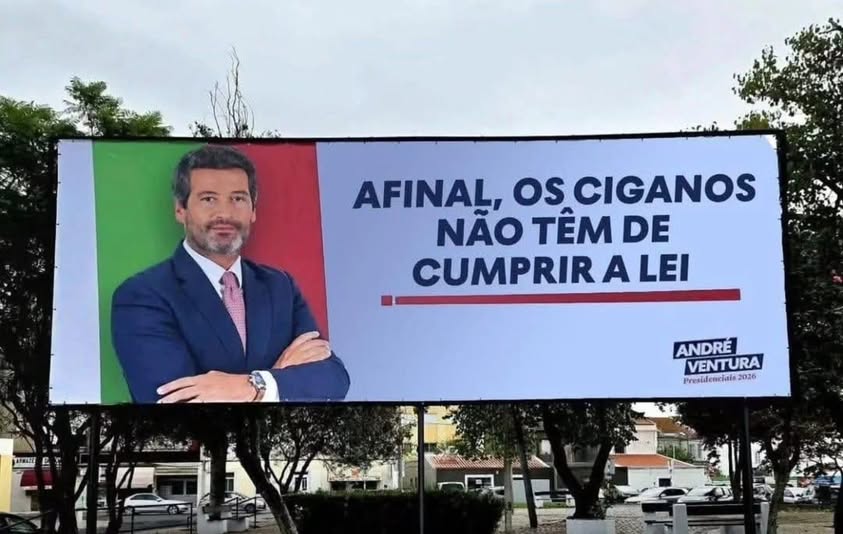
André Ventura’s ‘billboards in poor taste’ are still up all over the country – and he is now calling for a suspension of the judicial order to remove the ones referring to gypsies, on the basis that he is preparing an appeal to the Constitutional Court, ‘and if necessary, the European Court of Human Rights’.
Ventura’s argument is that his right to freedom of expression should take precedence over any ‘offence’ taken by the gypsy community. He also complains that court’s decision has effectively ‘determined how the election campaign should proceed’.
“This is a serious and irreversible decision in its effects, because if the posters are removed now and we wait for the appeal, by the time the appeal comes, the election campaign will be over,” he stresses.
Some news outlets have shown the offending posters being ‘removed’ (as ordered by the court), but Ventura refutes this, saying the works photographed were simply part of the ‘normal process of replacing messages’.
“The courts have their legitimacy, candidates too (…) parties as well. We look at the decision, we respect the decision, what we are asking is that its effects come into force when the decision is either made by the court of appeal, or the Constitutional Court,” he adds.
It is clear from clips already posted on social networks that Mr Ventura considers the court has tried to ‘censor’ what he feels is his right as a presidential candidate to produce a campaign poster – but the truth is that no presidential candidate has ever produced anything as divisive as the CHEGA candidate’s hoardings: the whole ethos of candidates up until this campaign has been to foment cohesion within the country.
As António José Seguro has stressed: a candidate’s role is to be “a reference of values, a reference of respect, a reference of hope – yet what I heard (in the last debate) was everything but that (…) We need to elevate the quality of our democracy – and candidates have responsibility for that. (We should be) talking of solutions for the concrete problems of the Portuguese. Politics is only politics if it resolves the problems of Portuguese people,” he told a meeting in his ‘home region’ of Penamacor on Christmas Eve.
Luís Marques Mendes, for his part, said that a President of the Republic “should not say everything that he thinks, but he should think about everything that he says, which is something which some of my adversaries have not been doing”.
The depth of this remark jarred somewhat with the fact that Marques Mendes made it at Braga’s celebrated ‘House of Bananas’ (Bananeiro), where he toasted Christmas Eve by drinking ‘moscatel’ (sweet wine) and eating bananas.
“President Marcelo Rebelo de Sousa created the tradition of (drinking) ‘ginginha’ (another traditional liquor) in Barreiro, very nice. I think if I am elected president, I will create the tradition of coming to Braga, to the House of Bananas, every Christmas. That’s a promise,” he said – ensuring that the presidential campaign reached Christmas in as bizarre a way as it has been running this far.
The country has ‘much more’ to expect in the coming days, as there is now just three weeks to go before voters put their crosses beside the names they would most like to see representing Portugal in a rapidly changing world.
Sources: LUSA/ Correio da Manhã