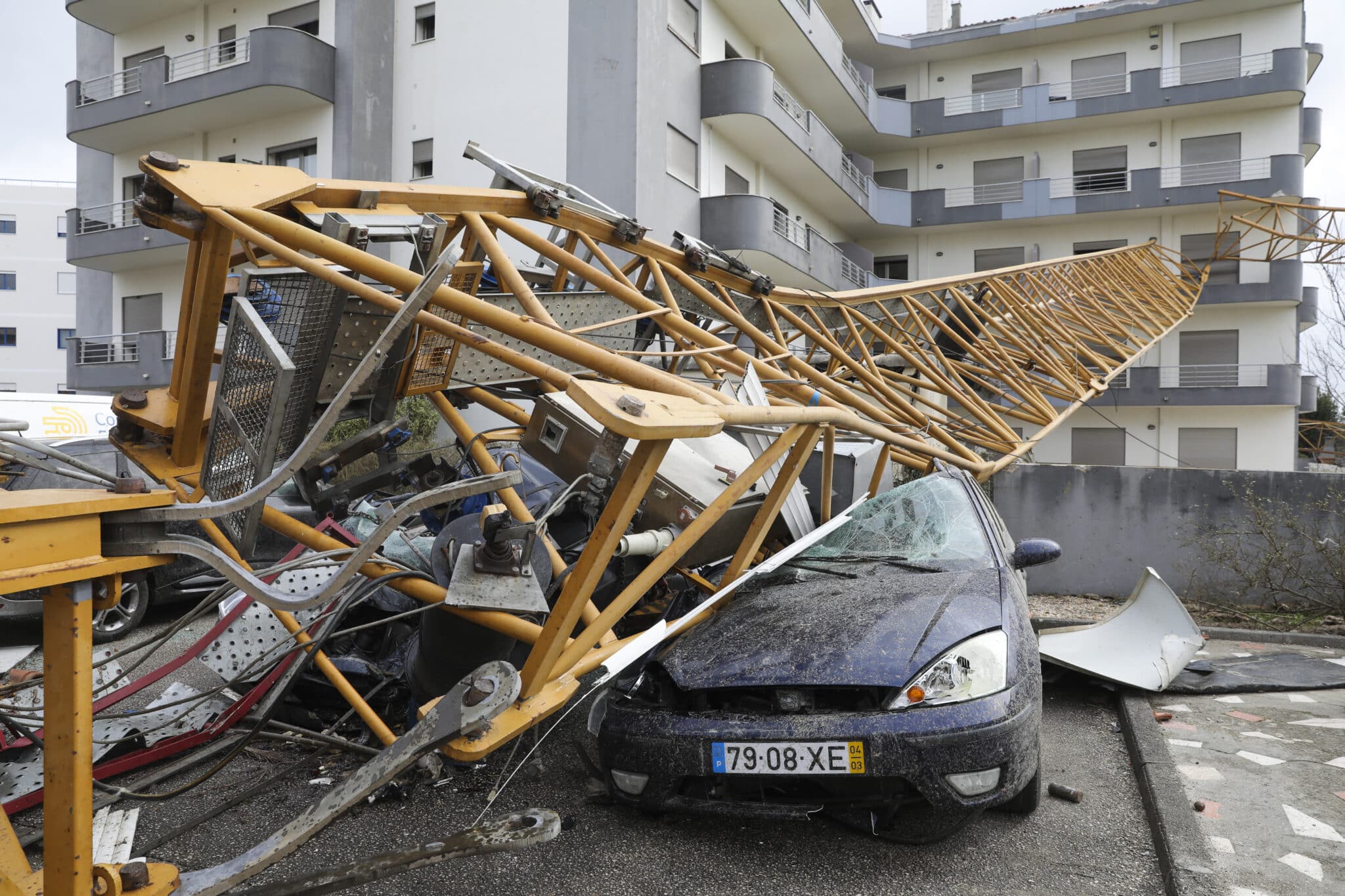
At least six people have lost their lives to the destructive force of Storm Kristin in Portugal, which has also caused considerable damage to infrastructures and left communities without access to water or electricity, authorities have confirmed.
So far, five deaths have been “officially” recognised by the authorities as a result of the storm: four in the Leiria district (two in Carvide, one in Fonte Oleiro and one in Marinha Grande) and one in Vila Franca de Xira (Lisbon district) – although at least two further fatalities may be linked to the bad weather.
In Carvide, one of the victims was struck by a metal sheet, while the other became trapped in the structure of a house.
The victim in Fonte Oleiro was found in cardiac arrest at a construction site, while in Vieira de Leiria, Marinha Grande, authorities confirmed the death of a 34-year-old man (no further information has been revealed). In Vila Franca de Xira, a man on his way to work died after a tree fell onto his car.
In the Algarve, two women have been found dead after going missing in the municipality of Silves.
The body of an 83-year-old Dutch woman was found in a stream near Algoz this afternoon. Her husband contacted the 112 emergency hotline at 10.57am, the Algarve Civil Protection Command told The Resident, reporting that his wife had been involved in a car accident and was being swept away by a nearby stream that had overflowed due to the recent heavy rainfall.
The woman’s car was found hours later, followed by her body, in the nearby stream. CM adds that the woman lived nearby and was used to travelling on the dirt road where the accident occurred. Reports suggest she may have been caught off guard, as the overflowing stream flooded the path.
Another incident a day earlier, not directly linked to Storm Kristin, involved a 70-year-old woman who died after falling into the Arade River in Silves. According to the authorities, the woman was dragged by a strong current after falling into the river. Her body was later located near the Fontes de Estômbar area, in the municipality of Lagoa, by a boat from the Silves fire brigade.
The storm has also flooded the riverside area of Silves, where the Arade River has overflowed its banks. The rising water levels, driven by persistent rain and strong river flows, have inundated low-lying areas of the town.
Widespread material damage
Leiria, one of the worst affected areas, has been described in reports as “unrecognisable”. The municipal football stadium was badly hit, with several structures completely destroyed. The local mayor has already asked the government to declare a “state of calamity” in the municipality.
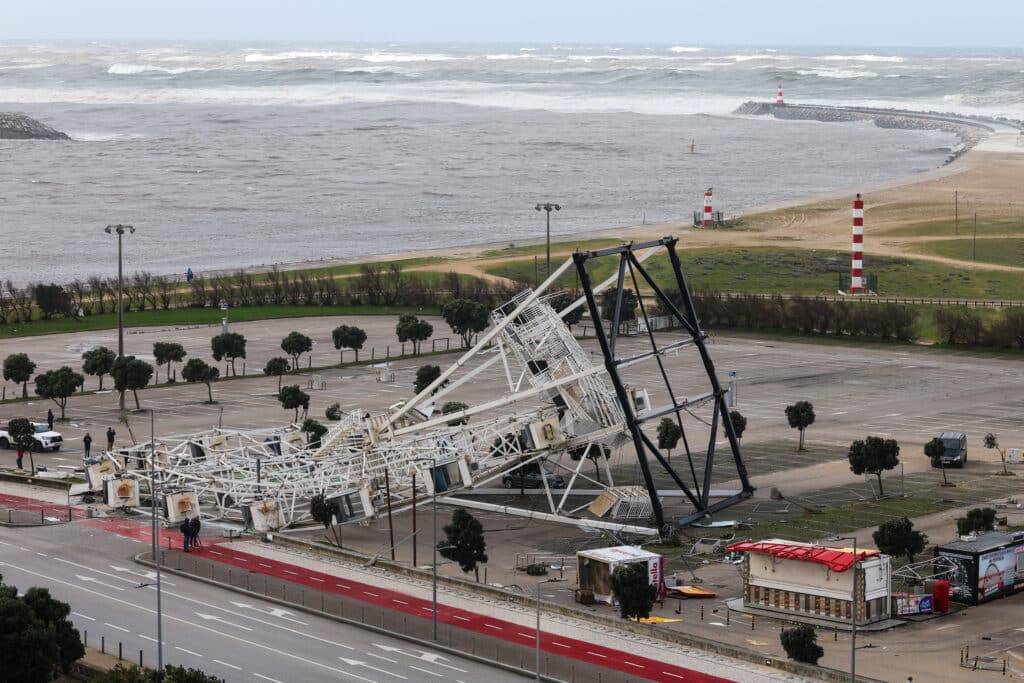
In Coimbra, several planes have been destroyed at the municipal aerodrome, with damages estimated to top €1 million, while a few dozen kilometres away in Figueira da Foz, a Ferris wheel was brought crashing down due to the ferocity of the winds, which reportedly have reached maximums of nearly 180km/h in some parts of the country.
Several roads have been closed to traffic as a precautionary measure, while railway travel has also been limited.
The bad weather has also forced the closure of countless schools across the country.
This Wednesday alone, between 12am and 2pm, a total of 4,183 occurrences were recorded across Portugal, with “fallen trees” being the most frequent type of incident.
Following the Civil Protection press conference, Prime Minister Luís Montenegro warned that severe weather conditions are set to continue in Portugal and said he does not rule out declaring a state of emergency in Leiria, as authorities assess the impact of Storm Kristin.
The PM added that he has been in contact with several authorities throughout the day, stressing the need for “preparation for the coming days”. He once again expressed his sorrow over the fatalities recorded and praised the “promptness” with which incidents were handled by the civil protection system, which he said, “began operating even before the event, with all preventive actions in place”.
“We will continue to have rainfall, strong winds and rough seas,” the prime minister warned, urging people to follow all safety recommendations to avoid further consequences. He explained that the high level of soil saturation and the fact that impacts have not yet been “normalised” mean that even less extreme weather events can still cause “great concern”.
Regarding Leiria’s request for a declaration of a state of calamity Montenegro said the situation is being evaluated and that he is not excluding any scenario. However, he stressed that no decision will be taken “without proper justification”. The government is expected to assess several affected locations on the ground within the next hours before making any final call.
Meanwhile, nearly 485,000 electricity customers are still without power, according to the latest update from E-REDES. The electricity distribution company said the storm caused widespread disruption to the national grid, with several districts particularly hard hit. Leiria is the most affected district, accounting for more than half of all impacted customers. Coimbra, Castelo Branco, Portalegre and Santarém are also among the areas with the highest number of power cuts.