State reforms outlined following Council of Ministers
Portugal’s AD government has revealed the opening gambits of its strategy for State Reform.
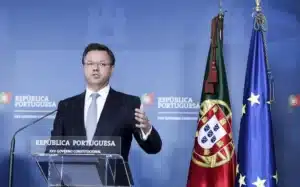
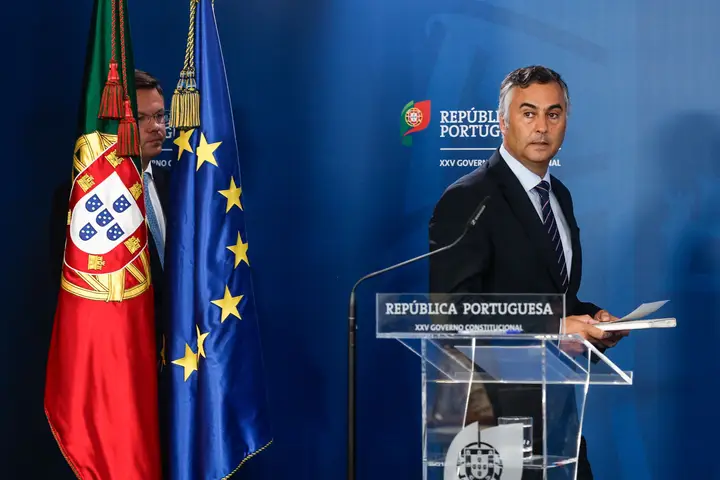
In a press conference following yesterday’s Council of Ministers, Gonçalo Matias, minister in charge of state reform, and Fernando Alexandre, minister for education, science and technology laid out the first steps in a masterplan that should come into full force by the middle of next year.
Matias explained that the focus is on the state becoming more effective and efficient: ministries are to be ‘reorganised’ and processes simplified (“using all the technology at our disposition”, including AI).
Among the many changes is the restructuring of the relatively new Agency for Administrative Modernisation (created during the last Socialist government of António Costa) to create: ARTE – the agency for Technological Reform, and the reduction of various entities covered by Fernando Alexandre’s ministry.
According to the press conference, the ministry’s current 18 separate entities will be reduced to seven – and the number of department heads reduced from 45 to 27. Among entities facing ‘merging’ into new agencies is the FCT (Foundation for Science and Technology). This is “an anachronistic structure out of step with current times and challenges”, Alexandre explained.
Not surprisingly, many in academic circles are smarting. In a statement, the Academic Association of the University of Lisbon (AAUL) publicly expressed its “deep concern over the Government’s decision’ to abolish the FCT and other bodies in the education sector.
“this measure, taken without public consultation, represents a profound and hasty reconfiguration of the institutional architecture of the Portuguese scientific and educational system”, says the statement. And in the specific case of the FCT, ‘it raises serious concerns about the continuity and stability of ongoing scientific projects, the predictability of grants awarded to students and researchers, and the credibility of the national scientific system.
“The FCT has been a pillar in the consolidation of academic careers and the promotion of cutting-edge research, playing an irreplaceable role in the Portuguese scientific ecosystem,” says the association, arguing that the abolition of other entities, like the DGES (general directorate for higher education) “raises particularly serious questions for students”, calling into question “students’ confidence in the higher education system”.
The association is also accusing the executive of failing to explain how “the highly specialised technical skills that the DGES brings together will be ensured, and how institutional coordination with universities and polytechnics will be guaranteed”.
No doubt, these explanations will come. But for now, there is great distrust.
The Scholarship Holders’ Association has also said that it considers yesterday’s announcements “misleading and dishonest”.
“There was no reference to this in the government’s programme or in the AD’s electoral programme, and therefore we consider this restructuring, which is now being presented to us as a measure for greater efficiency, to be a misleading narrative,” said the association’s president Sofia Lisboa.
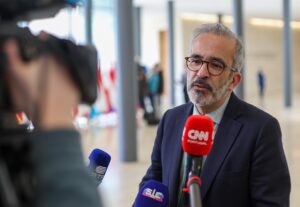
António Carlos Cortez, professor and poet, told SIC Notícias that he considers the extinction of the FCT “a mistake” in a country “where people don’t read.” If we digitise everything, we will be left without books “without memory, without research”, he warned.
Further reactions are inevitable. Indeed, as this text went up online, the secretary general of FENPROF (the national federation of teachers) suggested the restructuring of the Ministry of Education was “not a reform, or a reorganisation” but a “dismantling”.
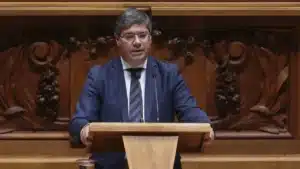
Speaking to Lusa, Francisco Gonçalves expressed “shock” at the “size of the cuts” envisaged: “We’re practically talking about the elimination of all directorates-general”, he said, adding that there is much within the small print that raises concerns.
Sources: Correio da Manhã/ SIC Notícias