Portugal’s government has started preparing legislation for the energetic crisis looming as events in the Middle East appear to be deteriorating rapidly.
Most importantly, a new consumer protection mechanism will come into effect if, in the retail market, there is an increase of more than 70% in the price of energy – or more than 2.5 times the average price over the last five years, exceeding €180 per megawatt-hour (MWh).
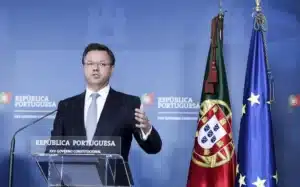
Explaining the decisions taken by the Council of Ministers this afternoon, minister for the presidency, António Leitão Amaro, said that safeguards will start coming into effect “if an energetic crisis is declared”. They ensure that the government can take measures to support domestic consumers and businesses by fixing the price for energy “below the cost price”.
The differential would be supported by the state – and would have to be “recovered later”.
The cap on energy prices will also have to be accompanied by energy efficiency measures: households will have to reduce their consumption to 80% of what they consumed in the previous year, and businesses to 70% of the previous year’s consumption.
According to the minister, this new mechanism can only be used in the event of an energy crisis being declared, “which will happen if prices continue to rise”.
In that case, support provided by the government cannot be considered state aid under European Union (EU) rules.
Also in the area of consumer protection, the government will require energy suppliers to offer fixed-price contracts with a one-year term in regions with more than 200,000 inhabitants, should prices rise further.
Suppliers will also be obliged to accept payment plans with longer terms, tailored to households’ financial circumstances.
In the event of non-payment, and before supply is cut off, there will have to be “a minimum supply guarantee” for households, which will operate by reducing consumption capacity to 1.5 kVA prior to cut-off.
Government promises to act with responsibility
Leitão Amaro added that the government will be accompanying the evolution of prices at a global level to decide which measures to put in place to avoid a worsening to the cost of living.
“Measures are being adopted in line with developments and forecasts of the specific situation,” he added – stressing that there is a distinct difference between increases in fuel (for which the government has already brought in measures) and the increase in the cost of electricity – because electricity has ‘more stable supply contracts’.
Equally, much of the consumption of electricity in Portugal comes from renewable sources. In the first two months of this year, for example, close to 80% of consumption originated from renewables, not from fossil fuels.
“We will act with responsibility and according to each moment of the cycle” he said.
The Council of Ministers also approved measures to boost renewable energy production capacity, with a view to increasing decentralised generation and self-consumption, thereby reducing the country’s dependence on fossil fuels, writes SIC Notícias, citing Lusa news agency.
Sources: SIC Notícias/ Lusa